
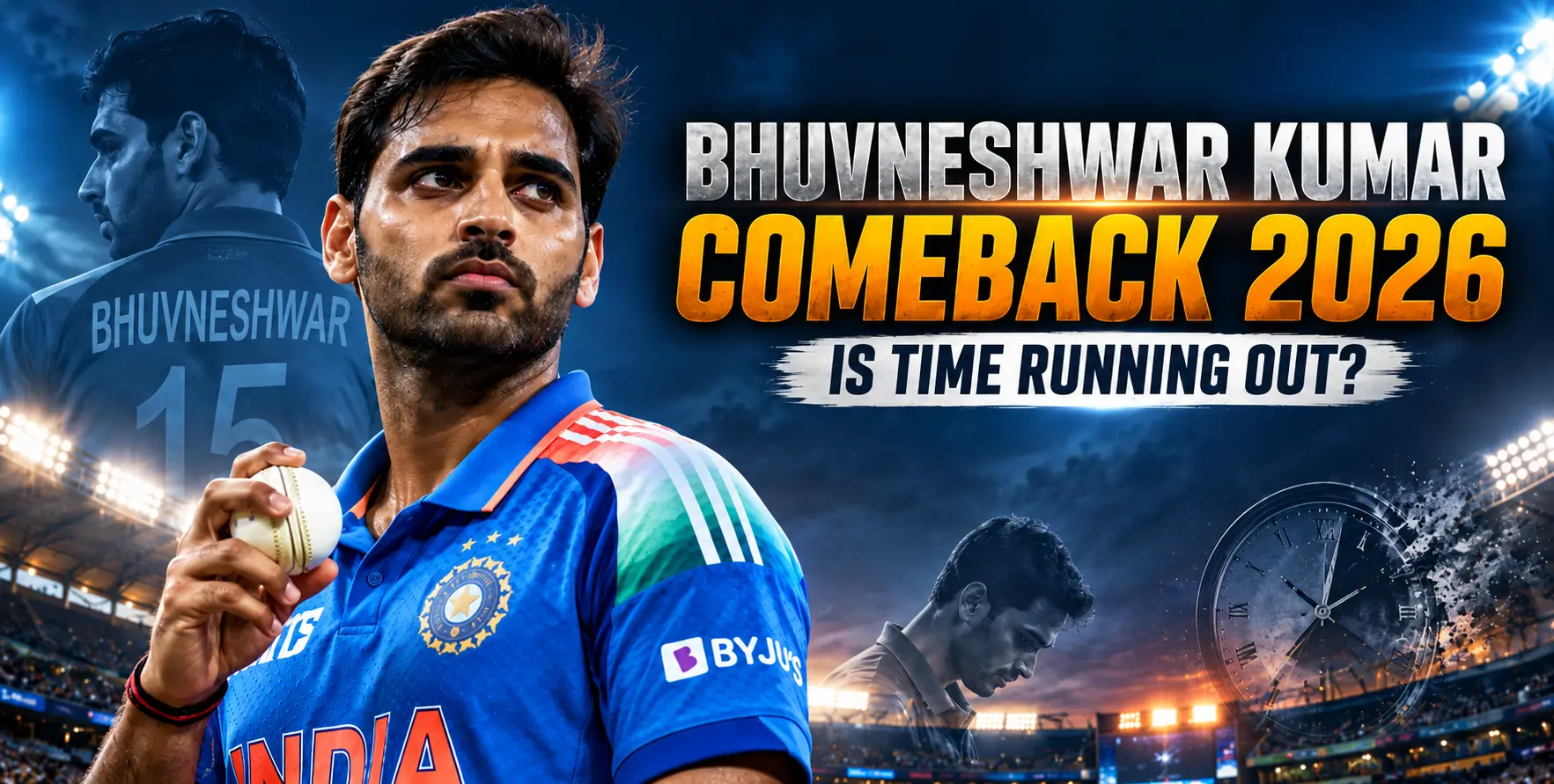
India cricket | Analysis | Updated 28 October 2026
Bhuvneshwar Kumar Comeback 2026 has become a major talking point after the experienced seamer returned to India’s T20I team. His selection was expected to bring swing, experience and strong IPL form. Three matches into the New Zealand series, however, it has raised a difficult question: can he adapt quickly enough to secure another opportunity?
India have won their first three T20Is in New Zealand, sealing the five-match series with two games remaining. Yet Bhuvneshwar has managed one wicket while conceding 139 runs from 12 overs. His economy rate of 11.58 is a sharp contrast to the control that defined his earlier international career. Those figures deserve scrutiny, although they do not tell the entire story of a comeback after nearly four years away.
At 36, Bhuvneshwar is no longer competing merely with opposition batters. He faces changing T20 tactics, demanding selection standards and the uncertainty surrounding India’s future pace-bowling plans. The next two matches offer opportunities, not a guaranteed final audition.
Bhuvneshwar Kumar Comeback 2026: What Has Happened?
India recalled Bhuvneshwar for the New Zealand T20I series beginning on 22 October 2026. His previous appearance in the format had come in November 2022, also against New Zealand. The selection reflected both his recent franchise performances and India’s interest in experienced seam-bowling options.
The opening match in Christchurch was uncomfortable. He returned 0/49 from four overs as New Zealand piled on 225/4. India eventually completed a remarkable four-wicket chase, but the team result did not erase the bowling concerns. Two no-balls were particularly striking for a player normally associated with accuracy.
In the second Christchurch match, Bhuvneshwar took one wicket but conceded 50 runs from four overs. India again won by four wickets. In Wellington on 27 October, he conceded another 40 runs without a wicket as New Zealand made 198/3. India chased the target to take an unassailable 3–0 lead.
| Match | Date and venue | Overs | Figures | Economy | India result |
|---|---|---|---|---|---|
| 1st T20I | 22 Oct, Christchurch | 4 | 0/49 | 12.25 | Won by 4 wickets |
| 2nd T20I | 24 Oct, Christchurch | 4 | 1/50 | 12.50 | Won by 4 wickets |
| 3rd T20I | 27 Oct, Wellington | 4 | 0/40 | 10.00 | Won by 6 wickets |
| Total | Three games | 12 | 1/139 | 11.58 | India lead 3–0 |
Graph 1: Runs conceded by Bhuvneshwar Kumar
Why has the comeback been so difficult?
Batters increasingly attack from the first delivery, target predictable lengths and refuse to abandon their approach after a successful over. That creates little margin for medium-pace bowlers who rely on movement and precision rather than extreme speed.
Shorter balls, meanwhile, require sufficient pace or deception to prevent batters from lining them up.
His current problems should not automatically be reduced to speed alone. Release points, seam position, execution, field settings and the quality of opposition hitting all affect an over. The bigger concern is the combination of expensive spells and too few breakthroughs.
For more cricket coverage and updates, explore Betting ID India.
Can his experience still make the difference for India?
Few Indian fast bowlers possess Bhuvneshwar’s understanding of swing, slower deliveries and T20 match situations. He has performed in the IPL across changing pitches, batting line-ups and tactical fashions. Experience cannot guarantee wickets, but it can help a bowler change plans without panicking.
The key question in Bhuvneshwar’s case is not whether he understands his craft; it is whether his best skills still translate consistently to the highest level.
He might remain valuable in specific match-ups, particularly if swing is available early. But India’s selectors must weigh that specialist contribution against the flexibility offered by bowlers who can operate effectively across several phases.
IPL 2025 and 2026: The performances that earned his recall

His selection came after substantial IPL contributions with Royal Challengers Bengaluru. Reporting on his recall credited him with 17 wickets in IPL 2025 and 28 in IPL 2026, figures that explain why India reconsidered an experienced option.
Still, the international environment brings new expectations, unfamiliar combinations and sometimes different roles within an attack.
| Competition | Wickets | What the figure suggests |
|---|---|---|
| IPL 2025 | 17 | Continued effectiveness in franchise T20 cricket |
| IPL 2026 | 28 | Outstanding wicket-taking campaign supporting recall |
| New Zealand T20Is, first 3 | 1 | Early international returns below expectations |
Graph 2: Wickets across recent competitions
What do Morne Morkel’s comments reveal?
India bowling coach Morne Morkel publicly supported Bhuvneshwar before the third T20I. As reported by the ICC, Morkel acknowledged the burden of expectations after four years outside the international team and encouraged the bowler to concentrate on his natural strengths rather than force a result.
An anxious bowler may chase swing, overuse variations or alter a successful length too quickly. Bhuvneshwar’s best performances have generally emerged from patience, disciplined lines and the ability to create uncertainty over consecutive deliveries.
Backing from the coaching staff should help him settle. It does not, however, make selection automatic. India have a responsibility to find combinations capable of defending totals and taking wickets against the strongest opponents.
Is bowling around 130 kph enough in modern T20 cricket?
Discussion of Bhuvneshwar’s pace has centred on deliveries around the 130 kph mark. Such speed is not inherently inadequate: successful seamers can compensate with swing, cutters, angle and variations. It becomes a limitation when the ball is neither moving nor landing consistently in difficult areas.
For Bhuvneshwar, the more informative measures are powerplay dot-ball percentage, genuine chances created, economy against different batting types and execution at the death. A speed-gun reading tells readers how fast a delivery travelled; it does not explain whether the batter was deceived.
A well-disguised slower ball can outperform a quicker delivery, provided the batter has not anticipated it. Seam movement remains useful, but only when paired with the appropriate line and length.
The powerplay is where he can still prove his value
Historically, Bhuvneshwar’s strongest argument for selection has been the opening six overs. Wisden’s examination of his T20I career before this comeback identified 47 powerplay wickets at an economy rate of 5.73. Those numbers illustrate why India saw value in reconsidering him.
During IPL 2026, the same analysis recorded 16 powerplay wickets and an economy rate of 7.03 across 192 balls. This is more meaningful than a vague claim that he remains experienced: it suggests a specific phase in which he has recently delivered results.
But the comparison also highlights the challenge. If India use him with the new ball, success should be measured by pressure and dismissals, not simply whether he completes two overs without a major mistake.
Bhuvneshwar Kumar Bowling Economy: 2026 vs His Past
At the start of October, published career summaries listed Bhuvneshwar’s T20I economy at approximately 6.96. Through his first three comeback appearances, he has gone at 11.58. The difference is substantial, even allowing for higher modern scoring rates and an unusually small sample.
Graph 3: Economy rates, runs per over
It would be unfair to expect the veteran to reproduce an earlier era’s figures on demand. Conversely, calling the difference irrelevant because modern T20 is high-scoring would ignore the practical cost of expensive overs. India need bowlers who can influence an innings when conditions are difficult.
Does age make this a last chance?
Bhuvneshwar’s sustained IPL work suggests that he remains capable of handling a demanding competition.
There is nevertheless less room for a long rebuilding process at international level. India must develop younger seamers, manage established fast bowlers and select combinations suitable for specific opponents. A veteran returning after several years may be asked to contribute immediately because his experience is the reason for his inclusion.
That tension explains the title question. He may not be running out of time to play cricket, but the number of chances available to secure a lasting India role could be limited.
What Bhuvneshwar said after India’s Wellington victory
Following the third T20I, Bhuvneshwar said he had not built his domestic career around chasing an international recall. He described representing India again as a source of pride and credited his IPL form for opening the door.
He also recognised how batting attitudes have changed. Modern hitters often continue attacking even after an expensive over, rather than treating the final deliveries as an opportunity to reset. That observation underlines the adjustment required of a bowler whose international experience spans different tactical eras.
That is sensible, but results in the middle will ultimately carry more weight than interviews.
What must improve in the remaining two T20Is?

India’s next matches are scheduled for 30 October in Auckland and 1 November in Hamilton. With the series already won, team management has flexibility to assess options. Whether Bhuvneshwar plays both is a selection decision, not a certainty.
- Cleaner execution: Avoid avoidable no-balls, loose full tosses and repeated deliveries in the hitting arc.
- New-ball threat: Make early breakthroughs or force batters to take risks against sustained pressure.
- Better adaptation: Change length and pace according to the surface without abandoning reliable methods.
- Clearer role: Establish where he is most effective instead of expecting him to cover every phase equally.
- Visible composure: Respond to an expensive delivery with a purposeful plan rather than an impulsive variation.
Coaches are likely to look beyond raw totals at his execution, suitability and ability to create chances.
What do the leading reports say about his future?
The broader reporting offers a more balanced picture than a simple ‘finished or not finished’ argument. ICC coverage emphasised Morne Morkel’s encouragement. Wisden highlighted the strength of Bhuvneshwar’s powerplay record and franchise resurgence. Reports following Wellington concentrated on his expensive figures but also his calm response to a long-awaited return.
Readers can consult the ICC’s report on Morne Morkel’s advice to Bhuvneshwar Kumar for the coaching perspective directly. It provides helpful context for why India’s staff may see improvement as achievable rather than treat three matches as a definitive verdict.
Bhuvneshwar earned his recall through genuine performances, and his early international output has not justified an unquestioned place. Selecting one conclusion while ignoring the other would distort the story.
Final verdict: Is Bhuvneshwar Kumar running out of time?
Yes, the pressure is increasing — but his opportunity has not yet disappeared. Bhuvneshwar Kumar has produced one wicket for 139 runs in his first three New Zealand T20Is, numbers that create legitimate selection concerns. His 2025 and 2026 IPL seasons, however, demonstrate recent wicket-taking ability, particularly with the new ball.
The strongest case for keeping faith is not nostalgia. It is the possibility that a skilled and experienced seamer can translate his franchise success into a specialised international role. The strongest case for moving on is equally practical: India cannot afford repeated expensive spells without breakthroughs.
The remaining fixtures may provide clearer evidence, but no individual match can fully answer a career question. For now, the verdict is straightforward: Bhuvneshwar has earned another look, yet he still needs to prove that his best qualities can withstand the relentless demands of modern T20 cricket.
Frequently asked questions
How many wickets has Bhuvneshwar Kumar taken against New Zealand in October 2026?
He took one wicket in the first three T20Is of the five-match series, conceding 139 runs in 12 overs through 27 October.
What was Bhuvneshwar Kumar’s economy rate in the first three T20Is?
His combined economy rate was approximately 11.58 runs per over, based on 139 runs conceded from 12 overs.
Why was Bhuvneshwar Kumar recalled to the India team?
Strong IPL performances, including 17 wickets in 2025 and 28 in 2026, strengthened his case. His experience and new-ball swing offered India another pace-bowling option.
Is Bhuvneshwar Kumar retiring from international cricket?
No retirement announcement is established in the reports reviewed for this article as of 28 October 2026. His future selection remains uncertain.
When is India’s next T20I against New Zealand?
The fourth match is scheduled for 30 October 2026 in Auckland, followed by the fifth on 1 November in Hamilton.