
PAKISTAN CRICKET · TEST HISTORY

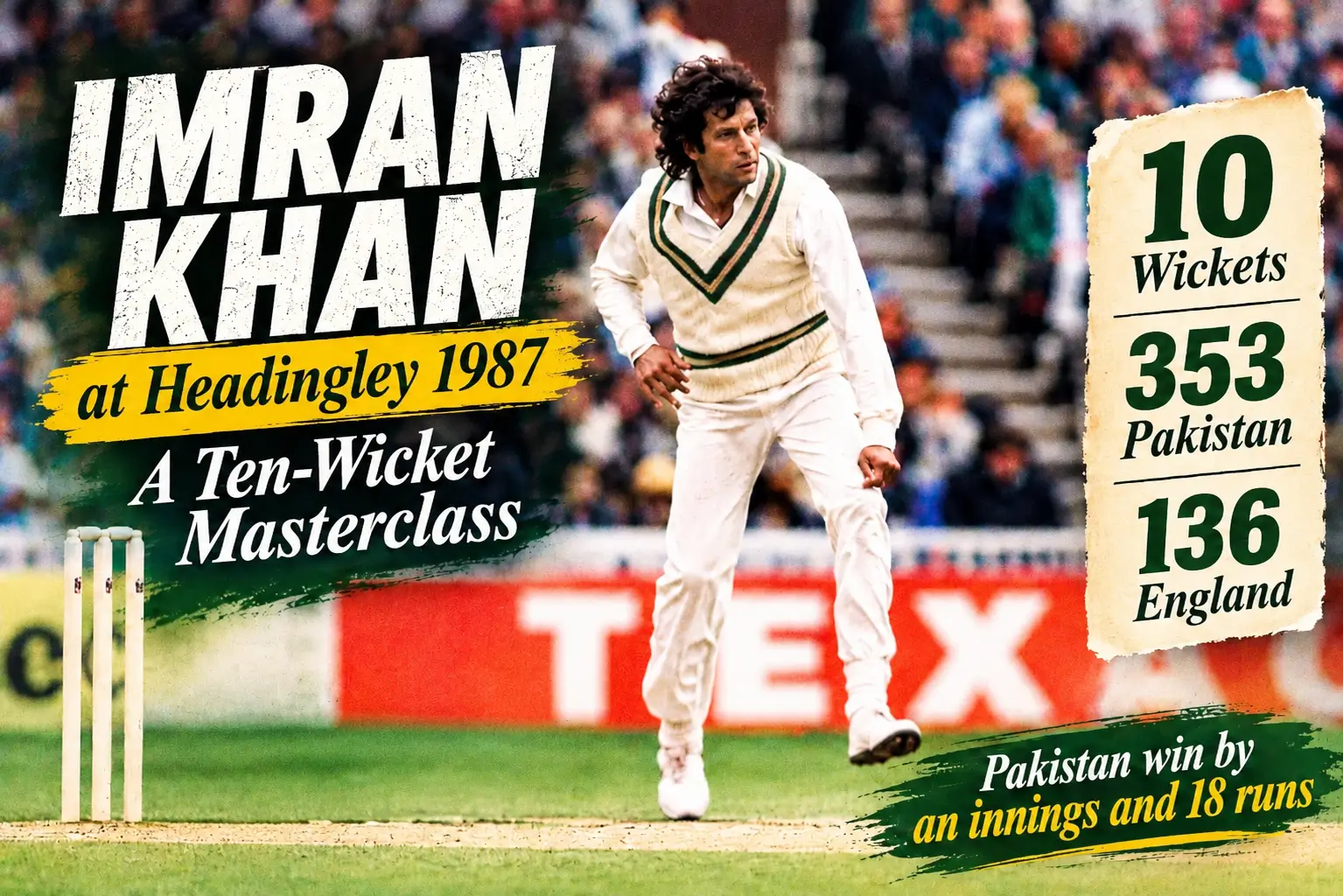
Imran Khan turned Headingley into his stage in 1987, taking 10 wickets for 77 runs and leading Pakistan to a landmark Test victory in England. His fast bowling broke England’s resistance and helped Pakistan claim a famous win on English soil.
A closer look at Imran Khan’s ten-wicket performance, Saleem Malik’s 99 and Pakistan’s historic Headingley victory.
Some performances become part of cricket history because the numbers are extraordinary, while others endure because one player takes charge of an entire contest. At Headingley in the summer of 1987, Imran Khan did both. Imran Khan was the central figure throughout the third Test. He took three wickets in England’s first innings and followed them with seven more in the second, finishing with match figures of 10 for 77.
The performance also brought him to 300 Test wickets, another milestone in a career built on skill, stamina and leadership. Pakistan’s win was completed by strong support from the rest of the side. Saleem Malik made a determined 99 to give Pakistan a substantial first-innings lead, while Wasim Akram helped unsettle England with the ball and added quick runs. But the defining image of Headingley 1987 remains Imran repeatedly returning to the attack and taking the wickets that brought Pakistan closer to victory.
England vs Pakistan 1987: Match Details and Scorecard
The third Test took place at Headingley in Leeds from July 2 to July 6, 1987, with England choosing to bat first after winning the toss. The decision did not bring the expected advantage, as Pakistan’s seamers found movement and attacked the stumps from the opening overs.
| Match detail | Information |
|---|---|
| Fixture | England vs Pakistan, third Test |
| Dates | July 2–6, 1987 |
| Venue | Headingley, Leeds, England |
| England, first innings | 136 all out |
| Pakistan, first innings | 353 all out |
| England, second innings | 199 all out |
| Result | Pakistan won by an innings and 18 runs |
| Player of the Match | Imran Khan |
| Series position after the Test | Pakistan led the five-Test series 1–0 |
Match in one line: England made 136, Pakistan replied with 353, and England’s second innings of 199 left them 18 runs short of making Pakistan bat again.
Why the 1987 Headingley Test Mattered
Pakistan arrived at Headingley facing a difficult challenge, as England were considered a strong side after their major Ashes success in Australia. Pakistan had not won a Test at the Leeds ground, where conditions could assist seam bowling and make batting uncomfortable. Weather affected the first two Tests, leaving the series without a decisive result and Pakistan needing a strong performance to build a series-winning campaign. Headingley provided that opportunity. The ground’s surface was known for offering seam movement, while the ball could swing in the air. These conditions suited Imran and Wasim, two bowlers who could combine pace with control.
Their ability to make the ball move in different directions made it difficult for England’s batters to settle. England’s collapse was especially striking because it happened in two sessions on the opening day. They lost their first wicket at one run and were five down at 31, leaving the lower order to salvage what it could. Pakistan closed the day at 76 for two and were already in a strong position to take control. Pakistan’s success also showed the importance of responding after a strong bowling start. England’s Neil Foster later produced an excellent spell of his own, leaving Pakistan at 86 for four. Instead of collapsing, Pakistan found stability through Saleem Malik and useful contributions from the lower order.
Imran Khan and Wasim Akram Trigger England’s Collapse
England’s first innings lasted only 60.4 overs and ended at 136. Pakistan’s bowlers made an immediate impact, removing key batters before the home side could build a partnership. The scoreboard soon showed England at 31 for five, a position that placed the innings in serious danger.
England’s top order falls early
Imran dismissed Tim Robinson, Bill Athey and David Gower. Wasim Akram removed Chris Broad and captain Mike Gatting, adding pressure from the other end. With experienced batters already back in the dressing room, England had little room to recover. Ian Botham and Test debutant David Capel tried to steady the innings. They added 54 runs, giving England a short period of resistance. Wasim’s reverse-swinging delivery struck Botham on the boot and left him unable to bowl in the match, according to the retrospective account in The Cricket Monthly.
Capel then became England’s top scorer in the innings with 53 from 161 balls. He showed patience and helped the total reach 136, but Pakistan continued to take wickets around him. Mohsin Kamal claimed the final three wickets, while Imran and Wasim each finished with three.
Pakistan’s bowling figures in the first innings
| Bowler | Overs | Runs | Wickets |
|---|---|---|---|
| Imran Khan | 19 | 37 | 3 |
| Wasim Akram | 14 | 36 | 3 |
| Mohsin Kamal | 8.4 | 22 | 3 |
| Mudassar Nazar | 14 | 18 | 1 |
| Abdul Qadir | 5 | 14 | 0 |
The figures show that England were not undone by one bowler alone. Imran led the attack, Wasim created pressure with his left-arm angle and movement, and Mohsin Kamal finished the innings. Pakistan’s attack worked as a unit and gave England little time to rebuild. For readers following cricket match analysis and exploring Cricket Betting ID information, this match highlights the importance of understanding team performance, bowling strategies and match conditions.
Saleem Malik’s 99 Rescues Pakistan’s Innings

Pakistan had started strongly with the ball, but England fast bowler Neil Foster kept the match competitive by moving the ball in both directions. He removed early batters before dismissing Mansoor Akhtar and Javed Miandad in quick succession. At 86 for four, Pakistan were in danger of losing the advantage gained by their bowlers. Miandad, one of the team’s most experienced players, was out for a duck. Pakistan needed a batter who could stay at the crease for a long time and make England work for every wicket.
A patient innings under pressure
Saleem Malik answered with 99 from 238 balls. He batted for nearly six hours and built partnerships with Saleem Yousuf, Imran Khan and Ijaz Ahmed. Rather than chase quick runs, Malik focused on protecting his wicket and punishing loose deliveries. His innings was especially valuable because Foster was bowling so well. The England quick finished with eight wickets for 107 runs, the best figures of his Test career. Malik’s patience stopped the innings from falling apart and helped Pakistan turn a difficult position into a commanding lead.
Malik missed his century by one run when he drove a full toss from Phil Edmonds to cover, but his contribution had already changed the match. His 99 became the foundation of Pakistan’s total and one of the defining batting performances of the Test. Malik’s innings also gave Pakistan time to recover after the loss of Javed Miandad, who was dismissed for a duck. The contrast between Pakistan’s position at 86 for four and their final total of 353 shows how important one long, composed innings can be in Test cricket.
Support from Ijaz Ahmed and Wasim Akram
Ijaz Ahmed added 50, while Saleem Yousuf made 37. Imran scored 26, helping Pakistan extend their innings after the early losses. These contributions mattered because they kept England’s bowlers working and prevented Foster’s spell from restricting Pakistan to a small total. Wasim Akram then delivered an attacking finish. He scored 43 from only 42 balls, hitting four sixes. His late scoring lifted Pakistan to 353 all out in 131.2 overs. The final total gave the visitors a 217-run first-innings lead, a huge advantage in a Test match.
Headingley 1987: Innings Totals Compared
Runs scored in each innings
Pakistan built a 217-run first-innings lead. England finished 18 runs short of making Pakistan bat again.
Imran Khan’s Seven-Wicket Spell Seals the Win
England began their second innings 217 runs behind and needed to erase the deficit before building a lead to make Pakistan bat again. Imran made that task almost impossible, taking early wickets and returning repeatedly to break partnerships.
Imran reaches 300 Test wickets
Imran dismissed Chris Broad and Tim Robinson early, then removed Bill Athey, David Gower, David Capel, wicketkeeper Jack Richards and Graham Dilley. Dilley’s dismissal ended England’s innings at 199 and confirmed Pakistan’s victory. Imran’s second-innings figures were seven for 40 from 19.1 overs. Combined with three for 37 in the first innings, he finished with match figures of 10 for 77. Jack Richards became Imran’s 300th Test wicket, making Imran the first Pakistani bowler to reach that milestone. David Gower offered the strongest resistance with 55, while Capel scored 28 and Botham made 24.
England still could not build the partnerships needed to save the match; Wasim took two wickets in the innings and Mohsin Kamal claimed one. Imran Khan’s Headingley bowling figures First innings: 3 wickets for 37 runs. Second innings: 7 wickets for 40 runs. Match total: 10 wickets for 77 runs.
Key Player Statistics from the Headingley Test
| Player | Team | Contribution |
|---|---|---|
| Imran Khan | Pakistan | 3/37 and 7/40; 10 wickets in the match |
| Saleem Malik | Pakistan | 99 runs from 238 balls |
| Ijaz Ahmed | Pakistan | 50 runs |
| Wasim Akram | Pakistan | 43 runs from 42 balls; 5 wickets in the match |
| Neil Foster | England | 8/107 in Pakistan’s first innings |
| David Capel | England | 53 in the first innings and 28 in the second |
| David Gower | England | 55 in the second innings |
Imran Khan’s wickets by innings
Imran Khan’s 10 wickets by innings
His second-innings spell of 7 for 40 completed match figures of 10 for 77.
What Made Imran Khan So Effective at Headingley?
Imran’s success came from a rare mix of pace, swing, accuracy and tactical awareness. He could move the ball in the air, hit the seam and make batters unsure whether to play or leave. On a surface that offered assistance to seamers, those skills became especially dangerous. His control also mattered. Imran did not need every delivery to produce a wicket. By maintaining pressure and attacking the stumps, he encouraged batters to make mistakes. The early collapse increased the pressure on England’s middle order, while the second-innings deficit forced them to take risks.

Leadership was another part of the performance. Former team-mate Mohsin Kamal recalled Imran encouraging bowlers to focus on taking wickets rather than runs conceded, an approach that suited the conditions and helped Pakistan maintain an attacking mindset. Wasim’s contribution was equally important to the overall strategy. His left-arm pace offered a different angle from Imran’s bowling, and his reverse swing troubled England’s batters. The pair complemented each other, while Mohsin Kamal and Mudassar Nazar supported the attack at key moments.
How the Headingley Victory Decided the 1987 Test Series
The Headingley match was the only Test of the five-match series that produced a winner. Pakistan had moved ahead 1–0 after the third Test, and the remaining two matches ended in draws. Pakistan therefore secured a historic series victory in England. The fourth Test at Edgbaston was a high-scoring contest: Pakistan made 439 in their first innings and England replied with 521. In a tense final period, England finished 15 runs short of the target before the match was drawn. The fifth Test at The Oval also ended in a draw after Pakistan scored 708, including 260 from Javed Miandad, 102 from Saleem Malik and 118 from Imran.
England followed on but held on to avoid defeat, leaving Pakistan with a 1–0 series result. That wider context makes Headingley even more important. Pakistan’s win was not just an isolated performance; it provided the decisive result in a difficult away series. It was also remembered as Pakistan’s first Test victory at Headingley and their only innings victory in England, as noted in the historical coverage of the match.
Why the 1987 Test Still Matters to Pakistan Cricket
The match remains a useful example of how a Test team can win through balance: the bowlers made early breakthroughs, the batters responded when the innings became difficult, and the attack returned with a clear target in the second innings. Every part of the team contributed to the result. For Imran, the Test reinforced his reputation as one of cricket’s great all-rounders and leaders. He influenced the match with his bowling, contributed 26 valuable runs and helped set the standard for the attack. His ten wickets remain the most memorable individual statistic from the game.
Saleem Malik’s 99 is just as important to the match story. Without that long innings, Pakistan might not have built a lead of 217. His effort showed that a score just short of a century can still be decisive when it comes at the right time and under pressure. The game also showcased Wasim Akram’s growing impact. His five wickets and quick 43 demonstrated how he could affect a Test with both ball and bat. Together, Imran and Wasim gave Pakistan a formidable fast-bowling combination that could trouble even a strong home side.
Frequently Asked Questions
1. When did Pakistan beat England at Headingley in 1987?
The third Test was played from July 2 to July 6, 1987, at Headingley in Leeds. Pakistan won by an innings and 18 runs.
2. How many wickets did Imran Khan take in the Headingley Test?
Imran took 10 wickets: three for 37 in England’s first innings and seven for 40 in the second innings.
3. Who scored 99 runs for Pakistan at Headingley?
Saleem Malik scored 99 from 238 balls. He missed a century by one run but helped Pakistan build a 217-run first-innings lead.
4. Who took eight wickets in Pakistan’s first innings?
England fast bowler Neil Foster took eight wickets for 107 runs in Pakistan’s first innings of 353.
5. Did Pakistan win the 1987 Test series in England?
Yes. Pakistan won the five-Test series 1–0. Headingley was the only Test to produce a winner; the other four matches were drawn.
6. What was Imran Khan’s milestone at Headingley?
Jack Richards became Imran’s 300th Test wicket during England’s second innings. Imran was the first Pakistani bowler to reach 300 Test wickets.
7. How many runs did Wasim Akram score in the match?
Wasim scored 43 runs from 42 balls in Pakistan’s first innings, including four sixes. He also took five wickets across England’s two innings.
More Key Facts from the 1987 Headingley Test
The scorecard reveals how quickly the match changed direction. England lost their first wicket at one run and were five down for 31, while Pakistan’s attack kept the pressure on until the innings ended after 60.4 overs.
Pakistan’s lead was built over 131.2 overs
Pakistan batted for 131.2 overs to reach 353. Saleem Malik faced 238 balls for his 99, while wicketkeeper Saleem Yousuf contributed 37 from 132 balls. Their patience helped Pakistan recover from 86 for four and establish a substantial lead.
Wasim Akram changed the pace of the innings
Wasim’s 43 came from only 42 balls and included four sixes. His late scoring helped Pakistan push the total to 353, turning a useful lead into a 217-run advantage. He also took three wickets in England’s first innings and two in the second.
England’s second innings began under immediate pressure
England lost Chris Broad and Tim Robinson with only four runs on the board. Imran removed both openers, and the early damage forced the middle order to rebuild while still trailing by 217. England eventually reached 199, but they remained 18 runs short of making Pakistan bat again.
Four days of play produced a decisive result
The match was scheduled across July 2–6, but play ended on July 6 after England’s second innings was completed. Pakistan’s victory was achieved without needing a second innings with the bat. The innings margin reflected both their first-innings lead and their ability to dismiss England again.
The team effort behind Imran’s ten wickets
Imran was the leading performer, but Pakistan had several contributors. Wasim Akram took five wickets in the match, Mohsin Kamal claimed four across England’s two innings, and Mudassar Nazar took one in the first innings. This support helped prevent England from building a recovery partnership.
By 2007, Imran was no longer part of Pakistan’s playing or coaching setup. However, Pakistan’s 1992 triumph became part of the country’s cricketing legacy and shaped expectations for every major tournament. In Johannesburg, Pakistan came close to another world title, but Misbah-ul-Haq’s dismissal in the final over ended the chase.
Conclusion: A Classic Imran Khan Masterclass
Pakistan’s Headingley victory in 1987 remains a landmark in the country’s Test history. Imran Khan’s ten wickets, Saleem Malik’s determined 99 and Wasim Akram’s all-round contribution combined to deliver a decisive result against England. The margin of an innings and 18 runs tells only part of the story. The win gave Pakistan their first Test victory at Headingley and secured the only decisive result in the five-match series. Decades later, it remains a powerful example of fast bowling, patient batting and leadership working together at the highest level.