
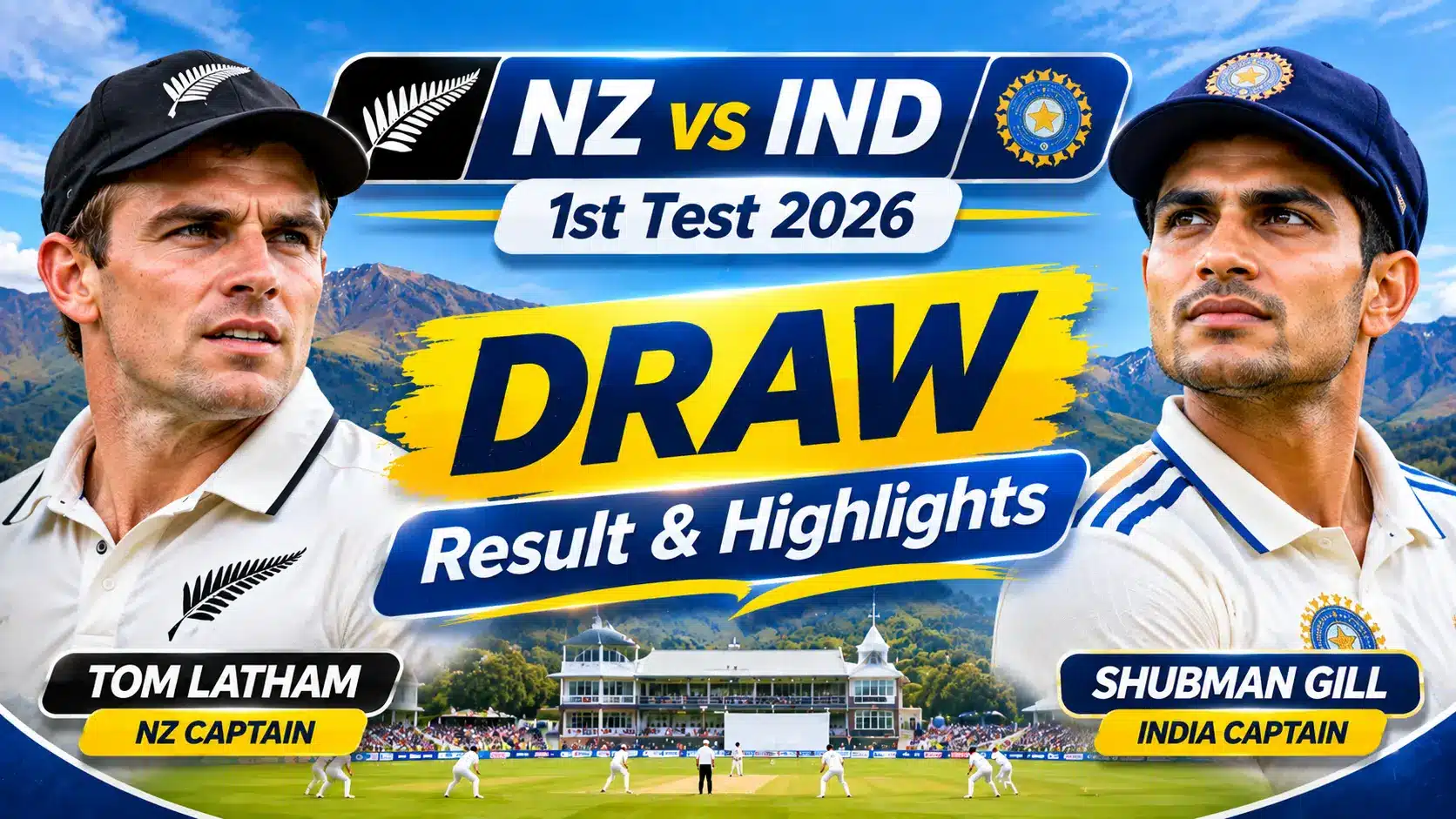
New Zealand vs India 1st Test 2026 ended in a draw at the Basin Reserve in Wellington on November 23. India posted 720/9 declared after New Zealand had made 368 in the first innings. New Zealand then finished on 239/5 from 120 overs in their second innings. Daryl Mitchell was unbeaten on 49 and Glenn Phillips on 26 when the teams shook hands, with New Zealand still 113 runs behind.
Runs by innings
A comparison of the three completed innings in the Wellington Test.
Bar lengths use 720 runs as the maximum reference value. The innings are shown separately; this is not a run-chase comparison.
The NZ vs IND 1st Test 2026 Draw was a contest of two contrasting phases. India dominated with the bat and built a substantial advantage, while New Zealand showed patience and resilience over long periods at the crease. India began the final day needing eight wickets, but New Zealand’s resistance left the visitors five wickets short of victory when the teams shook hands.
The match was played from November 19 to 23 at the Basin Reserve in Wellington. India captain Shubman Gill won the toss and elected to field. New Zealand were dismissed for 368 before India declared at 720/9. The hosts finished their second innings at 239/5, still 113 runs behind India, and the match ended in a draw.
NZ vs IND 1st Test 2026: Match Result and Final Score
The final result was a draw. India gained a 352-run first-innings lead after scoring 720/9 in reply to New Zealand’s 368. New Zealand finished its second innings at 239/5, still 113 runs behind, when the teams shook hands.
| Team | Innings | Score | Overs |
|---|---|---|---|
| New Zealand | First | 368 all out | 121.0 |
| India | First | 720/9 declared | 166.0 |
| New Zealand | Second | 239/5 | 120.0 |
Result: Match drawn. Venue: Basin Reserve, Wellington. Dates: November 19–23, 2026.
The scoreline captures the main story. India’s huge total gave the visitors control of the match situation, but the time available and the nature of the surface made a ten-wicket finish difficult. New Zealand’s second innings was built around occupying the crease rather than chasing a target. That approach protected the draw and denied India the series lead.
It is also important to understand the result in the context of the five-day format. A team can dominate one innings and still fail to win if the opposition has enough time and batting depth to defend. In Wellington, New Zealand used that time effectively. This match analysis is also relevant to readers following cricket news and Cricket Betting ID updates, as the final result reflected both India’s first-innings batting strength and New Zealand’s ability to adapt when survival became the priority.
How the Match Unfolded Across Five Days
New Zealand’s first innings: a recovery to 368
New Zealand’s first innings began under pressure. India made early inroads and reduced the hosts to 70/5, putting the middle and lower order under immediate pressure. Henry Nicholls and Glenn Phillips then produced the defining partnership of the innings. Their sixth-wicket stand was worth 216 runs and changed the shape of the contest.
Nicholls remained unbeaten on 175 from 335 balls, while Phillips scored 118 from 216 deliveries. Their partnership helped New Zealand recover from a difficult position and reach 368 in 121 overs. The innings showed the value of partnerships in Test cricket: after losing five wickets, New Zealand needed two batters to absorb pressure, build a platform and make the total competitive.
Jasprit Bumrah led India’s attack with four wickets for 92 runs. Akash Deep claimed three for 53, while Anshul Kamboj took two wickets. Prasidh Krishna picked up one. The early breakthroughs gave India a strong start, but Nicholls and Phillips ensured the first innings did not end quickly.
India’s reply: 720/9 declared
India responded with a commanding 720/9 declared in 166 overs. The innings featured centuries from KL Rahul and Rishabh Pant, along with important contributions from the rest of the batting order. Rahul made 136 from 290 balls, showing concentration and control over a long period. Pant scored 128 from 153 deliveries, adding momentum and taking advantage of scoring opportunities.
Yashasvi Jaiswal made 85, Devdutt Padikkal scored 80, Shubman Gill contributed 98, and Dhruv Jurel added 78. Anshul Kamboj made 38, Washington Sundar scored 24, Akash Deep added 13 and Jasprit Bumrah remained unbeaten on seven. The innings was notable for its depth: several players converted starts into substantial scores, and India’s total kept growing even after the top order had made its impact.
Glenn Phillips was New Zealand’s leading wicket-taker with three for 154. Rachin Ravindra took two wickets, while Matt Henry, Kyle Jamieson, Jacob Duffy and Nathan Smith claimed one each. India’s declaration at 720/9 placed New Zealand under significant pressure and left the hosts needing to bat for a long time to avoid defeat.
New Zealand’s second innings: survival under pressure
New Zealand began the second innings with a large deficit and a clear task: bat long enough to take the game out of India’s reach. The hosts lost Tom Latham early, but Devon Conway and the middle order helped rebuild. Conway scored 65 from 165 balls, providing stability at the top of the order.
Henry Nicholls made 31, and Rachin Ravindra scored 37. Both were dismissed after spending time at the crease, but their contributions helped New Zealand move through the middle sessions. Tom Blundell added 15 before becoming the fifth wicket to fall at 176. At that stage, India still had an opportunity to push for a late breakthrough.
Daryl Mitchell and Glenn Phillips then shut the door on India’s remaining hopes. Mitchell finished unbeaten on 49 from 186 balls, while Phillips remained not out on 26 from 126 deliveries. Their unbroken sixth-wicket partnership was worth 63 runs. It was not a fast-scoring stand; its importance came from the time it consumed and the discipline with which the batters defended their wickets.
Day 5 Highlights: Mitchell and Phillips Secure the Draw

New Zealand began Day 5 at 119/2, with India needing eight wickets to complete a win. India kept attacking through its seamers and spinners. Washington Sundar removed Devon Conway for 65, while Prasidh Krishna dismissed Rachin Ravindra for 37. Anshul Kamboj later accounted for Tom Blundell, leaving New Zealand at 176/5. India had taken three wickets during the day, but still needed five more.
Blundell’s dismissal gave India another opening, but Mitchell and Phillips handled the pressure with a disciplined defensive approach. They left deliveries outside off stump, defended straight balls and avoided unnecessary risks. The pair knew that batting through the remaining time would secure the draw.
Mitchell’s unbeaten 49 was an innings built around patience. He faced 186 balls and struck four fours and one six. Phillips made 26 from 126 balls, hitting two boundaries. Their partnership of 63 runs was decisive because India could not separate them before the match ended. New Zealand closed on 239/5 after 120 overs.
India’s bowlers continued to attack, but the pitch offered limited assistance as the match progressed. Gill later said that taking all ten wickets on the surface was always going to be difficult. With 15 overs still remaining, the teams shook hands. Gill also cited the fast bowlers’ workload and the short turnaround before the Christchurch Test as reasons for not continuing to push for a result.
Complete Batting Scorecard: New Zealand and India
New Zealand first innings – 368 all out
| Batter | Runs | Balls | Dismissal |
|---|---|---|---|
| Tom Latham | 0 | 2 | b Bumrah |
| Devon Conway | 4 | 13 | c Pant b Kamboj |
| Henry Nicholls | 175* | 335 | Not out |
| Rachin Ravindra | 15 | 50 | c Pant b Akash Deep |
| Daryl Mitchell | 1 | 8 | c Jaiswal b Bumrah |
| Tom Blundell | 5 | 22 | c Gill b Bumrah |
| Glenn Phillips | 118 | 216 | b Akash Deep |
| Nathan Smith | 14 | 44 | lbw b Prasidh |
| Kyle Jamieson | 11 | 21 | c Rahul b Akash Deep |
| Matt Henry | 1 | 9 | lbw b Bumrah |
| Jacob Duffy | 4 | 12 | c Pant b Kamboj |
| Extras | 20 | — | — |
| Total | 368 | 121 overs | All out |
India first innings – 720/9 declared
| Batter | Runs | Balls | Dismissal |
|---|---|---|---|
| Yashasvi Jaiswal | 85 | 89 | c Blundell b Henry |
| KL Rahul | 136 | 290 | b Nathan Smith |
| Devdutt Padikkal | 80 | 175 | b Jamieson |
| Shubman Gill | 98 | 146 | b Duffy |
| Rishabh Pant | 128 | 153 | c Nathan Smith b Ravindra |
| Anshul Kamboj | 38 | 42 | c Conway b Phillips |
| Dhruv Jurel | 78 | 79 | st Blundell b Phillips |
| Washington Sundar | 24 | 26 | c & b Ravindra |
| Akash Deep | 13 | 5 | c Latham b Phillips |
| Jasprit Bumrah | 7* | 5 | Not out |
| Prasidh Krishna | — | — | Did not bat |
| Extras | 33 | — | — |
| Total | 720/9 | 166 overs | Declared |
New Zealand second innings – 239/5
| Batter | Runs | Balls | Dismissal |
|---|---|---|---|
| Tom Latham | 0 | 2 | c Pant b Bumrah |
| Devon Conway | 65 | 165 | c Pant b Sundar |
| Henry Nicholls | 31 | 59 | c Jurel b Prasidh |
| Rachin Ravindra | 37 | 129 | c Rahul b Prasidh |
| Daryl Mitchell | 49* | 186 | Not out |
| Tom Blundell | 15 | 54 | c Pant b Kamboj |
| Glenn Phillips | 26* | 126 | Not out |
| Nathan Smith | — | — | Did not bat |
| Kyle Jamieson | — | — | Did not bat |
| Matt Henry | — | — | Did not bat |
| Jacob Duffy | — | — | Did not bat |
| Extras | 16 | — | — |
| Total | 239/5 | 120 overs | Match drawn |
Top Performers and Bowling Figures

Several players shaped the result, but the most influential performances came from the two sides’ leading run-scorers. Nicholls and Phillips rescued New Zealand in the first innings, while Rahul and Pant gave India the platform for a commanding total. Mitchell and Phillips then provided the resistance that mattered most on the final day.
| Player | Team | Performance | Match impact |
|---|---|---|---|
| Henry Nicholls | New Zealand | 175* and 31 | First-innings recovery |
| Glenn Phillips | New Zealand | 118 and 26* | Two key sixth-wicket stands |
| KL Rahul | India | 136 | Long innings in India’s reply |
| Rishabh Pant | India | 128 | Fast-scoring century |
| Daryl Mitchell | New Zealand | 1 and 49* | Helped bat out the final day |
| Devon Conway | New Zealand | 4 and 65 | Second-innings resistance |
With the ball, Bumrah’s four wickets in the first innings were important because they came during New Zealand’s early collapse. Akash Deep’s three wickets also helped India keep the first-innings total under control. In New Zealand’s second innings, Prasidh Krishna took two wickets for 23 runs from 19 overs, while Washington Sundar, Bumrah and Kamboj each took one.
For New Zealand, Phillips’ three wickets in India’s innings were the best return. His bowling figures were three for 154, and he followed that contribution with two major batting partnerships. Nicholls was named Player of the Match for his unbeaten 175 in the first innings, an innings that gave New Zealand a route back into the contest after the early losses.
India bowling figures
| Bowler | New Zealand 1st innings | New Zealand 2nd innings |
|---|---|---|
| Jasprit Bumrah | 4/92 (29 overs) | 1/42 (20 overs) |
| Akash Deep | 3/53 (23 overs) | 0/47 (20 overs) |
| Anshul Kamboj | 2/69 (23 overs) | 1/45 (22 overs) |
| Prasidh Krishna | 1/100 (26 overs) | 2/23 (19 overs) |
| Washington Sundar | 0/45 (20 overs) | 1/65 (35 overs) |
| Devdutt Padikkal | Did not bowl | 0/2 (1 over) |
| Yashasvi Jaiswal | Did not bowl | 0/4 (2 overs) |
| Dhruv Jurel | Did not bowl | 0/1 (1 over) |
Bowling figures are shown as wickets/runs, with the number of overs in brackets. The figures are taken from the completed match scorecard.
Why India Could Not Force a Win
India’s position after the first innings was strong. The 352-run lead gave the visitors ample control, and the early wickets in New Zealand’s second innings created a chance to push for victory. However, a large lead does not automatically guarantee a result in Test cricket. The bowling side still needs enough time, favourable conditions and sustained pressure to dismiss the opposition twice.
The Basin Reserve pitch became increasingly difficult for India’s bowlers to exploit. New Zealand’s batters were able to defend for long periods, and the scoring rate remained low. That reduced the number of opportunities for India to force errors. The visitors also had to balance the desire to win with the workload of their bowlers ahead of the second Test.
India did create openings. Conway, Ravindra and Blundell all fell, leaving New Zealand five wickets down. But Mitchell and Phillips played out the remaining overs. Their partnership was an example of a lower-order stand serving a specific match objective: the pair did not need to dominate the bowling; they needed to stay together.
Gill explained that the wicket offered little help to the bowlers and that another five to ten overs were unlikely to change the outcome. He also noted that the fast bowlers had each bowled close to 50 overs in the match and needed recovery time before travelling to Christchurch. His comments explained the decision to end the contest with 15 overs remaining.
What the Draw Means for the Second Test
The drawn result leaves the two-Test series level at 0-0. India will travel to Christchurch for the second Test, scheduled to begin on November 27 at 3:30 AM IST, according to the BCCI’s published fixture list. The match is an opportunity for both teams to finish the series with a victory.
India can take confidence from the batting depth shown in Wellington. Rahul and Pant scored centuries, while Jaiswal, Padikkal, Gill and Jurel all made important contributions. The challenge will be to turn that batting control into a match-winning position by taking wickets at the right moments.
New Zealand will take encouragement from their ability to recover after being reduced to 70/5 in the first innings and then survive 120 overs in the second. Nicholls and Phillips demonstrated the value of long partnerships, while Conway and Mitchell made significant contributions in the final innings. Their bowlers will look for a more consistent performance after conceding 720 runs.
For the next match, the key tactical question is whether the surface will offer more assistance to seamers and spinners. Gill indicated that India would welcome a pitch that gives bowlers a stronger chance of taking wickets. New Zealand, meanwhile, will want to make better use of home conditions and avoid another large first-innings deficit. Fans can also check the Hagley Oval official match information for details about the upcoming India vs New Zealand Test.
Frequently Asked Questions
1. What was the result of the NZ vs IND 1st Test 2026?
The first Test between New Zealand and India ended in a draw on November 23, 2026, at the Basin Reserve in Wellington. New Zealand finished its second innings at 239/5, still 113 runs behind India’s first-innings total.
2. What was India’s score in the first innings?
India scored 720/9 declared in 166 overs. KL Rahul made 136 and Rishabh Pant scored 128, while several other batters passed 50.
3. How many runs did New Zealand score in both innings?
New Zealand made 368 in the first innings and 239/5 in the second. The second innings lasted 120 overs and secured the draw.
4. Who was the Player of the Match?
Henry Nicholls was named Player of the Match after scoring 175 not out in New Zealand’s first innings. His 216-run partnership with Glenn Phillips helped New Zealand recover from 70/5.
5. Who scored the most runs for India?
KL Rahul was India’s leading scorer with 136 runs. Rishabh Pant also made a century, scoring 128 from 153 balls.
6. When is the second NZ vs IND Test in 2026?
The second Test is scheduled to begin on November 27, 2026, at Hagley Oval in Christchurch. The listed start time is 3:30 AM IST.
Conclusion
The NZ vs IND 1st Test 2026 Draw delivered a strong batting display from India and a determined response from New Zealand. India’s 720/9 declared put the visitors in a commanding position, but Nicholls and Phillips’ first-innings partnership and the final-day resistance from Mitchell and Phillips kept the hosts in the match. New Zealand finished on 239/5 after 120 overs, leaving India five wickets short of victory.
India will take positives from its batting performance, while New Zealand can be pleased with the resilience shown after an early collapse. With the series still level, the second Test in Christchurch becomes important for both sides. .