
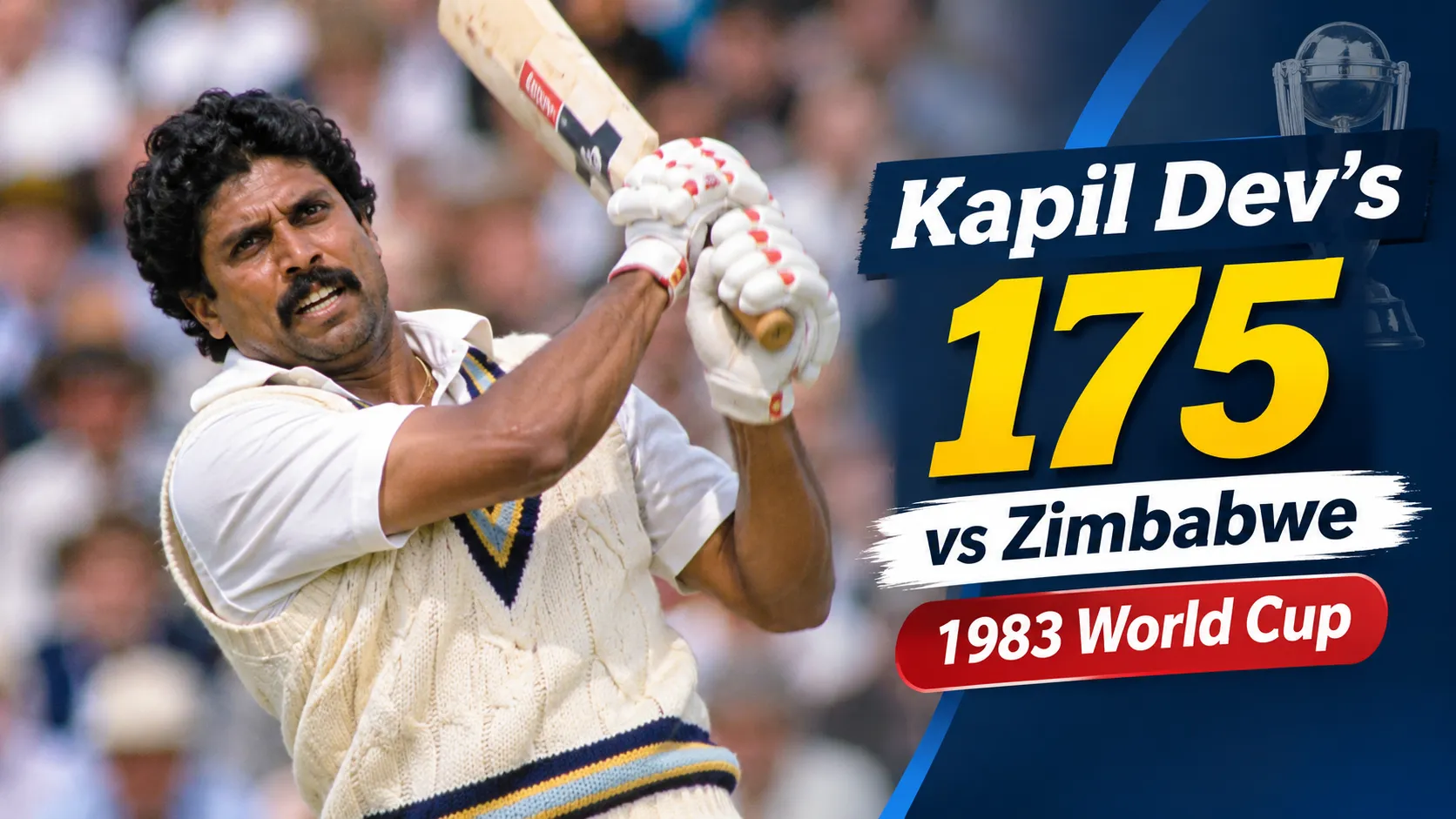
On 18 June 1983, Kapil Dev produced one of the greatest rescue acts in cricket history. India were 17 for 5 against Zimbabwe at Tunbridge Wells. Their captain answered with an unbeaten 175 from 138 balls and turned a likely defeat into a famous 31-run victory. The innings became a defining moment in India’s journey to its first Cricket World Cup title.
1. India vs Zimbabwe, 1983 World Cup: Match Overview
The match took place at the Nevill Ground in Tunbridge Wells, England, on 18 June 1983. It was a Group B fixture in the Prudential World Cup, played under the 60-over format. India entered the contest under serious pressure after losing their previous two matches against Australia and West Indies.
India had started the tournament well, beating West Indies and Zimbabwe. Those wins were followed by heavy defeats, which left the team needing a strong response. The return match against Zimbabwe had become almost a knockout contest for India’s hopes of reaching the semi-finals.
Kapil Dev won the toss and chose to bat, giving India the opportunity to set a target. However, Zimbabwe’s new-ball bowlers made the conditions count. Peter Rawson and Kevin Curran found movement early and quickly put India’s famous batting line-up under pressure. This opening spell became an important moment in the India vs Zimbabwe head to head history, showing how Zimbabwe challenged the defending champions in the 1983 World Cup.
| Match detail | Information |
|---|---|
| Tournament | Prudential World Cup 1983 |
| Match | India vs Zimbabwe, Group B |
| Date | 18 June 1983 |
| Venue | Nevill Ground, Tunbridge Wells |
| Format | 60 overs per side |
| Result | India won by 31 runs |
| Player of the Match | Kapil Dev |
2. India’s Collapse: From 9/4 to 17/5
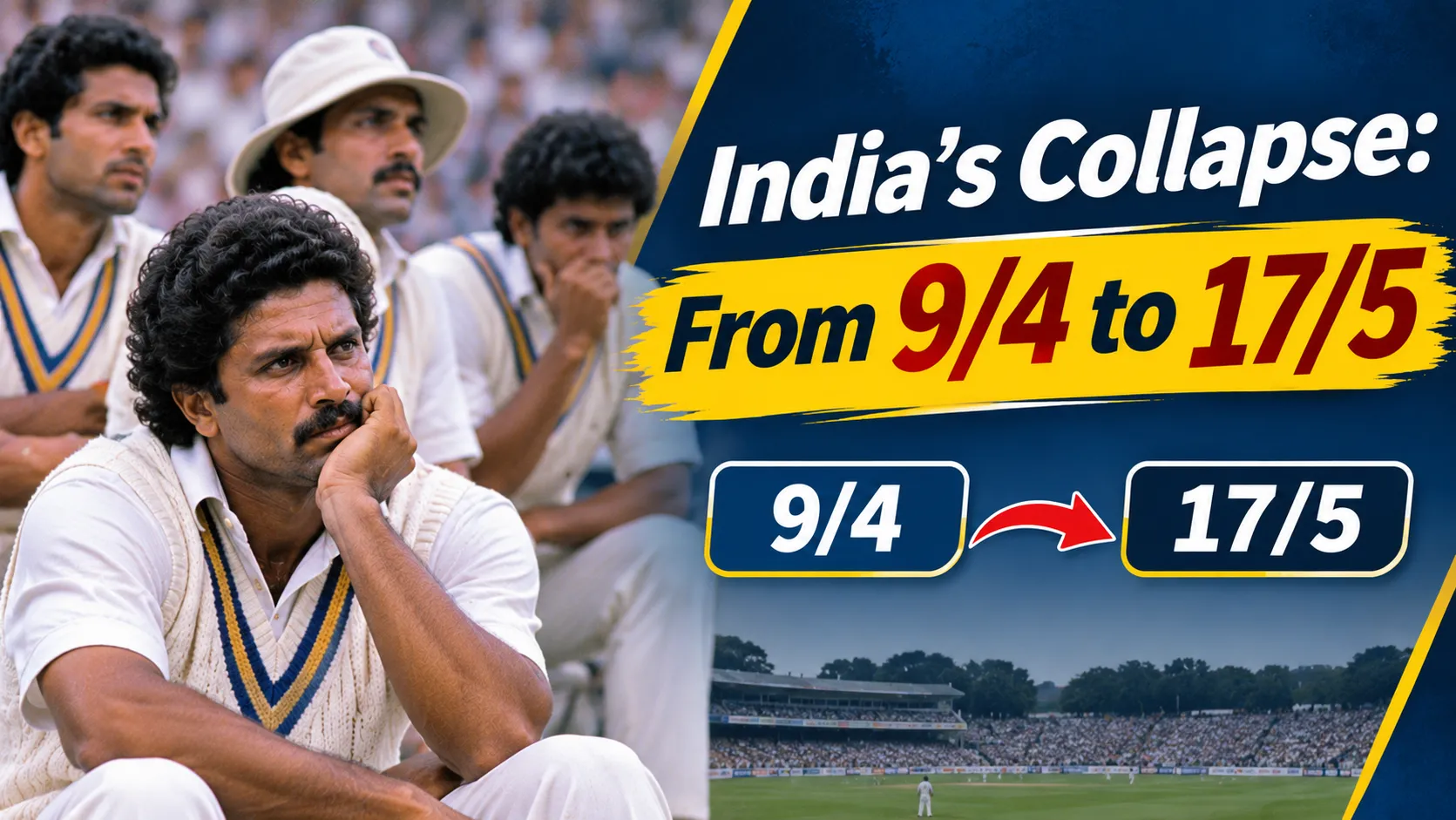
India’s innings began with a shock. Sunil Gavaskar was dismissed for a duck in the opening over. Kris Srikkanth also failed to score, and the score slipped to 6 for 2. Mohinder Amarnath and Sandeep Patil fell soon afterwards, leaving India at only 9 for 4.
Kapil came in at number six with the innings close to falling apart. He had to rebuild against a Zimbabwe attack that was bowling with confidence. Yashpal Sharma was dismissed for nine, and India were reduced to 17 for 5. Five recognised top-order batters had gone, and the scoreboard offered little hope.
At that point, a total of even 150 looked difficult. Kapil did not panic or try to finish the match with one big shot. He focused on surviving the good deliveries, finding gaps and putting away loose balls. That balance between patience and attack became the foundation of his innings.
| Wicket | Score | Batter dismissed |
|---|---|---|
| 1st | 0/1 | Sunil Gavaskar |
| 2nd | 6/2 | Kris Srikkanth |
| 3rd | 6/3 | Mohinder Amarnath |
| 4th | 9/4 | Sandeep Patil |
| 5th | 17/5 | Yashpal Sharma |
India’s fall of wickets, as recorded in the archived scorecard.
3. Kapil Dev’s 175 Not Out: How the Historic Innings Unfolded
Kapil’s innings was built on control before it became a display of power. He attacked when the bowlers missed their lengths, but he did not give away his wicket. His back-foot shots helped him score without taking needless risks early in the innings. As his confidence grew, he began to use the full range of his hitting.
After reaching his hundred, Kapil increased the pressure on Zimbabwe. He struck the ball over the infield and cleared the boundary with clean, powerful swings. The innings finished at 175 not out from 138 deliveries, with 16 fours and six sixes. His strike rate was 126.81, an extraordinary scoring rate for a 60-over match in 1983.
What made the score special was not only its size. Kapil had arrived when India were close to losing the match. He stayed until the end, managed the lower order and gave his team a total worth defending. His effort also showed that a captain could change a match through calm decisions under extreme pressure.
| Kapil Dev’s batting | Figure |
|---|---|
| Runs | 175 not out |
| Balls faced | 138 |
| Fours | 16 |
| Sixes | 6 |
| Strike rate | 126.81 |
| Batting position | No. 6 |
4. The Partnerships That Helped India Reach 266/8
Kapil did not score every run alone. He built important partnerships with the lower order, giving India time to recover and then accelerate. Roger Binny added 22, and their partnership helped take the score beyond the early collapse. Madan Lal then contributed 17 as India continued to rebuild.
The most important stand came with Syed Kirmani. The wicketkeeper-batter stayed with Kapil and played a patient supporting role. Their unbeaten 126-run partnership for the ninth wicket set a world record at the time in ODI cricket. Kirmani made 24 not out from 56 balls, while Kapil controlled the scoring and kept the innings moving.
India finished on 266 for 8 from 60 overs. The total was remarkable considering the team had been 17 for 5. Kapil’s 175 accounted for nearly two-thirds of India’s final score, but the support from the lower order allowed him to bat through the innings.
Kapil’s key partnerships
Partnership runs with Kapil Dev, based on the match report. Bars are scaled to the largest stand, 126 runs.
5. Zimbabwe’s Chase: Kevin Curran Keeps the Match Alive

Zimbabwe needed 267 runs to win. Their reply began with useful contributions from the top order, but India kept taking wickets. Robin Brown scored 35, while Guy Paterson added 23. Zimbabwe’s middle order could not build a long partnership to match Kapil’s effort.
Kevin Curran became Zimbabwe’s main hope. He scored 73 from 93 balls and kept the chase alive even as wickets fell around him. His innings included eight fours. Curran’s resistance meant India could not relax, and the result remained uncertain for much of the second innings.
India’s bowlers eventually broke through. Madan Lal took three wickets for 42 runs, while Roger Binny claimed two for 45. Kapil also took a wicket, dismissing John Traicos. Zimbabwe were bowled out for 235 in 57 overs, giving India a 31-run victory.
| Zimbabwe batter | Runs | Balls |
|---|---|---|
| Kevin Curran | 73 | 93 |
| Robin Brown | 35 | 66 |
| Guy Paterson | 23 | 35 |
| Iain Butchart | 18 | 43 |
| David Houghton | 17 | 35 |
| India bowler | Overs | Runs | Wickets |
|---|---|---|---|
| Madan Lal | 11 | 42 | 3 |
| Roger Binny | 11 | 45 | 2 |
| Balwinder Sandhu | 11 | 44 | 1 |
| Mohinder Amarnath | 12 | 37 | 1 |
| Kapil Dev | 11 | 32 | 1 |
India’s wicket-takers against Zimbabwe
Wickets taken by India’s bowlers in Zimbabwe’s innings. Bars are scaled to Madan Lal’s three-wicket haul.
6. Why Kapil Dev’s 175 Was a Turning Point in the 1983 World Cup
The win over Zimbabwe kept India’s campaign alive. The team still had to beat Australia in another crucial group match to reach the semi-finals. India responded by scoring 247 and then bowling Australia out for 129. That result secured India’s place in the last four.
India went on to beat England in the semi-final and West Indies in the final at Lord’s. The final victory gave India its first men’s Cricket World Cup title. Kapil’s rescue innings against Zimbabwe did not win the trophy by itself, but it helped restore belief at a critical stage of the tournament.
The innings also changed how many people viewed India’s ability in one-day cricket. The team had entered the competition without a strong record in the first two World Cups. Kapil’s performance showed that India could fight back against difficult situations and compete with the strongest teams.
The match has another unusual detail: it was not televised. People at the Nevill Ground witnessed the innings live, while many fans elsewhere could only hear about it later. The ICC’s account of India’s 1983 World Cup campaign describes the collapse, Kapil’s record stand and the importance of the win.
7. Records and Legacy of the 175-Run Knock

At the time, Kapil’s 175 not out was the highest individual score in men’s ODI cricket. It was also the highest score in a World Cup innings at that point. His 126-run partnership with Kirmani set a new ninth-wicket ODI record. These milestones made the innings important beyond India’s immediate tournament situation.
The world record for the highest ODI score later moved on. Viv Richards made 189 not out against England in 1984, taking the record beyond Kapil’s mark. Viv Richards later raised the ODI individual-score record with 189 not out against England in 1984. Kapil’s 175, however, remains one of the most celebrated World Cup innings because of the match situation in which it was scored.
Its lasting value comes from the combination of skill, leadership and timing. A big score can be memorable, but a big score after a team has lost five early wickets carries a different meaning. Kapil gave India a chance when the match seemed almost beyond reach.
What Made the Innings So Difficult to Play?
The conditions and match situation made Kapil’s task harder than the final score alone suggests. Zimbabwe’s seamers moved the ball and used the bounce at the Nevill Ground. India’s top order had already shown how difficult it was to settle against that attack. Kapil had to judge when to defend, rotate the strike and attack.
He also had to manage the innings across a long 60-over contest. Modern one-day cricket has different fielding restrictions and a shorter innings. In 1983, a batter needed to build a score over a longer period while protecting the wickets that remained. Kapil’s 138-ball innings was fast for that match, but it was not a blind assault.
The scorecard shows the value of his control. India lost eight wickets, yet Kapil remained unbeaten. He faced 138 deliveries and struck 22 boundaries, scoring at a strong rate without giving Zimbabwe his wicket. Kirmani’s patience at the other end was just as important. Kapil took more of the scoring responsibility, while Kirmani helped keep the partnership intact.
Zimbabwe did not surrender after India’s recovery. Kevin Curran’s 73 gave the chase real substance, and Zimbabwe reached 230 before losing their ninth wicket. India still needed to finish the job. The bowlers took the final wickets and kept the target beyond reach. The match was a complete team win built around an extraordinary individual innings.
Key Match Numbers at a Glance
These figures bring together the main contributions from both innings. They show how India’s batting recovery was followed by a competitive chase and a disciplined bowling finish.
| Key performance | Player or team | Figures |
|---|---|---|
| Highest score | Kapil Dev (India) | 175* off 138 |
| Best score for Zimbabwe | Kevin Curran | 73 off 93 |
| Best bowling for India | Madan Lal | 3/42 in 11 overs |
| Best bowling for Zimbabwe | Peter Rawson | 3/47 in 12 overs |
| India’s total | India | 266/8 in 60 overs |
| Zimbabwe’s total | Zimbabwe | 235 all out in 57 overs |
| Winning margin | India | 31 runs |
Frequently Asked Questions
1. How many runs did Kapil Dev score against Zimbabwe in the 1983 World Cup?
Kapil Dev scored 175 not out from 138 balls on 18 June 1983 at Tunbridge Wells.
2. How many fours and sixes did Kapil Dev hit?
He hit 16 fours and six sixes during his unbeaten 175-run innings.
3. What was India’s score when Kapil Dev came to bat?
India were 9 for 4 when Kapil arrived. The score later became 17 for 5 after Yashpal Sharma was dismissed.
4. How many runs did Kapil Dev and Syed Kirmani add?
They shared an unbeaten 126-run partnership for the ninth wicket, which was a world record at the time.
5. What was the result of India vs Zimbabwe in the 1983 World Cup?
India scored 266 for 8 and bowled Zimbabwe out for 235. India won the match by 31 runs.
6. Was Kapil Dev’s 175 televised live?
No. The match was not televised, so only the spectators at the Nevill Ground saw the innings live.
Conclusion: An Innings That Changed India’s World Cup Story
Kapil Dev’s 175 not out against Zimbabwe was much more than a record-breaking score. It rescued India from 17 for 5, lifted the team to 266 for 8 and created a target Zimbabwe could not reach. His innings combined patience, attacking skill and outstanding leadership.
India’s 31-run win kept the team’s 1983 World Cup dream alive. The side went on to defeat Australia, England and West Indies to lift the trophy. Decades later, Kapil’s innings remains a powerful reminder that one player can change a match—and sometimes change the course of a team’s history.