
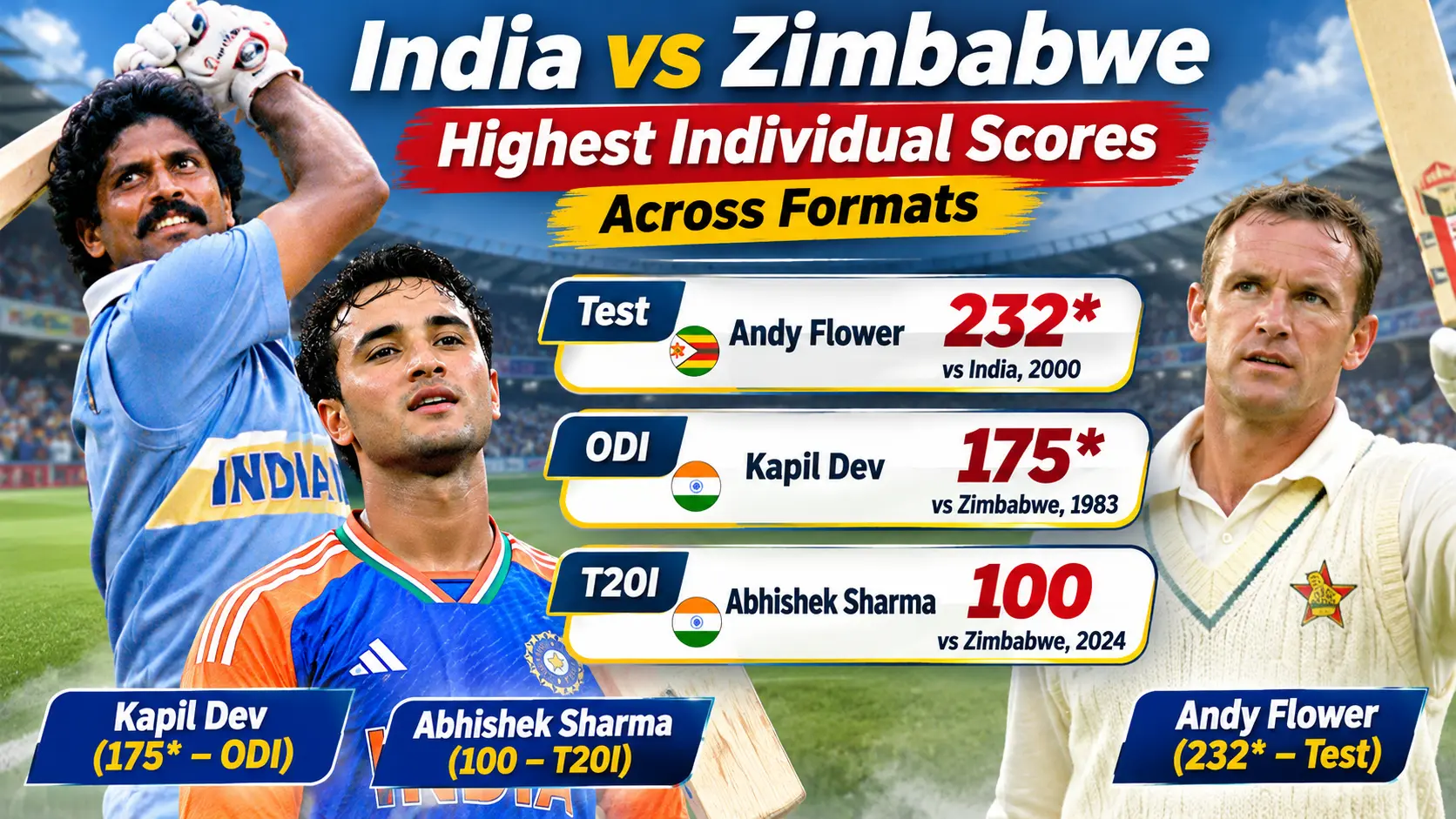
India and Zimbabwe have produced memorable batting performances in Test, One-Day International and T20 International cricket. Some innings came in difficult match situations, while others changed the course of famous games. The highest individual scores in this rivalry belong to Andy Flower, Kapil Dev and Abhishek Sharma.
This guide explains each record, the match behind it and the other major innings in the India vs Zimbabwe highest individual score lists. It also explains why the format and match context matter when comparing these performances.
India vs Zimbabwe Highest Individual Scores: Record Table
The table gives the top individual score in each international format. These are head-to-head records from official matches between the two countries, including World Cup fixtures. The list is not limited to bilateral tours.
| Format | Player | Team | Score | Venue | Year |
|---|---|---|---|---|---|
| Test | Andy Flower | Zimbabwe | 232* | Nagpur | 2000 |
| ODI | Kapil Dev | India | 175* | Tunbridge Wells | 1983 |
| T20I | Abhishek Sharma | India | 100 | Harare | 2024 |
The unbeaten symbol (*) means the batter was still at the crease when the innings ended. It does not change the number of runs, but it is important when reading a scorecard. A not-out innings may also have helped the team use all available overs or finish a chase.
India vs Zimbabwe Test Highest Individual Score

Andy Flower’s unbeaten 232 at Nagpur
Andy Flower made 232 not out for Zimbabwe in the second Test at Nagpur from 25 to 29 November 2000. He faced 444 balls and struck 30 fours and two sixes. His innings remains the highest individual score in a Test between India and Zimbabwe.
The innings came after Zimbabwe had been asked to follow on. India had declared their first innings at 609 for six, with Sachin Tendulkar scoring 201 not out, Rahul Dravid making 162 and Shiv Sunder Das adding 110. Zimbabwe were then under pressure to avoid an innings defeat.
Flower responded with patience and outstanding concentration. He built a long innings and received support from Alistair Campbell, who scored 102, and other lower-order batters. Zimbabwe reached 503 for six in their second innings before the match ended in a draw.
The result made the innings even more important. Flower did not simply collect a large score; he helped his side survive a difficult match situation against a strong Indian attack. His 232 not out also became a landmark performance in the history of Test wicketkeepers.
Other major Test scores in the rivalry
| Batter | Team | Score | Venue / Match |
|---|---|---|---|
| Andy Flower | Zimbabwe | 232* | Nagpur, 2000 |
| Vinod Kambli | India | 227 | Delhi, 1993 |
| Sachin Tendulkar | India | 201* | Nagpur, 2000 |
| Rahul Dravid | India | 200* | Delhi, 2000 |
| Andy Flower | Zimbabwe | 183* | Delhi, 2000 |
These scores show that the rivalry has featured outstanding long-form batting from both sides. India’s leading contributions came from technically strong top-order players, while Andy Flower produced two major unbeaten innings during the 2000 tour.
India vs Zimbabwe ODI Highest Individual Score
Kapil Dev’s historic 175 not out at Tunbridge Wells
Kapil Dev made 175 not out against Zimbabwe on 18 June 1983 at Tunbridge Wells during the Cricket World Cup. India were in serious trouble after losing five wickets for just 17 runs. This remarkable innings became the India vs Zimbabwe highest individual score in ODI cricket and remains one of the most famous performances in World Cup history.
He scored 175 not out from 138 balls, hitting 16 fours and six sixes. His innings lifted India to 266 for eight in a 60-over match. India went on to win by 31 runs, a result that helped keep their campaign alive on the way to their first World Cup title.
The innings remains the highest individual ODI score in India–Zimbabwe matches. It is also remembered because the match was not widely televised, so the innings became famous through scorecards, reports and stories shared by players and supporters.
Other leading ODI innings
| Batter | Team | Score | Venue | Year |
|---|---|---|---|---|
| Kapil Dev | India | 175* | Tunbridge Wells | 1983 |
| Andy Flower | Zimbabwe | 145 | Colombo | 2002 |
| Brendan Taylor | Zimbabwe | 138 | Auckland | 2015 |
| Shubman Gill | India | 130 | Harare | 2022 |
| Sachin Tendulkar | India | 127* | Bulawayo | 1998 |
| Ambati Rayudu | India | 124* | Harare | 2015 |
Shubman Gill’s 130 in 2022 was a major modern-era innings. He reached his maiden ODI century in the third match of the series and helped India complete a clean sweep. Brendan Taylor and Andy Flower also feature prominently among Zimbabwe’s best ODI performances against India.
Kapil’s 175 remains far ahead of the more recent scores. The innings came in a 60-over World Cup match, so it should be compared with the conditions and playing rules of its time rather than treated as a modern 50-over innings.
India vs Zimbabwe T20I Highest Individual Score
Abhishek Sharma’s 100 from 47 balls
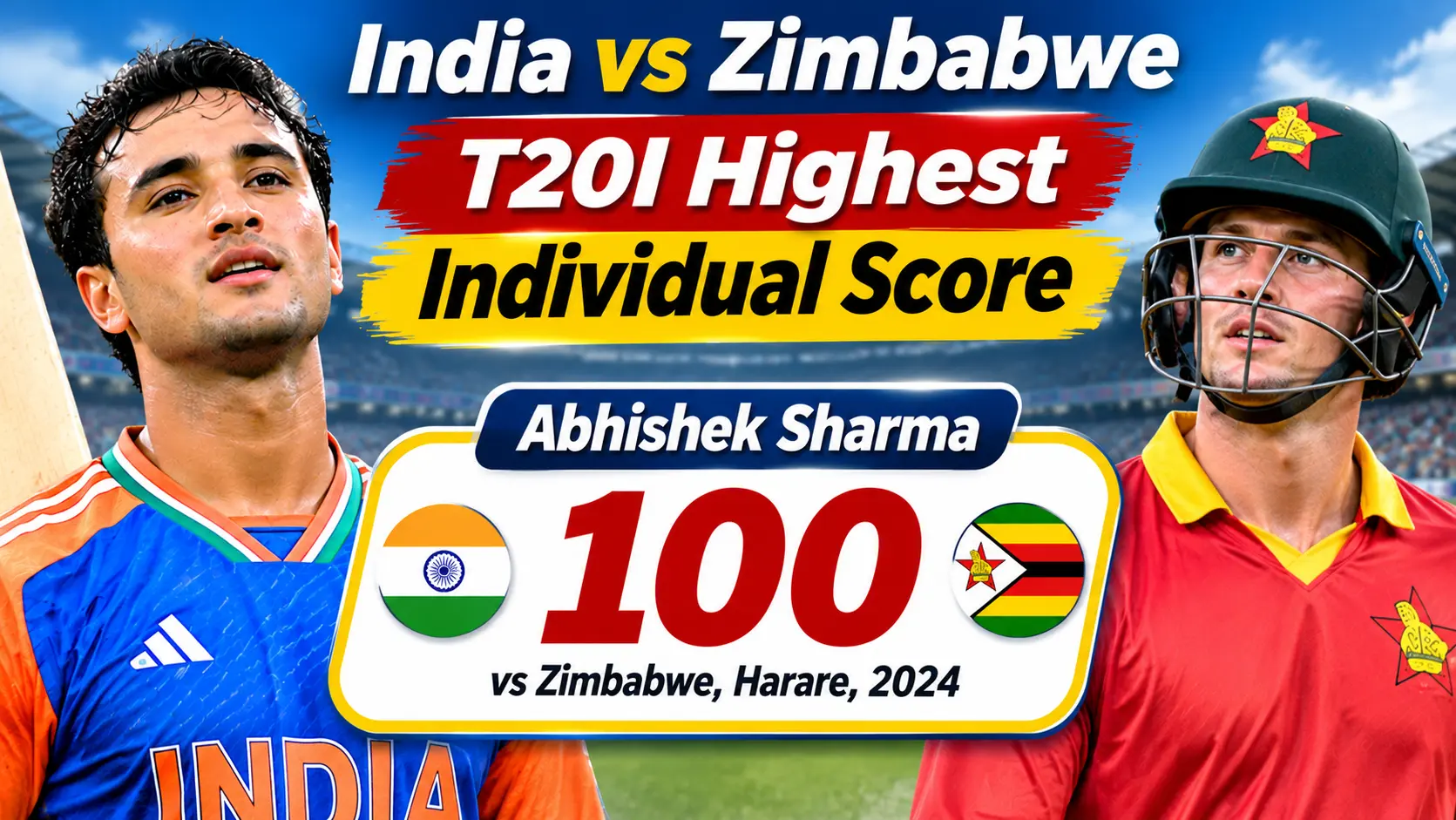
Abhishek Sharma scored 100 from 47 balls against Zimbabwe in the second T20I at Harare on 7 July 2024. He hit seven fours and eight sixes. India posted 234/2 and won by 100 runs.
It was a remarkable response after Abhishek had been dismissed for a duck in his T20I debut in the opening match of the series. He attacked from the start, found boundaries around the ground and reached his hundred in only his second international appearance.
His century remains the highest individual T20I score in India–Zimbabwe matches, ahead of Brian Bennett’s 97 not out in the 2026 T20 World Cup. It also became one of the defining moments of India’s 2024 tour. The innings showed how quickly a T20 batter can change a match through power, timing and confidence.
Other notable T20I scores
| Batter | Team | Score | Balls | Year |
|---|---|---|---|---|
| Abhishek Sharma | India | 100 | 47 | 2024 |
| Brian Bennett | Zimbabwe | 97* | 59 | 2026 |
| Yashasvi Jaiswal | India | 93* | 53 | 2024 |
| Ishan Kishan | India | 81 | 44 | 2026 |
| Vaibhav Sooryavanshi | India | 81 | 49 | 2026 |
Brian Bennett’s unbeaten 97 in the 2026 T20 World Cup is Zimbabwe’s closest entry to the top mark. Yashasvi Jaiswal’s 93 not out in 2024 also stands out because India completed the chase without losing a wicket. Ishan Kishan and Vaibhav Sooryavanshi have also made 81 against Zimbabwe in 2026.
How the Three Format Records Compare
The three top scores reflect very different demands. A Test double century requires concentration across long periods. An ODI innings can balance risk and control over a fixed number of overs. A T20I hundred usually depends on scoring quickly while protecting wickets and maintaining a high run rate.
| Record | Top score | Key quality | Match context |
|---|---|---|---|
| Test | 232* | Endurance and patience | Follow-on rescue in a drawn Test |
| ODI | 175* | Recovery and attacking range | India recovered from 17/5 |
| T20I | 100 | Power and scoring speed | India posted 234/2 |
Andy Flower’s innings was about saving a match. Kapil Dev’s knock was about rebuilding an innings that seemed almost lost. Abhishek Sharma’s century was about taking control of a short-format contest. Each score is memorable for more than the number beside the batter’s name.
Why These India–Zimbabwe Batting Records Matter

Records help readers understand how a rivalry has changed. The Test record highlights Zimbabwe’s ability to produce a major performance even when India were in a strong position. The ODI record connects the teams to one of cricket’s best-known World Cup stories. The T20I record reflects the modern game, where a batter can reach three figures in fewer than 50 balls.
These innings also show that individual records do not always match the final result. Flower’s 232 not out came in a drawn match. Kapil’s 175 not out helped India win a crucial World Cup fixture. Abhishek’s century powered a 100-run victory. Match context is essential when judging the value of a score.
For readers following cricket statistics and match coverage, use scorecards rather than short social posts when checking balls faced, boundaries, venue and result. The original India vs Zimbabwe batting records and scorecard archive is a useful starting point for checking historical figures.
India’s Best Batting Contributions Against Zimbabwe
India’s record list includes several generations of batters. Kapil Dev’s 175 not out belongs to the early World Cup era, while Sachin Tendulkar and Rahul Dravid produced major Test and ODI scores during the late 1990s and early 2000s. More recently, Shubman Gill has added a memorable century in Harare. These performances show how Indian batters have built large innings in different eras and match situations.
Tendulkar’s 201 not out at Nagpur came in the same Test in which Andy Flower made 232 not out. The two innings created a rare match in which both sides had a batter pass 200. India’s total of 609 for six gave them a substantial advantage, but Zimbabwe’s second-innings resistance prevented a home victory. This is a useful reminder that a high score should be considered alongside the match situation.
In ODIs, India’s batting records against Zimbabwe include both recovery innings and dominant run chases. Kapil’s 175 is the most dramatic example of recovery. Shubman Gill’s 130 in 2022 was a more modern innings built with control and clean stroke play. Ambati Rayudu’s unbeaten 124 in 2015 also demonstrated how an experienced batter can manage an innings deep into the final overs.
Zimbabwe’s Best Batting Contributions Against India
Zimbabwe’s record holders deserve equal attention. Andy Flower’s 232 not out is the highest Test score in the rivalry, and his 145 in Colombo is among the leading ODI scores. Brendan Taylor’s 138 in Auckland and Sikandar Raza’s 115 in Harare are further examples of Zimbabwe batters producing high-quality innings against India.
These performances are significant because they came against an opposition with a strong record in the fixture. Zimbabwe’s batters often had to face experienced Indian bowlers and manage pressure while building partnerships. A large individual score could keep a match competitive even when the team result went against them.
In T20Is, Brian Bennett’s unbeaten 97 is a recent reminder that Zimbabwe can produce explosive batting too. His score sits close to Abhishek Sharma’s hundred in the head-to-head list. As more T20Is are played, the leading scores may change quickly, especially when pitches and match conditions favour aggressive batting.
How to Read Individual Score Records Correctly
There are a few details worth checking before comparing two innings. First, confirm the format. A 175 in a 60-over ODI from 1983 was played under different conditions from a modern 50-over innings. Second, check whether the batter remained not out. The asterisk in a scorecard indicates that the innings ended without the batter being dismissed.
Third, compare the venue and match situation. A batter may score quickly on a flat pitch, while another may need to rebuild after early wickets. The score alone does not show the pressure faced, the quality of the bowling attack or how the innings affected the result. Reading the full scorecard provides a more complete picture.
Finally, separate head-to-head records from bilateral tour records. The Kapil Dev innings came in a World Cup match, not a bilateral series. It still counts in India–Zimbabwe ODI records because the teams played each other in an official ODI. This article uses the broader head-to-head definition across Tests, ODIs and T20Is.
Frequently Asked Questions
1. Who has the highest individual score in India vs Zimbabwe Test matches?
Andy Flower holds the record with 232 not out for Zimbabwe at Nagpur in November 2000. He faced 444 balls in the drawn Test.
2. Who scored the highest ODI score between India and Zimbabwe?
Kapil Dev made 175 not out for India at Tunbridge Wells in the 1983 World Cup. India won that match by 31 runs.
3. Who has the highest T20I score in India vs Zimbabwe matches?
Abhishek Sharma scored 100 from 47 balls at Harare on 7 July 2024. India won the match by 100 runs.
4. What was Andy Flower’s score against India in 2000?
Andy Flower scored 232 not out in Zimbabwe’s second innings at Nagpur. The innings helped Zimbabwe draw the match after following on.
5. Was Kapil Dev’s 175 scored in a bilateral ODI series?
No. Kapil Dev made the 175 not out against Zimbabwe during the 1983 Cricket World Cup. It is included because it is an India–Zimbabwe ODI head-to-head record.
6. Can the highest T20I score record change?
Yes. The record can change whenever India and Zimbabwe play another T20I and a batter scores more than 100. Check updated scorecards for the latest position.
Conclusion
The India vs Zimbabwe highest individual score records feature three outstanding innings. Andy Flower’s 232 not out remains the Test benchmark, Kapil Dev’s 175 not out is the ODI high point, and Abhishek Sharma’s 100 leads the T20I list. Each innings tells a different story about skill, match pressure and the demands of its format.
These records are more meaningful when read with their match context. From Flower’s long fight at Nagpur to Kapil’s World Cup recovery and Abhishek’s explosive century, the rivalry has produced performances that cricket fans still remember. Keep checking verified scorecards as future matches may add new names to the record books.