
India enter this preview as narrow favourites, but New Zealand could benefit from playing at home. The hosts may look to use early movement with the new ball, while India will rely on their batting depth and attacking top order. The final result could depend on how well each team handles the powerplay and controls the middle overs.
Probable Playing XI and Match Prediction
The probable playing XIs in this article are projections, not confirmed team sheets. Official line-ups are usually announced at the toss, so check for late updates about player fitness and team selection. The prediction is an editorial assessment rather than a guarantee. Use the pitch report, head-to-head record and confirmed teams together when judging which side has the advantage.
India vs New Zealand meet in the first T20I at Hagley Oval in Christchurch on Thursday, 22 October 2026. Play starts at 12:30 PM IST, which is 8:00 PM local time in New Zealand. India are narrow favourites in our editorial estimate, with 55% against 45% for the hosts. This guide covers probable XIs, injury news, the pitch, the weather and the head-to-head record.
| Detail | Information |
|---|---|
| Match | India vs New Zealand, 1st T20I of five |
| Date | Thursday, 22 October 2026 |
| Ground | Hagley Oval, Christchurch |
| Start time | 12:30 PM IST / 8:00 PM local time |
| Captains | Shreyas Iyer (India); Mitchell Santner (New Zealand) |
| Head-to-head (T20Is) | India 19 wins, New Zealand 11 wins |
| Editorial lean | India, narrowly (55% to 45%) |
📊 India vs New Zealand 1st T20I Prediction
India start as slight favourites because their record against New Zealand in T20Is is strong. They lead the head-to-head by 19 wins to 11 and won the 2026 T20 World Cup final by 96 runs. New Zealand have home conditions on their side, but they are missing Mark Chapman, Zak Foulkes and Rachin Ravindra. The 55% to 45% split is an editorial judgement, not bookmaker odds or a calibrated model.
Hagley Oval adds uncertainty, because the chasing side has won eight of the 14 completed T20Is there. Grass and early seam movement could trouble India’s powerplay batters, especially in the first few overs. India’s counter is depth, with Abhishek Sharma, Sanju Samson and Ishan Kishan all capable of fast starts. Treat the estimate as pre-toss and revisit it once the XIs and the pitch are known.
India vs New Zealand Probable Playing XI
Both squads are confirmed, but neither side has publicly named its playing XI ahead of the toss. The XIs in Table 2 are KhelKhabri projections, built from the announced 16-player squads and recent selection patterns. India’s squad was named on 6 October, with Shreyas Iyer as captain and Tilak Varma as vice-captain. New Zealand’s squad is led by Mitchell Santner and now includes Josh Clarkson and Blair Tickner as replacements.
| No. | India probable XI | New Zealand probable XI |
|---|---|---|
| 1 | Sanju Samson (wk) | Finn Allen |
| 2 | Abhishek Sharma | Tim Seifert (wk) |
| 3 | Ishan Kishan | Devon Conway |
| 4 | Shreyas Iyer (c) | Glenn Phillips |
| 5 | Tilak Varma | Daryl Mitchell |
| 6 | Shivam Dube | Bevon Jacobs |
| 7 | Axar Patel | Michael Bracewell |
| 8 | Bhuvneshwar Kumar | Mitchell Santner (c) |
| 9 | Arshdeep Singh (fitness permitting) | Matt Henry |
| 10 | Mayank Yadav | Jacob Duffy |
| 11 | Varun Chakravarthy | Lockie Ferguson |
Every player in both projected XIs comes from the squads announced by BCCI and New Zealand Cricket. Arshdeep Singh is the main doubt for India after a blow to his bowling shoulder on 14 October. If he misses out, Prince Yadav or Kuldeep Yadav could come in to rebalance the attack. New Zealand must choose between three frontline quicks and an extra all-rounder such as Clarkson. Readers looking for an Online Cricket ID can find more information through this link.
Injury and Team News Before the Toss
| Player | Team | Status | Potential impact |
|---|---|---|---|
| Mark Chapman | New Zealand | Out of the T20Is with a left hamstring tear; expected back for the ODIs | Middle-order batting depth reduced |
| Zak Foulkes | New Zealand | Out with a right hip-flexor injury; return timeline not set | Seam-bowling depth reduced |
| Rachin Ravindra | New Zealand | Not in the T20I squad because of injury; expected back for the ODIs | Batting and spin all-rounder unavailable |
| Josh Clarkson | New Zealand | Called in as a replacement | Power-hitting all-round option |
| Blair Tickner | New Zealand | Called in as a replacement | Extra fast-bowling option |
| Arshdeep Singh | India | Fitness doubt after a shoulder blow on 14 October | New-ball option uncertain |
| Bhuvneshwar Kumar | India | Returns to the T20I squad after nearly four years | Swing and powerplay experience |
As Table 3 shows, New Zealand Cricket confirmed on 9 October that Chapman and Foulkes will miss the series. Chapman suffered a left hamstring tear in the European T20 league in September, while Foulkes hurt his right hip flexor. Josh Clarkson and Blair Tickner replace them, though neither is guaranteed a place in the XI. For India, Bhuvneshwar Kumar returns, while Jasprit Bumrah and Ravi Bishnoi are not in the squad.
Hagley Oval Pitch Report and Christchurch Weather
| Hagley Oval T20I record | Figure |
|---|---|
| Average first-innings total | 162.0 |
| Chasing side wins in completed games | 8 of 14 |
| Toss winners who chose to field | 11 of 15 |
| Highest total | 236/4 (England v New Zealand, 2025) |
| Highest individual score | 99* (Devon Conway v Australia, 2021) |
| Pitch scenario | First-innings range |
|---|---|
| Difficult surface | 140–160 |
| Balanced pitch | 165–185 |
| Batting-friendly | 190+ |
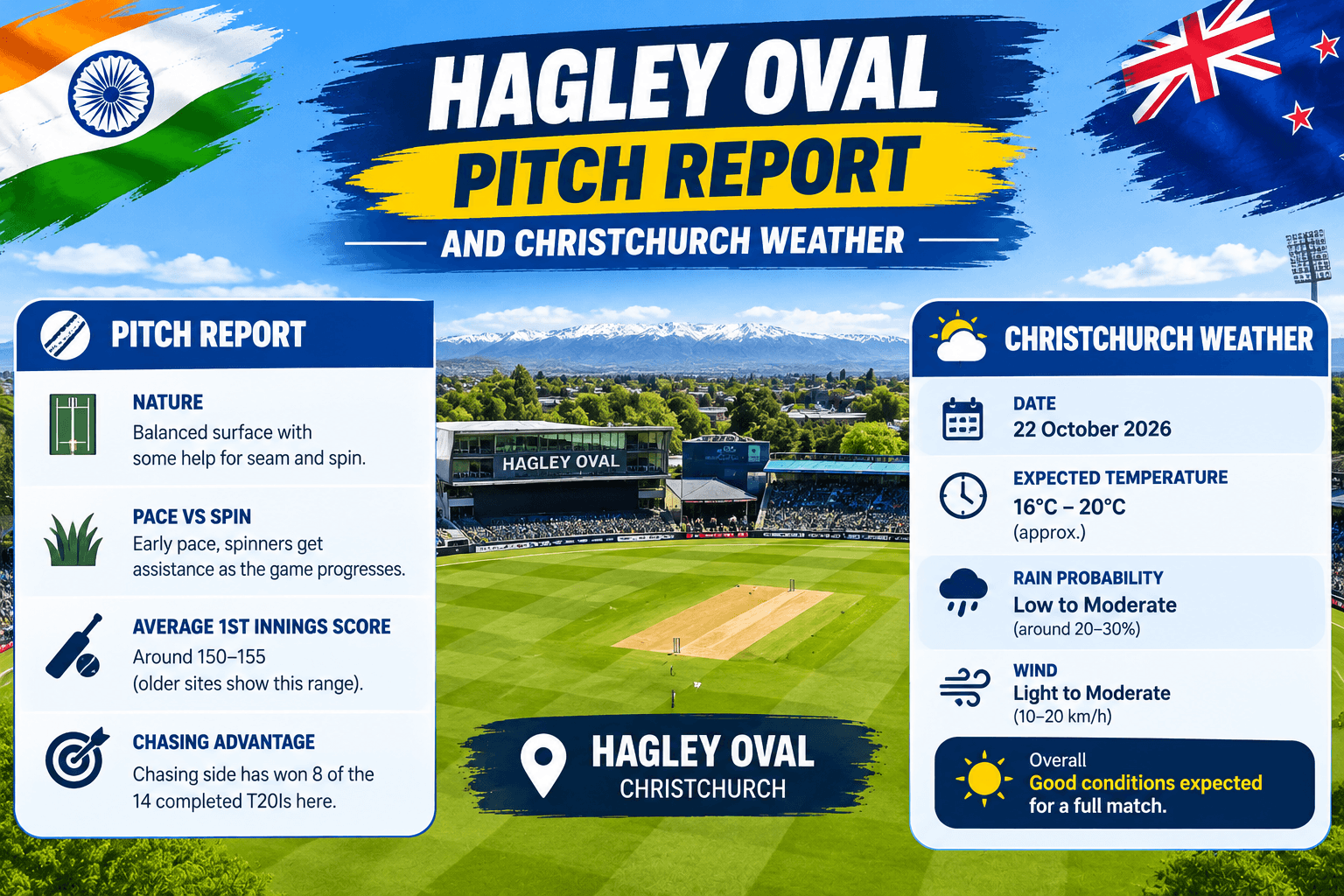
Venue averages sit near 162, so a balanced pitch should produce a first-innings total between 165 and 185. A green surface could hold scores to 140–160, while a flat track and quick starts could push totals past 190. These ranges, shown in Table 5, are editorial scenarios for a full 20-over innings, not venue averages. Chasing sides have the better record here, so captains may prefer to field, but the toss guarantees nothing.
Christchurch weather outlook
The forecast for Thursday shows a high near 23°C, a low near 9°C and a 10% chance of rain. The match starts at 8:00 PM local time, so evening temperatures will be cooler than the daytime high. Conditions in spring can change quickly, so readers should check the forecast again on match day. Any rain interruption would shorten the innings and could change the targets and win chances significantly.
India vs New Zealand T20I Head-to-Head and Recent Form
T20I wins: India vs New Zealand
Source: CricTracker. Totals vary by source because of ties and no-results.
India have won 19 and New Zealand 11 of their T20I meetings, according to CricTracker. Other sites list between 30 and 33 matches, so readers should expect small differences in totals. India’s latest meeting was the T20 World Cup final in Ahmedabad on 8 March 2026. India won it by 96 runs after making 255/5, the highest total in a T20 World Cup final.
India also beat New Zealand 4-1 in a five-match T20I series at home in January 2026. New Zealand’s only win in that series came by 50 runs in Visakhapatnam on 28 January. Both squads look different from the sides that met earlier this year, with several regular players absent. That makes past results useful context for the rivalry, but a weak guide to this particular match.
🏏 Four Player Battles That Could Decide the Match
| Battle | Why it matters |
|---|---|
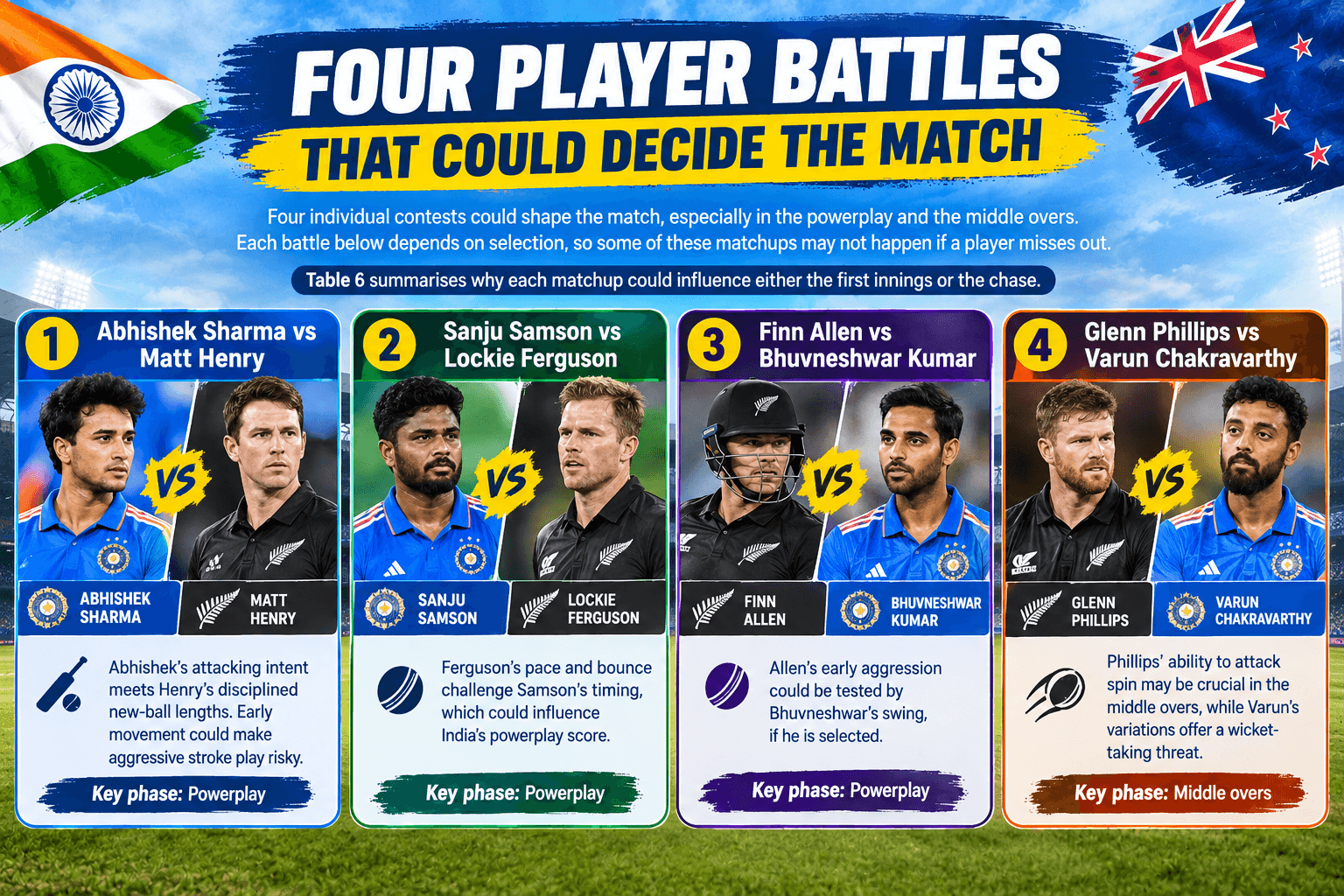
| Abhishek Sharma vs Matt Henry | Abhishek’s attacking intent meets Henry’s disciplined new-ball lengths. Early movement could make aggressive stroke play risky. |
| Sanju Samson vs Lockie Ferguson | Ferguson’s pace and bounce challenge Samson’s timing, which could influence India’s powerplay score. |
| Finn Allen vs Bhuvneshwar Kumar | Allen’s early aggression could be tested by Bhuvneshwar’s swing, if he is selected. |
| Glenn Phillips vs Varun Chakravarthy | Phillips’ ability to attack spin may be crucial in the middle overs, while Varun’s variations offer a wicket-taking threat. |
What will decide the match?
| Factor | What to watch |
|---|---|
| New-ball wickets | The side that handles seam movement better could take an early lead. |
| Middle-overs control | Santner, Bracewell and Varun may be important if the pitch grips. |
| Death-overs execution | Yorkers, slower deliveries and field placement will matter if the scores are close. |
| Final selection | Pace-bowling balance and injury-related changes could shift the contest. |
India vs New Zealand T20I Series Schedule 2026
| Match | Date | Venue |
|---|---|---|
| 1st T20I | 22 October, Thursday | Christchurch |
| 2nd T20I | 24 October, Saturday | Christchurch |
| 3rd T20I | 27 October, Tuesday | Wellington |
| 4th T20I | 30 October, Friday | Auckland |
| 5th T20I | 1 November, Sunday | Hamilton |
The five T20Is open India’s 12-match tour of New Zealand, which also includes five ODIs and two Tests. The first two matches are played in Christchurch, followed by single matches in Wellington, Auckland and Hamilton. Fixture details may change, so fans should always check the official organisers for any late updates.
India vs New Zealand 1st T20I FAQs
Who will win the India vs New Zealand 1st T20I?
India are narrow pre-match favourites in this editorial preview, with an estimated 55% chance of winning. New Zealand have a 45% estimate, and their home seam attack keeps the contest open. This is an editorial judgement made before the toss, so it is not a guaranteed result.
When is the first IND vs NZ T20I in 2026?
The first T20I is scheduled for Thursday, 22 October 2026, at Hagley Oval in Christchurch. It starts at 12:30 PM IST, which is 8:00 PM local time in New Zealand. The five-match series then continues with four more T20Is across Christchurch, Wellington, Auckland and Hamilton.
Where will the match be played?
The first T20I will be played at Hagley Oval in Christchurch, on New Zealand’s South Island. Christchurch also hosts the second T20I on 24 October, so the same ground is used twice. The venue can offer seam movement and bounce, which makes the opening overs especially important for batters.
What is the Hagley Oval pitch report?
Hagley Oval can offer early seam movement and bounce, particularly when the surface has fresh grass. The average first-innings total in recent T20Is is about 162, and chasing sides have won eight of 14 completed games. The match-day strip should be assessed before play, because conditions can change from the forecast.
Are Mark Chapman and Zak Foulkes playing?
No, both players have been ruled out of the T20I series because of injuries, according to New Zealand Cricket. Mark Chapman has a left hamstring tear, while Zak Foulkes has a right hip-flexor injury and will also miss out. New Zealand have added Josh Clarkson and Blair Tickner to the squad as their replacements for the series.
Is Arshdeep Singh fit for the first T20I?
Arshdeep Singh took a blow to his bowling shoulder during the fourth T20I against West Indies on 14 October. BCCI said his availability depended on his recovery, and no later fitness update was found before publication. Readers should treat him as a doubt until the official XI is announced at the toss.
Are the probable playing XIs confirmed?
No, the probable XIs in this guide are editorial projections and not official team sheets. The official playing XIs are only announced at the toss, shortly before the first ball is bowled. Late fitness news or pitch conditions can still change the final combinations for both teams.
What is a competitive first-innings score?
A working editorial estimate for a competitive first-innings score is 165–185 on a balanced pitch. Lower totals could be competitive if the ball moves, while a flat pitch could push scores above 190. Actual conditions on the day, including weather and dew, should decide what the right target is.
Final Thoughts
The Christchurch opener promises a competitive start to the series between two evenly matched sides. India’s attacking batting gives them a small pre-match edge, while New Zealand’s experienced seamers keep the contest open. The toss, confirmed line-ups and actual pitch behaviour will decide whether this prediction needs updating.