
A balanced look at batting stability, bowling progress, overseas adaptability and long-term ODI success.

Bangladesh can beat leading ODI opponents, but becoming a consistently top-ranked team requires dependable batting, stronger finishing, effective fielding and better results across different conditions. They have shown remarkable resilience in difficult matches. However, occasional series victories and individual performances do not always translate into sustained success at ICC tournaments. A stronger all-round approach would help turn promising results into regular performances.
Bangladesh’space-bowling resources have improved, and the squad includes skilled batters and capable all-rounders. The challenge is to combine those strengths in the same match. Clear roles, long-term player development and better execution under pressure can help Bangladesh become more competitive.
*Men’s ODI rankings snapshot checked on 22 October 2026; rankings may change.
Where Does Bangladesh Cricket Team Stand in ODI Cricket?
Bangladesh are a respected ODI team, but a gap remains between occasional success and sustained excellence. Their history includes important victories over established international opponents. The leading ODI sides, meanwhile, compete regularly in different conditions and remain effective throughout entire series.
In the men’s ODI rankings snapshot for 22 October 2026, Bangladesh were ninth with 41 matches, 3,304 points and a rating of 81. India led with 115, followed by New Zealand on 109. These figures describe a dated ranking, not a live score or a prediction. Check the official ICC ODI team rankings for subsequent changes.
| Team | Rank | Matches | Points | Rating |
|---|---|---|---|---|
| India | 1 | 36 | 4122 | 115 |
| New Zealand | 2 | 35 | 3809 | 109 |
| South Africa | 3 | 34 | 3547 | 104 |
| Pakistan | 4 | 34 | 3505 | 103 |
| Australia | 5 | 35 | 3568 | 102 |
| England | 6 | 35 | 3287 | 94 |
| Sri Lanka | 7 | 40 | 3752 | 94 |
| Afghanistan | 8 | 30 | 2812 | 94 |
| Bangladesh | 9 | 41 | 3304 | 81 |
ODI rating comparison
Why Recent Victories Still Matter
Bangladesh’s 2026 ODI series victory over New Zealand demonstrated their potential. The team retained much of its squad for the following Australia series, suggesting an emphasis on continuity. Such results show that Bangladesh can challenge strong opponents, particularly when bowling and batting performances support each other. Bangladesh team profile (ICC).
One successful series does not define a side’s long-term standard. Strong ODI teams maintain their approach across different venues and oppositions. Bangladesh must aim to repeat good performances rather than depend on isolated achievements.
Why Is Bangladesh’s ODI Batting Still Inconsistent?
Batting consistency remains one of Bangladesh’s most important development priorities. A competitive ODI innings needs partnerships, regular singles and measured acceleration. Bangladesh have sometimes struggled to combine those skills, especially after losing early wickets.
Their 2025 Champions Trophy campaign illustrated that concern. Cricbuzz reported 340 dot balls across the first two matches against India and New Zealand. Long periods without scoring increased pressure on the batters and made acceleration more difficult. Read Cricbuzz’s Champions Trophy analysis.
Opening Partnerships and Early Wickets
A reliable opening partnership provides a foundation for the middle order. Early dismissals instead force later batters to rebuild, which can reduce scoring opportunities. Bangladesh needs openers who adjust to the conditions without abandoning positive intent.
Good ODI opening does not require reckless hitting. Rotating the strike, selecting suitable boundaries and protecting wickets can work together. The team should prioritise complementary batting styles and patient development of effective combinations.
Middle-Order Batting Under Pressure
The middle order connects the first powerplay with the final ten overs. It must repair early damage while still creating a platform for acceleration. Bangladesh have produced remarkable recovery partnerships, but these should become occasional achievements rather than routine necessities.
Against India in the 2025 Champions Trophy, Towhid Hridoy and Jaker Ali shared a sixth-wicket stand worth 154 runs. Hridoy completed a century, yet India won by six wickets. That performance showed resilience, but it also demonstrated the cost of a difficult start. Source: ICC match report
Reducing Dot Balls in the Middle Overs
The middle overs reward batters who find gaps and run decisively. When the scoreboard stops, players may take greater risks to catch up. Bangladesh should develop consistent scoring methods against both pace and spin.
Training should focus on placement, strike rotation and decision-making. Better running between wickets can add runs without depending entirely on boundaries. This skill helps control an innings even on slow or difficult pitches.
Does Bangladesh Need Better Finishing Power?
Bangladesh need dependable contributions from their lower-middle order. The last ten overs offer scoring opportunities, but wickets in hand are essential to use them. Specialist finishing practice can help batters handle pace variations and high-pressure moments.
Mehidy Hasan Miraz provided a remarkable example against India in December 2022. His unbeaten century helped Bangladesh recover from 69/6 and reach 271/7 in the second ODI. Exceptional recoveries are memorable, but reliable batting depth should reduce the need for them.
Bangladesh’s Bowling Attack: A Strength to Build Around

Bowling offers Bangladesh an encouraging platform for improvement. Their pace resources include bowlers who can take wickets early and apply pressure during important phases. A balanced attack also needs effective spin, good fitness and reliable alternatives.
Nahid Rana claimed eight wickets in the 2026 ODI series against New Zealand, including a five-wicket haul. Taskin Ahmed and Mustafizur Rahman offer different skills and experience. Maintaining bowling fitness and planning for different surfaces will remain crucial.
Balancing Pace and Spin
Bangladesh have often benefited from slower conditions at home. Spin remains important, but selection should reflect each venue rather than follow one rigid formula. A faster surface might require extra seam options, while a dry pitch may reward additional spin.
The best attacks also vary their plans across the innings. New-ball wickets, middle-over control and effective death bowling require different skills. Bangladesh can improve by developing bowlers for each responsibility.
How Can Better Fielding Improve ODI Results?
Fielding can influence closely contested ODI matches. Dropped chances, missed run-outs and slow ground coverage allow opponents extra runs and opportunities. Bangladesh need reliable standards throughout the innings, not only in isolated moments.
Catching practice should include pressure situations and varied match conditions. Direct-hit accuracy, anticipation and strong athletic movement are also valuable. Better fitness supports these skills during long fielding innings.
Why Must Bangladesh Become More Adaptable Away From Home?
ODI conditions vary between countries. Pitches in Australia, New Zealand or South Africa can behave differently from those in Bangladesh. A successful international team adjusts its methods while maintaining confidence in its basic skills.
Bangladesh should prepare batters for additional bounce and movement. Overseas experience can also improve bowling plans and understanding of competitive totals. Progress should be judged over several tours rather than one disappointing result.
Reading Conditions and Match Situations
Match strategy should respond to pitch behaviour, weather and opposition strengths. A total that wins on a slow surface might be insufficient at a high-scoring venue. Players must understand when to rebuild, attack or protect wickets.
Better situational decisions help teams stay competitive even when conditions are unfamiliar. Rehearsing different match scenarios in training can strengthen those choices.
Why Does Selection Stability Matter?
Selection continuity allows players to learn their roles and build partnerships. Constant changes can make it harder for the batting order to settle. Nevertheless, stability should remain linked to clear responsibilities and credible performance standards.
Bangladesh need a dependable ODI core supported by emerging players. Mehidy Hasan Miraz contributes with both bat and ball, illustrating the value of versatile cricketers. Specialists should also be judged by the roles they perform, rather than reputation alone.
What Can Bangladesh Learn From the 2022 ODI Series Against India?
Bangladesh’s 2022 ODI series victory over India remains a useful example of resilience. Lower-order batting played a major role in both of Bangladesh’s early victories. The results showed the team could compete under intense pressure against a strong opponent.
They also revealed the risk of relying on late recoveries after batting collapses. A more secure top order could turn difficult games into more controlled performances. Our India vs Bangladesh 2022 series review examines those encounters and their lessons in greater detail.
What Separates Bangladesh Cricket Team From the Best ODI Teams?
Top ODI teams tend to combine batting depth, disciplined bowling, effective fielding and tactical flexibility. They remain competitive across different countries and multiple series. Bangladesh have shown these qualities at times, but bringing them together consistently is the major challenge.
It is important to distinguish isolated match weaknesses from long-term patterns. Not every defeat comes from poor batting, and not every victory proves a structural problem has been solved. Bangladesh should evaluate performance using evidence from several matches and conditions.
| Area | Existing strength | Priority |
|---|---|---|
| Opening batting | Attacking options | More stable partnerships |
| Middle order | Ability to rebuild | Strike rotation |
| Finishing | Match-winning contributions | Reliable acceleration |
| Pace bowling | Emerging wicket-takers | Fitness and depth |
| Spin bowling | Experience in slow conditions | Overseas adaptability |
| Fielding | Match-changing potential | Consistency |
| Selection | Young and experienced players | Role clarity |
Why Has Bangladesh Struggled in Major ICC ODI Tournaments?
Major ICC competitions give teams little time to recover from a poor match. Bangladesh’s 2025 Champions Trophy campaign highlighted the importance of strong starts and consistent batting. India beat Bangladesh by six wickets, and New Zealand won their meeting by five wickets. The final group match against Pakistan was abandoned.
Individual performances cannot always compensate for problems throughout a team. Bangladesh need contributions from several players in successive high-pressure matches. Scenario-based training can prepare the side for difficult chases, modest totals and early wicket losses.
How Should Bangladesh Measure ODI Improvement?
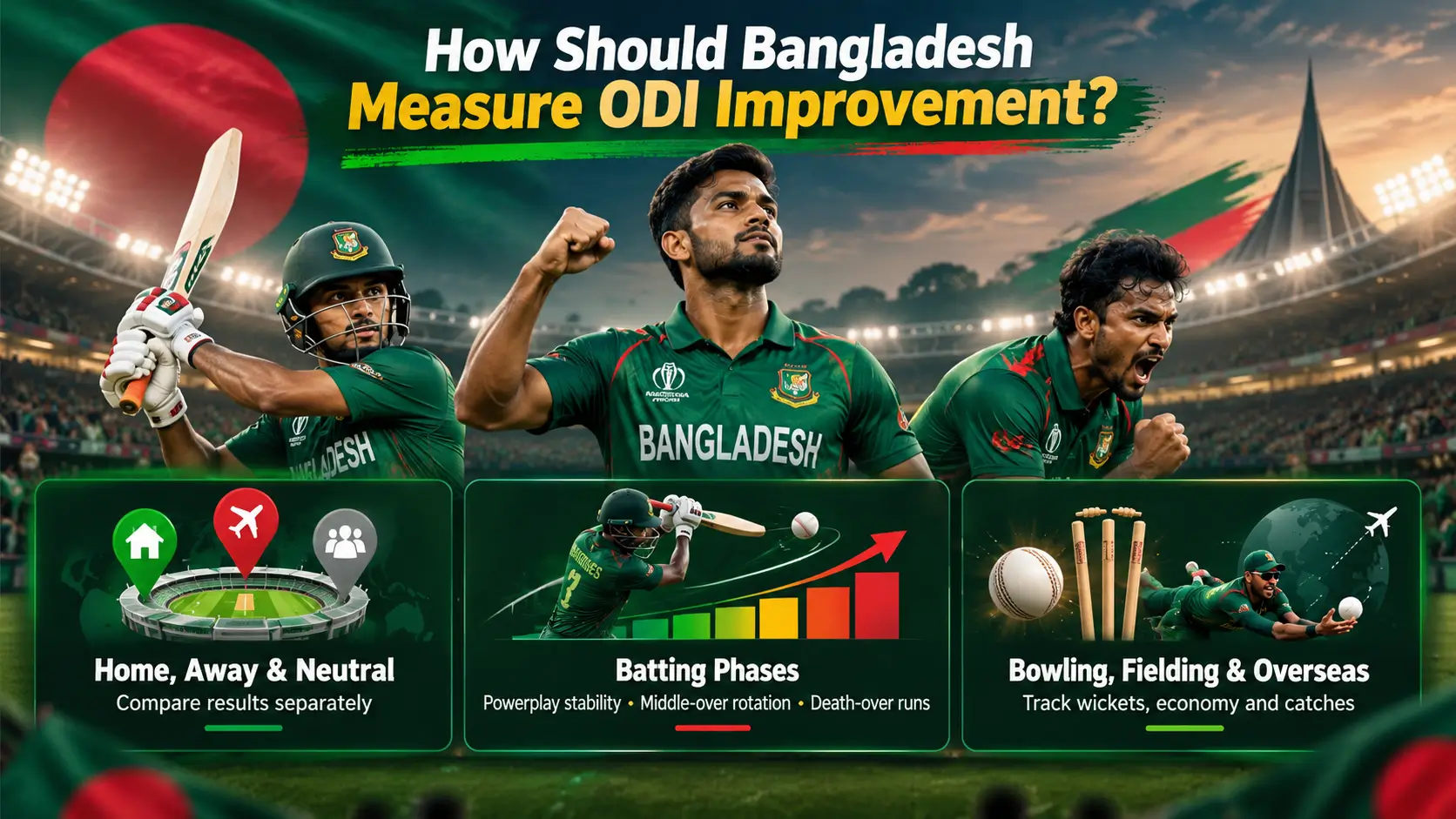
Bangladesh should assess progress through repeated match evidence, not one headline victory. Compare home, away and neutral-venue results separately. Use the same definitions and date ranges so trends remain meaningful.
Track Batting Performance by Innings Phase
Powerplay wickets lost show whether the opening pair provides stability. The middle-over dot-ball percentage measures how regularly batters rotate the strike. Runs and wickets in the final ten overs reveal whether Bangladesh can accelerate without a collapse.
Measure Bowling, Fielding and Overseas Results
New-ball wicket rates, death-over economy and catches converted each measure different tasks. Overseas ODI results should be judged across several tours and against comparable opponents. No single number captures all match conditions, so these indicators need written match context.
Method: these are recommended performance measures, not claimed Bangladesh historical averages or official selection targets. Sources for any future numerical comparisons should include ICC match records and original match scorecards.
A Practical Roadmap for Bangladesh’s ODI Improvement
Bangladesh’s long-term improvement should be assessed through measurable cricketing progress. The following priorities are recommendations, not official team targets. They focus on strengthening skills that influence results across different conditions.
Develop stable opening combinations, clearer middle-order roles and more effective strike rotation.
Train lower-middle-order batters to handle late acceleration and difficult recoveries.
Protect pace-bowling fitness, develop backup options and improve final-over execution.
Set clear player responsibilities and build international experience in varied conditions.
Monitor batting phases, catching efficiency, away results and performances against strong sides.
| Indicator | What it reveals |
|---|---|
| Opening partnership average | Early batting stability |
| Middle-over dot-ball rate | Strike rotation efficiency |
| Wickets lost before over 30 | Innings control |
| Runs in the final ten overs | Finishing quality |
| Powerplay wickets taken | Early bowling pressure |
| Catch conversion rate | Fielding execution |
| Away ODI win percentage | Adaptability |
Can Bangladesh Become a Top-Five ODI Team?
Bangladesh have the potential to move towards higher ODI rankings, but progress must be sustained. Their bowling resources and occasional victories over strong opponents provide encouragement. More consistent batting, effective fielding and better overseas results would make improvement more likely.
Rankings are outcomes rather than development plans. Bangladesh should concentrate on the quality of performances across several series. If those performances become more dependable, a stronger ranking may follow.
Frequently Asked Questions About Bangladesh ODI Cricket
What is Bangladesh missing to become a top ODI team?
Bangladesh needs more consistent batting, dependable finishing, improved fielding and greater adaptability away from home. Clear selection roles and sustained performances against strong teams also matter.
What is Bangladesh’s biggest ODI weakness?
Batting consistency has been a recurring concern. Early wickets and slow middle-over scoring can leave too much pressure on the remaining batters.
Does Bangladesh have a strong ODI bowling attack?
Bangladesh have promising pace resources, including Nahid Rana, Taskin Ahmed and Mustafizur Rahman. Their impact depends on form, fitness, conditions and support from the rest of the side.
Why can Bangladesh struggle against higher-ranked opponents?
Leading ODI teams often combine deeper batting, disciplined bowling and reliable fielding. Bangladesh must match those standards over entire matches and series.
How can Bangladesh improve their middle order?
Clear roles, stronger partnerships, better strike rotation and pressure-based practice can improve middle-order performance.
Why is overseas cricket important?
Different pitches and conditions test batting techniques and bowling plans. Better overseas results are evidence that a team can adapt.
What did the 2022 ODI series against India show?
The series demonstrated Bangladesh’s resilience and lower-order batting ability. It also showed the value of avoiding early collapses.
Why is selection stability important?
Consistent roles help players form partnerships and build confidence. Selection should still respond to performance and the needs of the team.
Can Bangladesh become a top-five ODI team?
Improvement is possible, but no ranking position is guaranteed. Sustained results against strong teams and better away performances would show progress.
What should Bangladesh prioritise for future World Cups?
Reliable batting combinations, finishing depth, bowling fitness, sharp fielding and good decisions under pressure should remain priorities.
Conclusion: What Bangladesh Cricket Team Really Need to Become a Top ODI Team
Bangladesh do not lack talent or the ability to defeat leading opponents. They have delivered memorable victories, produced outstanding individual performances and strengthened their pace bowling. The remaining task is to turn these strengths into dependable all-round results.
Batting stability, middle-over scoring and consistent finishing should remain major priorities. Better fielding, overseas adaptability and clear selection policies would support those improvements. The true measure of progress will be how often Bangladesh compete strongly across different conditions and tournaments.