
Afghanistan has improved its cricket through good spin bowling, strong batting, and teamwork. Bangladesh can learn from Afghanistan and use these lessons to improve its performance.
Introduction: Two Nations with Different Cricket Journeys
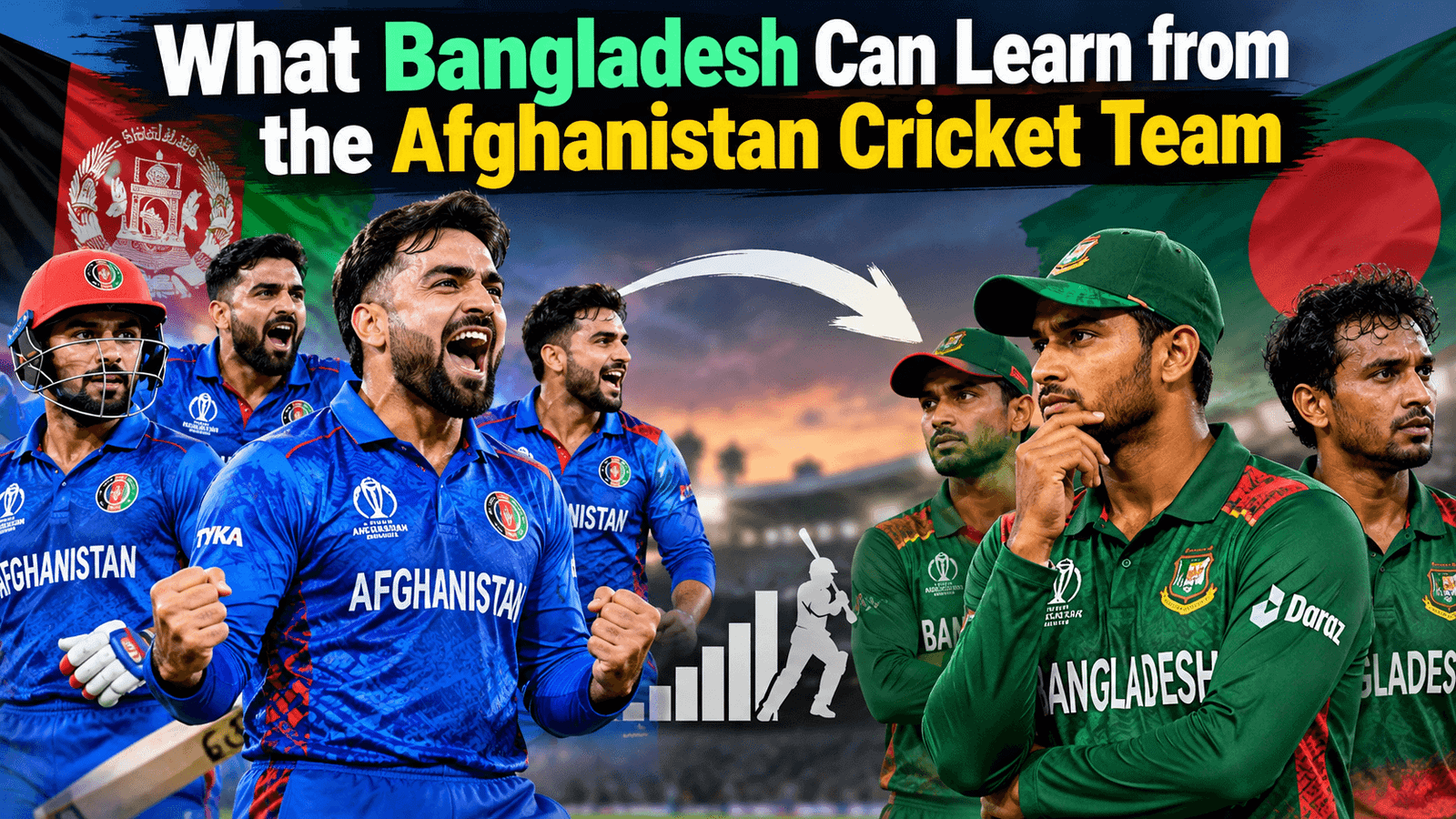
Cricket brings enormous excitement to Bangladesh and Afghanistan, where supporters follow every major performance. Both countries have talented players, devoted fans, and ambitions to compete with the strongest international teams. Yet their journeys through international cricket have developed differently, making their experiences useful to compare.
Bangladesh became a Test-playing nation in 2000 and has built decades of international experience. Afghanistan received Test status in 2017 and quickly made progress in limited-overs cricket. Its achievements show how a team can improve its competitiveness through clear priorities, specialised skills, and confidence against famous opponents.
The lesson is not that Bangladesh should copy Afghanistan in every detail. Their domestic systems, player pools, resources, and cricketing environments are different. Instead, Bangladesh can study what has worked for Afghanistan and adapt those ideas to its own circumstances.
What the Results Tell Us
Afghanistan’s 2023 ODI World Cup campaign marked a major step forward. The team won four matches, including victories over England, Pakistan, and Sri Lanka, and finished with eight points from nine games. In the 2024 Men’s T20 World Cup, Afghanistan reached the semi-finals for the first time, beating Australia by 21 runs and Bangladesh by eight runs under the Duckworth–Lewis–Stern method during the Super Eight stage. These results showed that Afghanistan could combine tactical planning with disciplined execution against high-pressure opposition. For Bangladesh, the lesson is to prepare specific match plans, stay composed in crucial overs, and turn good performances into consistent results.
These results are milestones, not proof that one national system is better in every area. Bangladesh also has its own history of major victories and experienced international players. The useful question is what specific habits and structures can help Bangladesh perform more consistently across formats and conditions.
| Milestone | Afghanistan result | Lesson for Bangladesh |
|---|---|---|
| 2023 ODI World Cup | Four wins in nine matches | Build plans that can challenge top-ranked teams. |
| 2023 ODI World Cup victories | Beat England, Pakistan, Sri Lanka, and the Netherlands | Prepare specific strategies for different opponents. |
| 2024 Men’s T20 World Cup | Reached the semi-finals for the first time | Develop tournament readiness and composure under pressure. |
| 2024 Super Eight | Beat Australia by 21 runs and Bangladesh by eight runs under DLS | Execute skills well in high-pressure, high-stakes matches. |
Source basis: Afghanistan Cricket Board history records and ICC tournament match reports. Results describe specific competitions, not a prediction of future performance.
1. Create a Clear and Recognisable Team Identity
Successful teams understand how they want to win. One side may depend on fast bowling, another on batting depth, and another on controlling the middle overs. Afghanistan has increasingly combined attacking intent with skilled spin bowling and energetic fielding, particularly in limited-overs cricket.
Bangladesh has long been associated with spin-friendly conditions and technically capable batters. Those strengths remain valuable, but a modern team needs a plan that travels beyond familiar pitches. Players should know their roles, understand the preferred tempo, and recognise how their contribution fits the match strategy.
A clear identity also improves selection. Coaches can choose players for defined responsibilities instead of selecting a team simply because its individual names look impressive. The approach should remain flexible, however, because conditions and opponents sometimes demand a different balance.
2. Invest in Spin Bowling as a Complete Skill
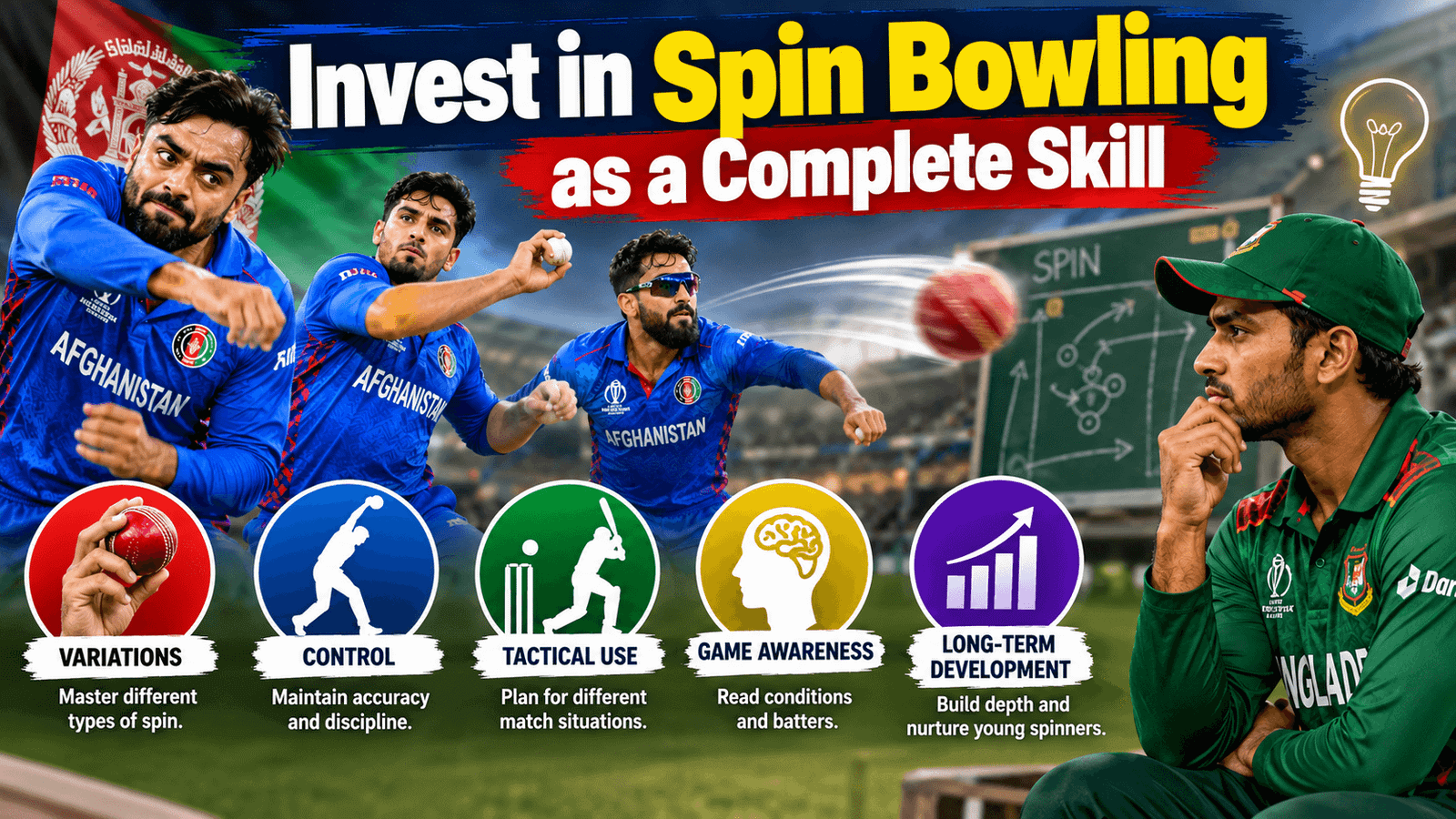
Afghanistan’s spin attack has become one of its strongest assets. Rashid Khan, Mohammad Nabi, and other spinners have shown how control, variation, and tactical awareness can change a limited-overs match. Their value comes not only from taking wickets but also from limiting scoring and forcing batters into difficult decisions.
Bangladesh also has a strong tradition of spin bowling. The next step is to develop a larger pool of specialists who can perform in different conditions. Young bowlers need to practise flight, pace changes, accuracy, angles, and plans for individual batters.
Coaches should assess a spinner’s impact across a spell rather than judging performance only by wickets. Dot balls, pressure, forced mistakes, and the ability to control a phase can all matter. A deeper spin-bowling group would give captains more tactical choices at home and abroad.
3. Give Young Players a Real Pathway to the Senior Team
Talent needs more than discovery; it needs a route to meaningful competition. Young cricketers require quality coaching, age-group tournaments, regular domestic matches, fitness support, and clear feedback. Without those opportunities, promising players may struggle when they face international pace, pressure, and expectations.
Bangladesh can strengthen the links between school cricket, clubs, regional programmes, age-group teams, and senior domestic competitions. Regional scouting can help find players outside established centres. Bangladesh Selection should consider performance and potential while giving emerging players enough time to learn from mistakes.
Patience does not mean removing accountability. Coaches should set measurable goals for technique, fitness, fielding, and decision-making. A young player should understand what needs improvement and receive a fair opportunity to demonstrate progress.
4. Play Fearless Cricket Without Confusing It with Recklessness
Afghanistan’s limited-overs batting has featured confident stroke-makers such as Rahmanullah Gurbaz and Ibrahim Zadran. Their attacking approach can put pressure on opponents and help the team compete against established bowling attacks. Aggression works best when players combine intent with awareness of the match situation.
Bangladesh should prepare batters for different phases of an innings. Powerplay players need to use scoring opportunities intelligently, while middle-order batters must rotate the strike and build partnerships. When wickets fall, the team needs a clear plan for rebuilding before accelerating again.
Training can recreate realistic match situations: chasing a steep target, defending a modest total, or recovering after an early collapse. Coaches should reward good decisions as well as runs scored. That balance encourages confidence without making reckless shots the default strategy.
5. Prepare for Overseas Conditions Before the Tour

Pitch pace, bounce, weather, ground dimensions, and local conditions can change the best tactical approach. A plan that works at home may not translate directly to a tour abroad. Adaptability therefore needs to be trained before a team arrives at the venue.
Bangladesh can organise preparation camps that reflect the conditions expected on tour. Batters can practise against relevant bowling styles, while bowlers can learn how to use different lengths and angles. Coaches should analyse venue trends and make selection decisions based on evidence rather than reputation alone.
Tour preparation should also cover recovery, travel schedules, communication, and mental readiness. Players who understand what to expect can spend more attention on execution. The aim is not to predict every challenge, but to reduce avoidable surprises.
6. Make Domestic Cricket More Valuable
Strong national teams need domestic competitions that develop players for international demands. Competitive fixtures, good pitches, experienced coaches, and consistent schedules help players build technique and resilience. Domestic cricket should be more than a route to selection; it should be a place where players learn specific match skills.
Bangladesh already has established domestic tournaments. The opportunity is to make them more consistent in quality and more closely connected to national-team needs. Selectors and coaches can communicate the skills required for each format, then review whether domestic competitions are helping players develop those skills.
Talent identification should reach beyond familiar names and major cities. Regional coaching and scouting programmes can broaden the pool of players available for selection. More competition for places can raise standards, provided the process remains transparent and performance-based.
7. Build Flexible Squads and Genuine All-Rounders
All-rounders offer captains more options with both bat and ball. Afghanistan has benefited from multi-skilled players such as Mohammad Nabi and Gulbadin Naib, whose abilities can help balance a limited-overs side. Flexible combinations become especially useful when conditions change or a specialist has an off day.
Bangladesh should support players who want to improve their second skill through structured coaching. Batters who bowl occasionally need a serious development plan, and bowlers should receive enough batting practice to contribute when lower-order runs matter. Both skills should be evaluated honestly rather than assumed from a player’s label.
Flexibility cannot replace specialist quality. A team still needs dependable top-order batters, wicket-taking bowlers, and players who can execute at the end of an innings. The goal is balance: enough all-round depth to adapt, alongside specialists who excel at their primary roles.
8. Practise for Pressure and Close Finishes
Close matches test decision-making as much as technique. Players must remain calm after losing wickets, defend totals when batters attack, and understand when a risky option is justified. These skills improve through deliberate practice rather than motivational speeches alone.
Afghanistan’s 2024 T20 World Cup campaign included a crucial win over Bangladesh that secured its semi-final place. Afghanistan scored 115 for five and then dismissed Bangladesh for 105 under the Duckworth–Lewis–Stern method. The result showed the importance of execution in a tense match where every over mattered.
Bangladesh can build pressure scenarios into regular training. Batters can practise chases with limited wickets remaining, while bowlers can rehearse defending small totals and delivering under fielding restrictions. Reviewing decisions after each simulation helps players identify patterns and improve their next response.
9. Use Data to Support Cricketing Judgement
Performance analysis can reveal patterns that are difficult to notice from memory alone. Teams can study scoring rates, wicket-taking phases, bowling match-ups, fielding errors, and success while chasing targets. The purpose is to answer practical questions, not to collect statistics without a plan.
Bangladesh could use simple dashboards to track powerplay performance, middle-over control, death-over economy, catching, and partnership building. These indicators should be reviewed across a meaningful period, because one match rarely tells the whole story. Data can guide training priorities and help evaluate whether changes are working.
Numbers must still be interpreted in context. A batter’s role, pitch conditions, opponent quality, and match situation can change what a statistic means. Coaches should combine evidence with experience, observation, and conversations with players.
10. Build Leadership and Long-Term Stability
Leadership is not limited to the captain. Senior players can mentor younger teammates, coaches can encourage open communication, and specialists can share knowledge across the squad. A team becomes more resilient when responsibility is spread rather than placed on one or two stars.
Bangladesh should define roles clearly and explain selection decisions honestly. Players need to know what the team expects from them and how their performance will be assessed. Tactical changes are sometimes necessary, but frequent unexplained shifts can undermine confidence and preparation.
Stability should not mean protecting poor performance indefinitely. It means using consistent standards, reviewing decisions fairly, and allowing players reasonable time to adapt. A long-term approach can help the team improve without reacting emotionally to every defeat.
11. Measure Progress Beyond the Scoreboard
Wins and losses matter, but they do not explain every part of a team’s development. Bangladesh should also track overseas competitiveness, fielding standards, successful chases, bowling control, and the contribution of emerging players. These indicators help identify where the team is improving and where more work is needed.
Targets should be realistic and specific to each format. Test cricket requires patience and sustained performance, ODIs demand adaptable innings and control across fifty overs, while T20 cricket rewards rapid decisions and execution. A single measure cannot fairly describe progress in all three formats.
Regular reviews can help coaches, selectors, and supporters understand the team’s direction. Publishing clear goals and reporting progress honestly would encourage accountability. It would also help separate a genuine long-term improvement from a short run of favourable results.
12. A Practical Action Plan for Bangladesh
Lessons from Afghanistan are useful only when they lead to action. Bangladesh can begin with a manageable programme that connects player development, specialist coaching, preparation, and performance review. The plan should have clear owners, realistic budgets, and regular checkpoints.
| Priority | Practical action | How to measure progress |
|---|---|---|
| Specialist skills | Expand coaching for spin, pace, batting, and fielding. | Track skill-specific performance over a season. |
| Youth pathway | Connect regional scouting with age-group and domestic cricket. | Review progression and playing opportunities for emerging players. |
| Overseas readiness | Run condition-specific camps before difficult tours. | Assess execution and adaptability during away matches. |
| Pressure training | Use realistic chases, defence drills, and close-match scenarios. | Review decisions and execution in simulated situations. |
| Performance analysis | Maintain clear dashboards for each format. | Check trends over multiple matches, not isolated results. |
These actions should be reviewed regularly and adjusted when evidence shows a better approach. Development takes time, and no single coach, player, or tournament can solve every challenge. Consistent execution is more valuable than ambitious promises without follow-through.
Conclusion: Learn from Afghanistan, Build Bangladesh’s Own Future
Afghanistan’s progress offers Bangladesh practical lessons in team identity, specialist skills, player pathways, and pressure management. Its performances in the 2023 ODI World Cup and 2024 T20 World Cup show that it can challenge established opponents in major competitions. Those milestones provide useful examples, not a guarantee of future success.
Bangladesh should adapt the ideas that fit its own resources and cricketing culture. Better domestic preparation, more complete skill development, clear roles, and evidence-based reviews could help the team become more consistent. Supporters deserve ambition, but lasting improvement depends on patient work behind the scenes.