

Our New Zealand vs India 3rd T20I prediction favours India narrowly. The visitors have shown greater finishing strength, with Sanju Samson, Naman Dhir, Tilak Varma and Nitish Kumar Reddy making important contributions across the first two matches. New Zealand’s batting has also been dangerous, especially through Glenn Phillips, but costly fielding errors and missed opportunities have stopped the hosts from turning strong positions into wins.
Tuesday’s match is a genuine pressure test. Another Indian victory would seal the five-match series with two games remaining. New Zealand need a cleaner fielding performance, a stronger death-bowling plan and a new-look pace combination after official changes to the squad.
New Zealand vs India 3rd T20I Match Details
| Detail | Information |
|---|---|
| Match | New Zealand vs India, 3rd T20I |
| Date | Tuesday, 27 October 2026 |
| Time | 8:00 pm New Zealand local time / 12:30 pm IST |
| Venue | Hnry Stadium, Wellington (also known as Sky Stadium) |
| Series | Five-match T20I series |
| Current score | India lead 2–0 |
| Captains | Mitchell Santner (NZ); Shreyas Iyer (IND) |
Recent Results: How India Took a 2–0 Lead
| Match | New Zealand | India | Result |
|---|---|---|---|
| 1st T20I · 22 Oct | 225/4 | 230/6 (19.4 ov) | India won by four wickets |
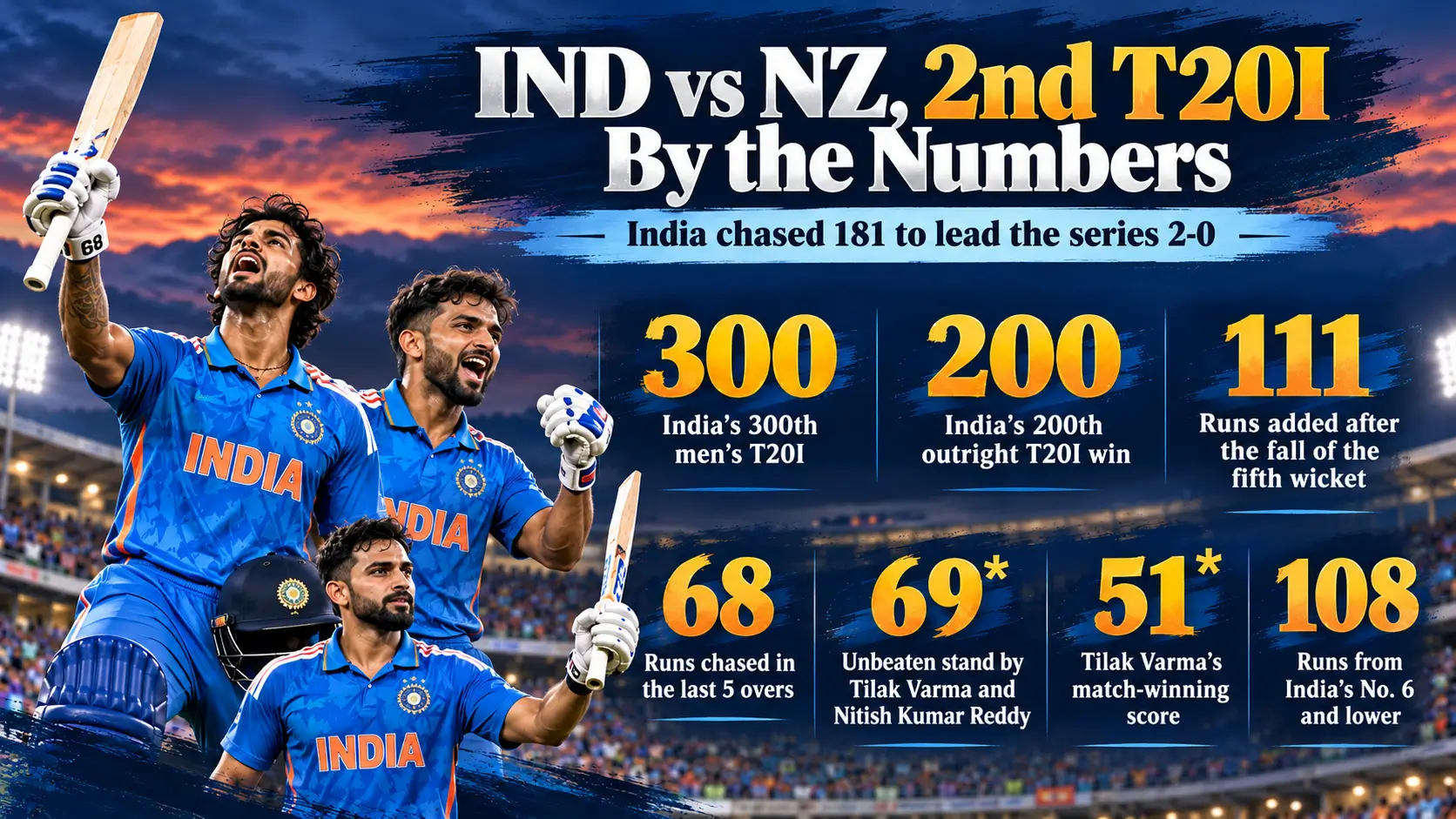
| 2nd T20I · 24 Oct | 180/5 | 181/6 (19.5 ov) | India won by four wickets |
Runs scored: First two T20Is
Score comparison from the two completed matches. Each bar represents a team’s total runs, not a win probability.
Source: match totals provided in the article. India won both matches by four wickets.
India’s first win was a record chase for the men’s team. Set 226 in Christchurch, India rode Sanju Samson’s 67 off 33 balls before Naman Dhir finished with an unbeaten 42 off 15. The visitors reached 230/6 with two deliveries unused. New Zealand had scored heavily but could not protect their advantage.
The second match followed a very different script. On a slower Christchurch surface, India slumped to 70/5 chasing 181. Captain Mitchell Santner claimed 4/21, yet Dhir’s 31 off 17 revived the pursuit. Tilak Varma then struck 51 not out from 26 deliveries, while Nitish Kumar Reddy’s 26 not out from 13 sealed another four-wicket victory.
Both chases revealed India’s range: they can attack on a high-scoring pitch and also recover when wickets fall early. However, the batting collapses are a warning. The top order cannot assume the finishers will rescue the team every time, especially against Santner on a pitch that helps spin.
Wellington Pitch Report: What Can Teams Expect?
Hnry Stadium is a different challenge from Hagley Oval. Wellington’s exposed setting can make wind and the direction of shots important. Seam movement early in an innings and variations of pace may matter, but the amount of assistance will depend on the actual match strip and conditions on Tuesday.
New Zealand captain Mitchell Santner has already stressed that pitches and boundary dimensions change as the series travels around the country. Batters must identify the safer scoring areas rather than assume they can reproduce the boundary rate from Christchurch. Spinners could also influence the middle overs if the surface grips.
Read our detailed India vs New Zealand 2nd T20I Match Analysis to discover how Tilak Varma, Naman Dhir and Nitish Kumar Reddy helped India secure a thrilling victory.
Editorial first-innings guide: around 165–185 could be competitive on a balanced surface, rather than a guaranteed par score. A fresh, hard pitch may support a higher total; appreciable movement or slower bounce may bring lower scores into play. This is a pre-match assessment, not a verified venue average or official pitch forecast.
Will the Toss Matter?
India chased successfully in both Christchurch matches, but Wellington should be judged independently. If conditions suggest later dew and easier batting, fielding first may appeal. If the pitch looks likely to slow down, setting a target could be attractive. The toss call should follow the final surface and weather assessment, not an automatic chasing rule.
Team News: Henry and Ferguson Missing for New Zealand
New Zealand Cricket confirmed on 25 October that Matt Henry will not play the remaining T20Is, while Lockie Ferguson will miss the third match before returning for the last two. Kyle Jamieson is available for Wellington, Blair Tickner joins for the final three games, and Matt Fisher travels as cover for this match only. Josh Clarkson is due to join from the fourth T20I.
Those are significant changes because the hosts have already found it difficult to close out chases. Jamieson’s height and bounce offer a different option, while Tickner and Fisher provide alternatives. The final fast-bowling combination will depend on fitness, workload plans and Tuesday’s pitch.
New Zealand Predicted Playing XI
This is an editorial projection, not an announced XI. It replaces unavailable pacers Henry and Ferguson with Jamieson and Milne. Blair Tickner is a realistic alternative in the pace attack, and the balance could shift if New Zealand decide an extra batting option is needed.
India Predicted Playing XI
India may prefer continuity after two victories, especially because Prince Yadav and Arshdeep Singh bowled useful spells in the second match. The management could still consider Mayank Yadav for additional pace or Varun Chakaravarthy if the wicket points towards greater spin assistance. These options remain speculative until the toss.
Players Who Could Decide the Third T20I
Glenn Phillips: Series batting form
Phillips has scored 152 runs across the first two games, with 82* in the opener and 70 in the second T20I.
Bars use a common scale, with 82 runs as the maximum.
Glenn Phillips: New Zealand’s Main Batting Threat
Phillips has been the most reliable run-maker in the series. His unbeaten 82 from 40 balls in the opener was followed by 70 from 43 in the second game, giving him 152 runs across two innings. He has shown that he can accelerate without sacrificing control.
India’s priority should be to dismiss him before the death overs. Allowing Phillips to bat deep would again give New Zealand a platform from which to produce a challenging total. Good length discipline and thoughtful field placements are more valuable than simply trying to bowl faster.
Mitchell Santner: The Bowler India Must Solve
Santner nearly won the second T20I with 4/21. His changes of flight and pace upset India’s top and middle order, and his control created pressure that eventually produced wickets. If the Wellington pitch offers grip, he could again be the game’s most influential bowler.
India need a clear approach rather than attempting to attack every delivery. Strong strike rotation can prevent Santner from controlling an entire phase of the innings. The batters who negotiate his overs will give the finishers a much better platform.
Tilak Varma, Naman Dhir and Nitish Kumar Reddy: India’s Finishing Core
Tilak’s unbeaten 51 in the second match demonstrated calm under pressure. Dhir has been decisive in both games, scoring 42 not out in the opener and 31 in the next. Reddy’s 26 not out made the difference once the chase reached its final stage.
That depth is why India enter Wellington with a narrow advantage. However, India’s lower order should be a strength rather than an emergency plan. A steadier top-order effort would reduce the need for another extraordinary recovery.
Kyle Jamieson: New Pace Option for the Hosts
Jamieson’s availability is important because New Zealand need fresh solutions at the start and end of an innings. His extra bounce may trouble batters who prefer a predictable length. How effectively he returns to the side will be one of the biggest selection and tactical questions in Wellington.
Three Key Battles to Watch
| Battle | Why it matters |
|---|---|
| Santner vs India’s middle order | His four wickets in the second T20I exposed India’s biggest weakness. |
| Arshdeep Singh vs New Zealand’s openers | Early wickets can stop Allen and Seifert setting the tempo. |
| Jamieson and Duffy vs India’s finishers | New Zealand must protect a target without Henry or Ferguson. |
What New Zealand Must Improve to Win
The hosts have not been outplayed for every phase of the series. Their batting has set two defendable targets, and Santner created a match-winning opening in the second game. Head coach Rob Walter’s concern that his players have not applied the finishing touches reflects the central problem.
For complete batting and bowling statistics, search ESPNcricinfo for the second T20I scorecard.
Fielding is the clearest area for improvement. Several missed catches and a no-ball wicket allowed Indian batters to continue in the second match. New Zealand also need sharper bowling decisions when a partnership begins to swing momentum. Another 15–20 runs saved in the field or at the death could change the result.
What India Must Improve to Seal the Series
India’s resilience is impressive, but two close wins do not remove batting concerns. A collapse to 70/5 in the previous game made a routine chase extremely difficult. Sanju Samson, Abhishek Sharma and Shreyas Iyer will aim to establish a sounder top-order foundation in Wellington.
The seamers also need to restrict Phillips and the other New Zealand batters more consistently. If Arshdeep Singh continues to find early wickets, and the remaining bowlers avoid expensive closing overs, India can make this match less dependent on late hitting.
NZ vs IND 3rd T20I Prediction: Who Will Win?
India have the series momentum and the more convincing finishing performances. New Zealand have home conditions, Glenn Phillips’ outstanding form and Santner’s match-winning ability, but the pace-bowling reshuffle creates added uncertainty. Our editorial pick is India, with a close contest more likely than an easy win.
New Zealand’s best route to victory is to take top-order wickets, hold every realistic catching chance and prevent India’s lower order from controlling the final overs. India’s best route is a stable first ten overs, disciplined bowling to Phillips and another composed finishing effort. The first six overs in both innings could decide which side controls the match.
Frequently Asked Questions
When is the New Zealand vs India 3rd T20I?
The third T20I is scheduled for Tuesday, 27 October 2026.
Where is the third T20I being played?
At Hnry Stadium in Wellington, formerly known as Sky Stadium.
What time does the match start in India?
The scheduled start is 12:30 pm IST, corresponding to 8:00 pm in Wellington.
Who is leading the T20I series?
India lead the five-match series 2–0 after winning both games in Christchurch by four wickets.
Will Matt Henry or Lockie Ferguson play the third T20I?
No. New Zealand Cricket confirmed that Henry is out of the remaining T20Is and Ferguson will miss the Wellington match.
Will Kyle Jamieson play against India in Wellington?
He is available for selection, according to New Zealand Cricket. His inclusion in the final XI is subject to team selection.
Who is the strongest candidate to decide the game?
Glenn Phillips and Mitchell Santner are New Zealand’s standout threats. Tilak Varma and Naman Dhir have been important finishers for India.
Who is predicted to win the third T20I?
Our editorial prediction gives India a slight edge, but this is a judgement rather than a statistical probability or a guaranteed outcome.
Final Verdict
The third T20I is about finishing the job. India have twice shown that they can recover from difficult positions, while New Zealand have twice failed to convert strong opportunities. Wellington offers a new pitch, altered boundaries and a fresh contest, but New Zealand’s pace changes may make the home side’s challenge harder.
India are our narrow favourites to win in Wellington and secure the series 3–0. Still, if Phillips produces another major innings and Santner receives better support in the field, the hosts have a realistic chance to pull one back. Expect a contest shaped by early wickets, catching quality and death-over execution.
Editorial note: Predicted XIs, pitch expectations and the match verdict are pre-match assessments, not confirmed team announcements or guaranteed results.