
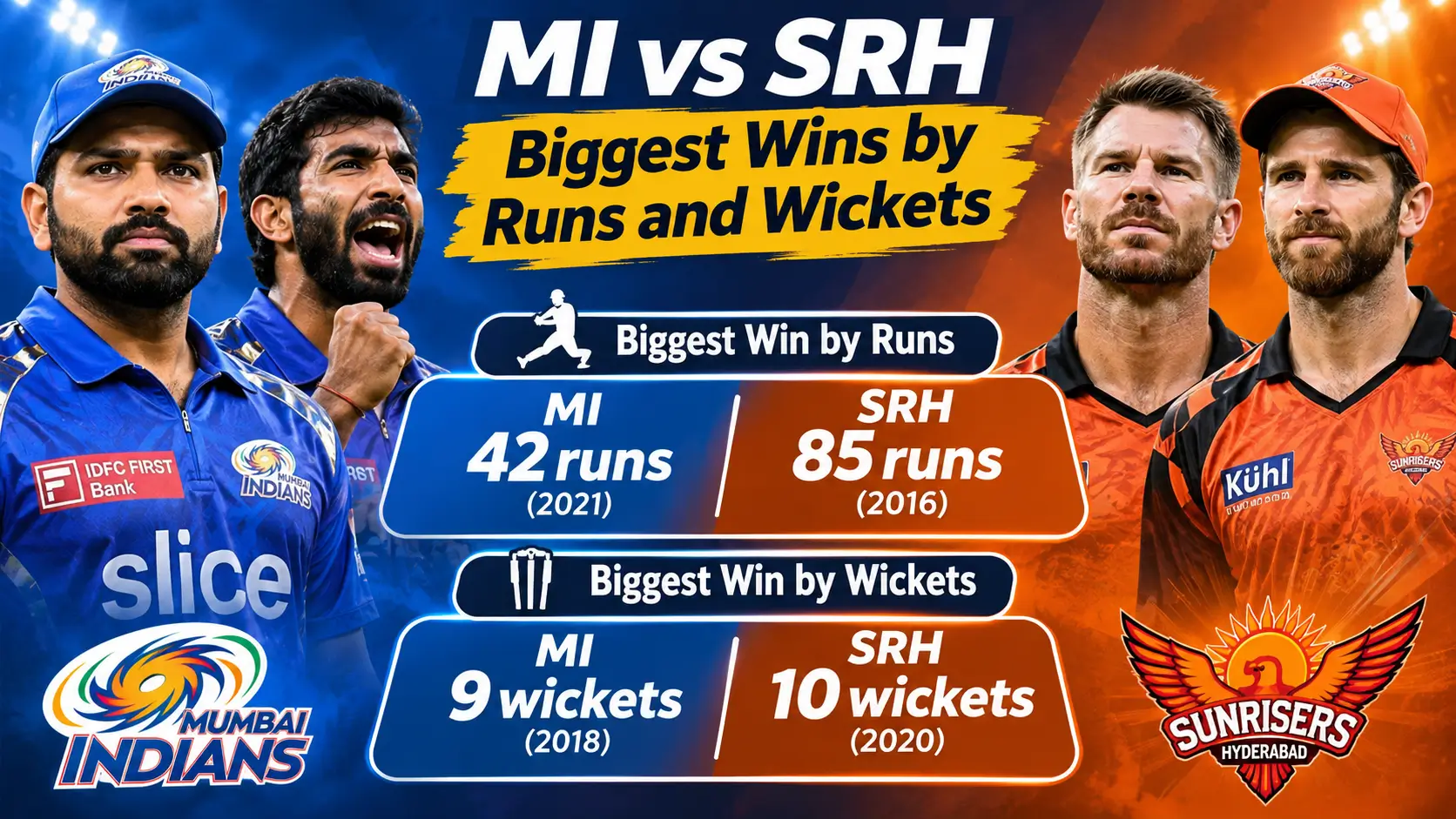
The margins alone do not tell the full story. Hyderabad defended 177 with a ruthless bowling display in 2016, but completed the 2020 chase without losing a wicket. Mumbai, meanwhile, defended a huge score in 2021 and made a modest target look easy in 2015. The matches offer four different ways of winning decisively.
MI vs SRH Biggest Wins: Records at a Glance
The following table separates wins by runs from wins by wickets. These are two distinct measures. A side batting first wins by runs when it defends its total; a chasing side wins by wickets according to how many batters remain undismissed. There is no fair way to convert a nine-wicket chase into an equivalent run margin.
| Winning side | Margin | Date | Venue | Innings scores |
|---|---|---|---|---|
| SRH | 85 runs | 8 May 2016 | Visakhapatnam | SRH 177/3; MI 92 all out |
| MI | 42 runs | 8 Oct 2021 | Abu Dhabi | MI 235/9; SRH 193/8 |
| SRH | 10 wickets | 3 Nov 2020 | Sharjah | MI 149/8; SRH 151/0 |
| MI | 9 wickets | 17 May 2015 | Hyderabad | SRH 113; MI 114/1 |
The difference between the two teams is striking. Hyderabad have the rivalry’s highest run-margin victory and its only 10-wicket victory. Mumbai’s greatest run-margin win came in an exceptionally high-scoring match, while its biggest wicket-margin win followed one of Hyderabad’s poorest batting displays. A reader comparing these results should always check the target, overs used, and wickets lost.
SRH’s Biggest Win by Runs: 85 Runs in IPL 2016
On 8 May 2016, Sunrisers Hyderabad produced the most one-sided win by runs in this rivalry at the ACA-VDCA Cricket Stadium in Visakhapatnam. Hyderabad scored 177/3, with Shikhar Dhawan batting through the innings for an unbeaten 82. Mumbai collapsed to 92 all out in 16.3 overs. The difference was 85 runs, which remains the largest run-margin result between these teams through 2026.
Dhawan gave Hyderabad a score worth defending
Dhawan’s 82 not out from 57 balls was the platform. David Warner contributed 48, while Yuvraj Singh’s 39 from 23 balls gave the innings late energy. A total of 177 was strong rather than unreachable, and it offered Mumbai room to build a chase with sensible batting. Hyderabad’s bowlers removed that option quickly.
What turned a solid batting effort into a record margin was the way Hyderabad attacked. Ashish Nehra dismissed key batters early and finished with three wickets for 15 runs. Mustafizur Rahman also claimed three for 16, while Barinder Sran took two. Their changes of pace and accurate lengths prevented partnerships from developing.
IPL enthusiasts looking for more cricket-related information can explore an Online Cricket ID and learn about the features and terms offered by online platforms.
Why Mumbai’s collapse was so severe
Mumbai did not merely fall short of a demanding asking rate. They lost wickets so frequently that there was no settled pair to manage the chase. Dot balls increased the pressure, and batters looking for a release shot were exposed. The final score of 92 made the result look like a mismatch even though Hyderabad had not crossed 200.
The lesson is that a big victory margin can be created by the fielding side, not just the batting side. SRH’s bowlers transformed 177/3 into an 85-run win. The same tactic has featured in other meetings, but few spells have combined early strikes with sustained control as effectively as this one.
MI’s Biggest Win by Runs: 42 Runs in IPL 2021
Mumbai’s record run-margin victory over Hyderabad arrived in a very different match on 8 October 2021 in Abu Dhabi. MI posted 235/9 and restricted SRH to 193/8. The 42-run margin was considerable, but the batting totals were far higher than in the 2016 match. This time the winner was established mainly by an explosive first innings and enough control during the chase.
Ishan Kishan and Suryakumar Yadav set the pace
Ishan Kishan attacked from the beginning and scored 84 from only 32 balls. He reached fifty from 16 deliveries, putting the bowling side under immediate pressure. Suryakumar Yadav later kept the attack alive with 82 from 40 balls, using placement and clean hitting to prevent SRH from recovering fully after taking wickets.
For context, Mumbai required an extraordinarily large win to stay in the playoff race. That urgency was clear in the batting approach. They accepted the risk of losing nine wickets because they needed as many runs as possible. The end result was an unusual scorecard: 235 runs, but only one wicket in hand.
Hyderabad’s chase was not a collapse of the kind seen in 2016. Manish Pandey scored 69, and the team reached 193/8. Yet the target was 236, which demanded a scoring rate close to 12 an over. When wickets fell during the middle phase, the chase needed even more boundaries. Mumbai preserved a 42-run advantage despite conceding almost 200.
To compare the two innings in more detail, the site’s complete MI vs SRH match scorecards bring the results together across the rivalry. They help show that a large winning margin can emerge from a very high target or from an ordinary target defended with exceptional bowling.
SRH’s Biggest Win by Wickets: 10 Wickets in IPL 2020
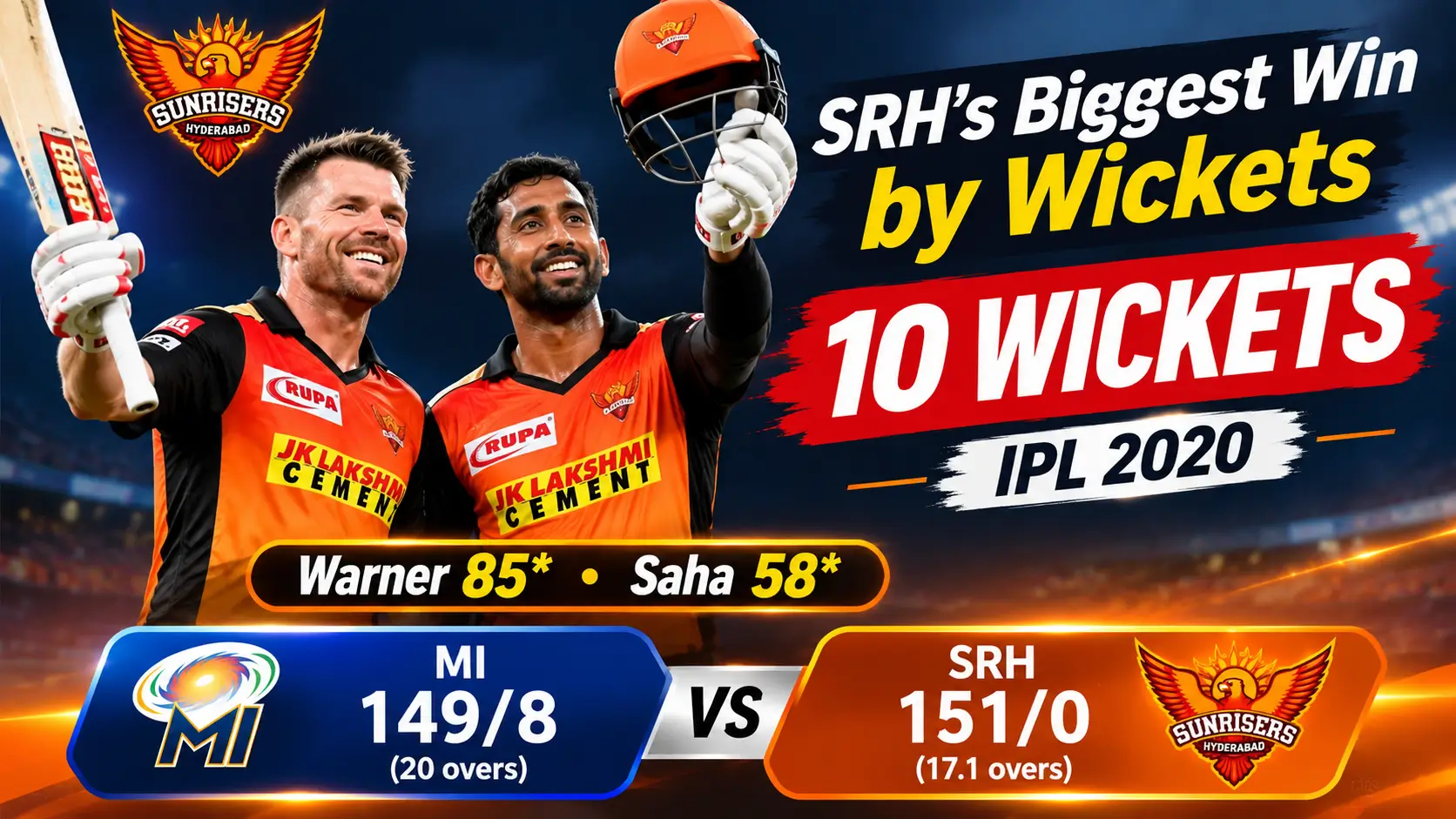
On 3 November 2020 at Sharjah, Sunrisers Hyderabad achieved the most complete chase in the history of this matchup. Mumbai scored 149/8, and SRH reached 151/0 in 17.1 overs. David Warner finished unbeaten on 85, and Wriddhiman Saha remained 58 not out. There was no dismissal, so the official margin was ten wickets.
Warner and Saha never allowed the chase to wobble
The opening pair did not need an extreme run rate. They still made sure the required rate remained comfortable by taking opportunities against both pace and spin. SRH had 56 on the board after the powerplay and 89 without loss after ten overs. By the time the century stand arrived, Mumbai had very few ways to turn the game. The setup came from their bowlers, and the wider record of best bowling figures in MI vs SRH matches shows why those early breakthroughs matter in this rivalry.
The final partnership was 151 unbeaten. Warner provided the larger innings, but Saha’s 58 was central to keeping the bowlers from focusing only on one end. When a chase reaches its target without losing a wicket, there has been no middle-order test at all. The opening batters solve the game themselves.
This result also had major tournament meaning. Hyderabad’s win secured a playoff spot. It was not a meaningless final league match, and that made the controlled chase more impressive. Mumbai had already performed strongly that season, but SRH’s opening stand gave them almost no opening to fight back.
MI’s Biggest Win by Wickets: Nine Wickets in IPL 2015
Mumbai’s record chase by wicket margin came on 17 May 2015 in Hyderabad. Sunrisers were bowled out for 113, and Mumbai reached 114/1 in 13.5 overs to win by nine wickets. It was a crucial late-season fixture, with both teams fighting for qualification. Mumbai handled the occasion by taking control in the first innings.
Early wickets made the difference
Lasith Malinga removed Shikhar Dhawan, while Mitchell McClenaghan dismissed David Warner. SRH slipped to 7/2, an especially damaging position in a contest where the opening pair carried much of the batting responsibility. McClenaghan eventually finished with 3/16, and Malinga returned 2/17. The rest of the attack kept the pressure on the middle order.
Hyderabad never built enough momentum to reach a competitive total. A target of 114 left Mumbai free to choose their shots, protect wickets and run down the score without forcing the pace. There was no need for a reckless powerplay or a rescue act late in the innings.
Parthiv Patel scored an unbeaten 51, with Lendl Simmons adding 48. They formed the opening partnership that effectively settled the contest. Mumbai lost only Simmons, then completed the chase in the 14th over. A nine-wicket win with more than six overs to spare combined security with speed.
The bowling story matters as much as the chase. Decisive spells such as McClenaghan’s in 2015 and Alzarri Joseph’s extraordinary 2019 performance show how a record margin often begins with a handful of well-timed wickets.
Other One-Sided MI vs SRH Results Worth Remembering
The four absolute records are the headline figures, but several other matches explain how this rivalry has changed. Some were comfortable chases of large targets; others were low-scoring games where wickets decided the result. Looking at both types helps avoid the mistaken idea that the biggest team score always produces the biggest win.
| Season | Winner | Result | Match context |
|---|---|---|---|
| 2019 | MI | 40 runs | MI 136/7, SRH 96 all out; Joseph 6/12 |
| 2020 | MI | 34 runs | MI 208/5, SRH 174/7 |
| 2023 | MI | 8 wickets | MI chased 201; Cameron Green 100* |
| 2024 | SRH | 31 runs | SRH 277/3, MI 246/5 |
| 2024 | MI | 7 wickets | MI chased 174; Suryakumar 102* |
| 2025 | MI | 7 wickets | SRH 143/8, MI 146/3 |
| 2026 | SRH | 6 wickets | SRH chased 244 at Wankhede |
Joseph’s six-wicket burst in 2019
Mumbai defended only 136/7 in Hyderabad on 6 April 2019. Alzarri Joseph, on IPL debut, took 6/12 and dismissed SRH for 96. The 40-run margin was unusually large for a team defending fewer than 140. It also proved that an exceptional bowling spell can be more valuable than a towering total. His figures remain among the greatest single-match bowling performances in IPL history.
Green’s century turned a 200-run chase into an easy win
On 21 May 2023, Hyderabad posted 200/5 at Wankhede. Mumbai reached 201/2 in 18 overs, winning by eight wickets. Cameron Green smashed an unbeaten 100 from 47 balls, while Rohit Sharma made 56. A target of 201 should normally bring serious pressure, but the power of their partnership changed the game. The margin was eight wickets even though the target was large.
The 2024 run-fest was not a record margin
SRH’s 277/3 against Mumbai in March 2024 remains the highest innings in the matchup through 2026. Yet MI replied with 246/5 and lost by only 31 runs. Both teams produced remarkable hitting, so the record total did not translate into a record winning margin. Hyderabad won because their innings was better, not because Mumbai failed badly with the bat.
The reverse meeting in May 2024 gave Mumbai a seven-wicket victory, powered by Suryakumar Yadav’s unbeaten 102. Those contrasting results show how much individual performance can influence a match without changing either team’s largest historical margin.
What the 2025 and 2026 Matches Add to the Record
The most recent meetings help put the older records in perspective. In April 2025 Mumbai won both games against Hyderabad. The second, in Hyderabad, finished with MI on 146/3 after SRH had managed 143/8. Trent Boult’s 4/26 was central to limiting the target. Mumbai won by seven wickets in 15.4 overs, a decisive result even though it did not challenge the nine-wicket record.
Earlier that season, MI won at Wankhede by four wickets while chasing 163. That was a more uneven chase, not a record-margin win. It illustrates why two victories in the same year can tell very different stories. The scoreline alone cannot explain whether the bowling or batting phases were most impressive.
On 29 April 2026, Sunrisers scored 249/4 in 18.4 overs to defeat Mumbai’s 243/5 by six wickets. The high-scoring chase was spectacular, but SRH lost four wickets, so the margin remained well below their ten-wicket landmark from 2020. Once again, a huge total did not automatically produce the largest margin.
These results reinforce a useful rule for reading IPL statistics: separate score records, wicket-margin records and run-margin records. A chase may be fast, high-scoring and comfortable without being the biggest victory by wickets. A low total may be defended by a wide run margin if the bowling side takes wickets rapidly.
What Do the Biggest Winning Margins Tell Us?
Bowling can make modest scores decisive
SRH’s 2016 win and Mumbai’s 2019 defence both rested on wickets. In one, the target was 178 and MI were dismissed for 92. In the other, MI defended just 137 because Joseph dismantled the batting order. The common feature was not raw pace alone. It was the ability to attack the stumps, change lengths and prevent a stable partnership.
Partnerships are the engine of big wicket-margin wins
SRH’s Warner–Saha opening stand in 2020 and MI’s Patel–Simmons partnership in 2015 removed the tension from their chases. A batting side that keeps its first two players at the crease can maintain a simple plan. There is less pressure on the middle order, and every over passed without a wicket increases the chasing team’s control.
Venue helps, but it does not decide the outcome
Some major results occurred on home grounds, while others happened at neutral venues in the UAE. Hyderabad’s 85-run win came in Visakhapatnam and its ten-wicket chase in Sharjah. Mumbai’s 42-run win came in Abu Dhabi, whereas its nine-wicket victory happened away in Hyderabad. The venue is part of the story, but the decisive performances came from individual batters, bowlers and partnerships.
Do wickets or runs show a more dominant victory?
Neither format of margin is universally more meaningful. An 85-run victory means the defending team scored 85 more than the opponent. A ten-wicket win means every batter in the chasing side remained available. The most useful comparison combines the margin with the target, wickets lost, balls unused and the balance of the match. That fuller view explains why these four records deserve separate categories.
Frequently Asked Questions
What is the biggest win by runs in MI vs SRH history?
Sunrisers Hyderabad beat Mumbai Indians by 85 runs at Visakhapatnam on 8 May 2016. SRH made 177/3 and dismissed MI for 92.
What is Mumbai Indians’ biggest win by runs against SRH?
Mumbai won by 42 runs in Abu Dhabi on 8 October 2021. MI scored 235/9 and restricted Hyderabad to 193/8.
What is the largest victory by wickets in MI vs SRH?
SRH won by ten wickets in Sharjah on 3 November 2020. Warner and Saha chased Mumbai’s target of 150 without losing a wicket.
When did MI beat SRH by nine wickets?
Mumbai achieved that result on 17 May 2015 in Hyderabad. MI dismissed SRH for 113 and reached 114/1 in 13.5 overs.
Did SRH’s 277/3 lead to the biggest run-margin win?
No. Hyderabad scored 277/3 against MI in 2024, but Mumbai replied with 246/5. The difference was 31 runs, much smaller than SRH’s 85-run victory in 2016.
Which bowler helped MI win by 40 runs in 2019?
Alzarri Joseph took six wickets for 12 runs on 6 April 2019. His spell helped MI defend 136/7 and bowl out SRH for 96.
Final Word: MI vs SRH Biggest Wins
The MI vs SRH biggest wins are defined by four distinct records. Hyderabad’s 85-run victory in 2016 is the widest run margin, and its ten-wicket chase in 2020 is the most complete wicket-margin result. Mumbai’s best figures are a 42-run win in 2021 and a nine-wicket victory in 2015.
These numbers capture the changing nature of the rivalry. One decisive night can be built around a brilliant bowling spell, another around a relentless opening stand, and a third around the speed of a high-pressure chase. When comparing famous matches, check both the margin and how the teams reached it. That is what separates a large victory from a truly dominant performance.