
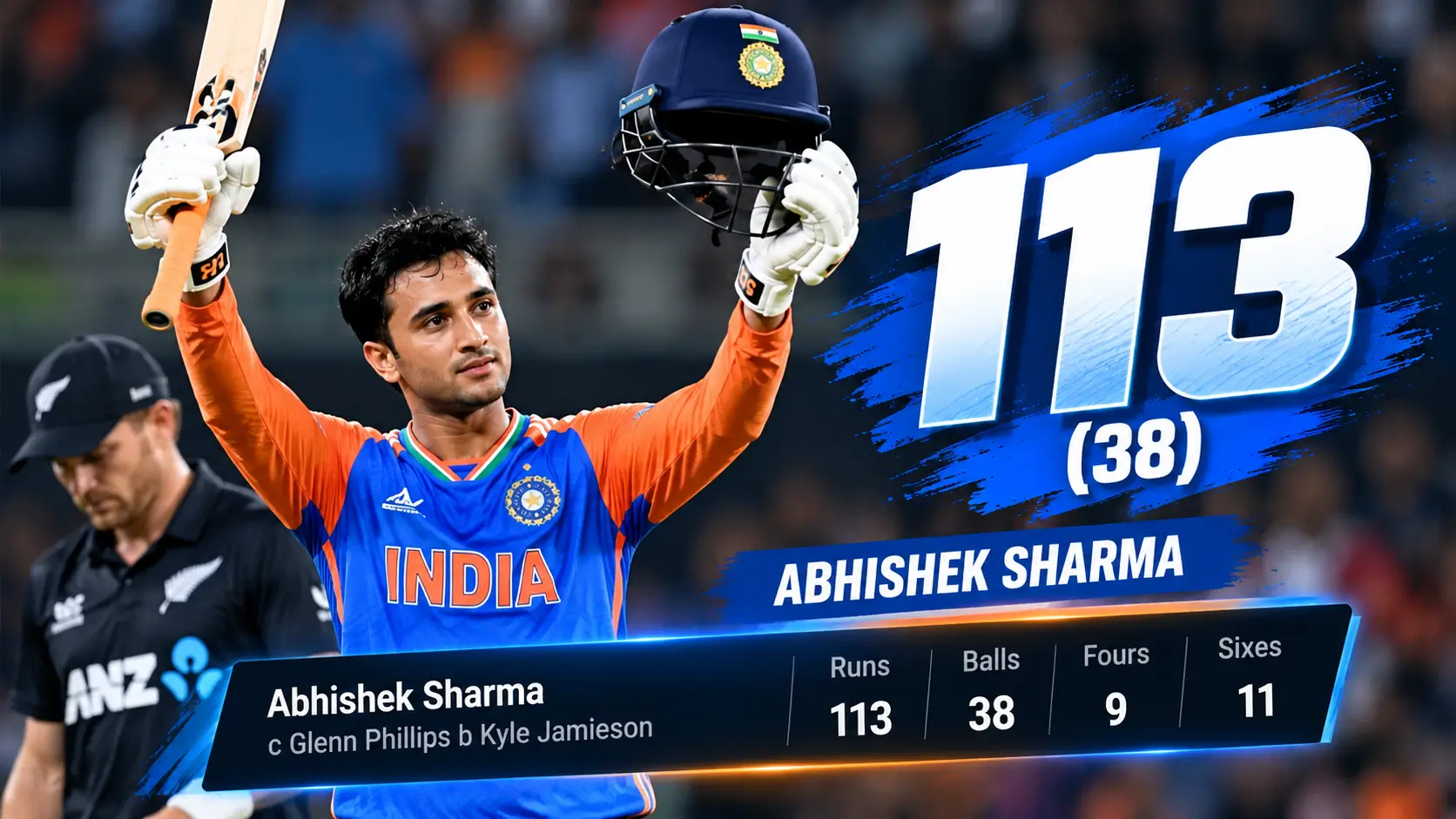
Abhishek Sharma smashed 113 runs from just 38 balls against New Zealand in the third T20I at Wellington on 27 October 2026. The Indian batter reached his century in only 35 balls, hitting nine fours and 11 sixes. It was his fourth T20 international hundred. His explosive innings put India close to chasing New Zealand’s total of 198/3 and securing the five-match series.
India entered the match with a 2–0 lead after winning the first two T20Is in Christchurch. New Zealand needed a victory to keep the series alive. Daryl Mitchell’s unbeaten 89 helped the hosts reach a strong total. However, Abhishek’s powerful batting quickly changed the direction of the match.
Abhishek Sharma’s 113 Off 38 Balls: Full Batting Scorecard
Abhishek played one of his most aggressive T20I innings in Wellington. He attacked the bowlers from the beginning and reached his half-century in only 15 deliveries. He continued scoring quickly and completed his hundred from 35 balls. His final score was 113 before Kyle Jamieson dismissed him.
| Batting record | Performance |
|---|---|
| Batter | Abhishek Sharma |
| Runs | 113 |
| Balls faced | 38 |
| Fours | 9 |
| Sixes | 11 |
| Strike rate | 297.37 |
| Balls to reach fifty | 15 |
| Balls to reach hundred | 35 |
| T20I centuries | 4 |
| Dismissal | c Glenn Phillips b Kyle Jamieson |
Abhishek scored 102 of his 113 runs through boundaries. His nine fours brought 36 runs, while 11 sixes added another 66. Only 11 runs came through other scoring shots. These numbers show how strongly he attacked New Zealand’s bowling.
Boundary runs: 102 of 113 (90.3%). Calculated from the nine fours and 11 sixes in the scorecard.
His strike rate of 297.37 means he scored almost three runs per ball. Maintaining that pace for 38 deliveries is a remarkable achievement. The innings gave India a major advantage during a difficult run chase.
How Abhishek Sharma Reached His 35-Ball Century
Abhishek began his innings with attacking intent. He looked for boundaries whenever New Zealand’s bowlers missed their line or length. Instead of allowing the required run rate to rise, he kept putting pressure on the fielding side. His fast scoring helped India stay ahead of the chase.
The left-handed batter reached 50 runs from only 15 balls. He used powerful strokes on both sides of the wicket. The New Zealand bowlers struggled to find a way to slow him down. Even changes in bowling failed to stop his aggressive approach.
Abhishek needed another 20 deliveries to move from fifty to hundred. He reached the landmark with a top-edged pull against Kyle Jamieson. Rather than slowing down after his century, he hit the next two balls for consecutive sixes. These shots showed his confidence against the New Zealand pace attack.
However, his innings ended on the final ball of the over. Abhishek attempted another attacking shot but failed to connect cleanly. Glenn Phillips completed the catch at deep midwicket off Jamieson’s bowling. The Indian batter departed with 113 runs from 38 balls.
India vs New Zealand 3rd T20I: Match Summary

New Zealand scored 198/3 after India won the toss and chose to bowl. The hosts recovered from an early wicket through important partnerships. Daryl Mitchell led the innings with an unbeaten 89 from 52 balls. India then began an aggressive chase, led by Abhishek Sharma and Vaibhav Sooryavanshi.
| Match detail | Information |
|---|---|
| Match | New Zealand vs India, 3rd T20I |
| Date | 27 October 2026 |
| Stadium | Hnry Stadium, Wellington |
| Toss | India chose to bowl |
| New Zealand score | 198/3 (20 overs) |
| India’s target | 199 runs |
| Abhishek Sharma | 113 (38) |
| Vaibhav Sooryavanshi | 45 (19) |
| Daryl Mitchell | 89 not out (52) |
| Series before match | India led 2–0 |
India needed 199 runs to win the third T20I. Abhishek’s innings gave the visiting side a very strong position. By the time he was dismissed, India had reached 178/2 after ten overs. The target was already within reach.
Vaibhav Sooryavanshi Scores 45 Off 19 Balls
Abhishek was not the only Indian batter to attack New Zealand. Young Vaibhav Sooryavanshi scored 45 runs from just 19 balls. His quick batting helped India build early momentum. Together, the aggressive performances put the hosts under pressure.
Sooryavanshi struck four boundaries and four sixes during his innings. He scored at a strike rate of 236.84. His attacking shots helped India score rapidly in the powerplay. The strong start made the large target look much easier.
Matthew Fisher dismissed Sooryavanshi after Daryl Mitchell completed the catch. However, the opening period had already given India a major advantage. Abhishek continued the attack after his teammate’s departure. New Zealand struggled to recover from the early damage.
Cricket fans who follow IPL matches may also explore an Online Cricket ID and review the terms and features of online platforms before using them.
Bars compare runs scored, not strike rates. Figures are taken from the article’s match scorecard.
Daryl Mitchell’s Unbeaten 89 Helps New Zealand Reach 198/3
Before Abhishek’s century, Daryl Mitchell played an important innings for New Zealand. The experienced batter scored an unbeaten 89 from 52 balls. His performance included five fours and five sixes. It helped the hosts recover from a difficult start.
New Zealand lost an early wicket with only six runs on the scoreboard. The team needed someone to build a stable partnership. Finn Allen responded with 40 runs from 25 balls. Mitchell also began attacking and helped turn the innings around.
Allen’s dismissal gave India another opportunity to control the game. However, Mitchell remained at the crease and continued scoring. He used both powerful shots and careful running to keep the scoreboard moving. His unbeaten innings carried New Zealand to 198/3 after 20 overs.
A target of 199 usually creates pressure in a T20 match. New Zealand had enough runs to challenge India if their bowlers started well. However, Abhishek’s aggressive response changed the situation quickly.
Why Abhishek Sharma’s Fourth T20I Century Matters
Abhishek’s hundred against New Zealand was the fourth of his T20 international career. Reaching four centuries in the shortest international format is a major batting achievement. It shows his ability to turn good starts into match-changing innings. His latest century also came during an important overseas series.
The 35-ball hundred was especially impressive because India were chasing a challenging target. Abhishek could not simply bat slowly and wait for loose deliveries. The required run rate demanded regular boundaries. He responded by attacking almost every bowler.
His innings also showed the value of batting freely during the powerplay. When a team scores quickly in the opening overs, the remaining batters face less pressure. Abhishek and Sooryavanshi gave India that advantage. Their performances made the chase far more manageable.
How India’s Batting Put New Zealand Under Pressure
New Zealand’s bowlers faced an extremely difficult challenge. They needed to defend 198 runs against an Indian batting line-up that started strongly. Abhishek’s aggressive shots gave them little room for mistakes. Even good deliveries could disappear to the boundary.
Jacob Duffy, Adam Milne, Michael Bracewell, Matthew Fisher and Kyle Jamieson were among the bowlers used by New Zealand. Mitchell Santner also tried to control the scoring through spin. However, the visiting batters continued finding boundaries. New Zealand could not build enough pressure during the early overs.
Abhishek’s dismissal gave the hosts a small opening. Yet India were already close to the target when he departed. Sanju Samson and captain Shreyas Iyer were the next batters at the crease. India’s strong position showed the impact of the earlier batting attack.
India’s 2–0 Series Lead Before the Wellington T20I
India arrived in Wellington after winning both opening T20Is in Christchurch. The visitors won the first match on 22 October by four wickets They followed it with another four-wicket victory on 24 October. Those results gave India control of the five-match series.
The second T20I was particularly close. New Zealand scored 180/5, and India reached 181/6 with one ball remaining. Tilak Varma contributed an unbeaten half-century to guide the chase. Nitish Kumar Reddy also played an important supporting role.
The third match therefore carried significant importance for both teams. India had the opportunity to secure an unbeatable series lead. New Zealand needed a win to keep the contest alive. Abhishek’s century put India in a commanding position during that crucial game.
Abhishek Sharma Century vs New Zealand: Key Highlights
- Abhishek scored 113 runs from 38 balls at a strike rate of 297.37.
- He reached his fifty in 15 balls and his hundred in 35 balls.
- His innings included nine fours and 11 sixes.
- The century was his fourth in T20 internationals.
- Kyle Jamieson dismissed him, with Glenn Phillips taking the catch.
- Vaibhav Sooryavanshi also scored a rapid 45 from 19 deliveries.
- India were chasing New Zealand’s 198/3 in the third T20I.
Frequently Asked Questions
How many runs did Abhishek Sharma score against New Zealand?
Abhishek Sharma scored 113 runs from 38 balls in the third T20I at Wellington on 27 October 2026. His innings included nine fours and 11 sixes.
How many balls did Abhishek Sharma take to complete his century?
Abhishek completed his hundred in 35 deliveries. He had earlier reached his half-century in only 15 balls.
How many sixes did Abhishek Sharma hit?
Abhishek struck 11 sixes during his 113-run innings. He also hit nine fours.
What was Abhishek Sharma’s strike rate?
His strike rate was 297.37. This means he scored almost three runs for every ball faced.
Who dismissed Abhishek Sharma?
Kyle Jamieson dismissed Abhishek Sharma for 113. Glenn Phillips took the catch at deep midwicket.
How many T20I centuries has Abhishek Sharma scored?
His century against New Zealand was the fourth of his T20 international career.
What was New Zealand’s score in the third T20I?
New Zealand scored 198/3 from 20 overs. Daryl Mitchell was the top scorer with an unbeaten 89.
How many runs did Vaibhav Sooryavanshi score?
Vaibhav Sooryavanshi scored 45 runs from 19 balls. His innings included four fours and four sixes.
Conclusion: Abhishek Sharma’s Century Dominates the Wellington T20I
Abhishek Sharma’s 113 from 38 balls was the standout batting performance of the third T20I in Wellington. His 35-ball hundred, 11 sixes and fearless approach made a target of 199 look manageable. Vaibhav Sooryavanshi also played an important part with his fast 45. Together, the Indian batters placed New Zealand under enormous pressure.
The innings showed why Abhishek has become such an important player in India’s T20 batting line-up. He can score quickly from the start and turn a challenging chase into an attacking contest. His fourth T20I century will be remembered for its speed and power. It was another major performance in his growing international career.