
India’s dominance in T20 international cricket represents one of the most impressive achievements in modern cricket history. From winning the inaugural ICC Men’s T20 World Cup in 2007 to successfully defending the championship in 2026, Team India has emerged as a powerhouse of international T20 cricket.
The Indian cricket team’s T20 success is built on explosive batting, quality bowling, tactical leadership, emerging talent, and exceptional performances under pressure. India’s ability to adapt to different conditions and produce new match-winners has made it one of the strongest sides in the shortest international format.
India’s historic victory over New Zealand in the ICC Men’s T20 World Cup 2026 final further strengthened its reputation. India scored 255/5 and defeated New Zealand by 96 runs to claim a record third men’s T20 World Cup title.
In this detailed analysis, we explore the top 10 reasons behind India’s domination in T20 cricket, including T20I records, World Cup achievements, batting statistics, bowling strengths, and future challenges.
India T20 International Records and Achievements
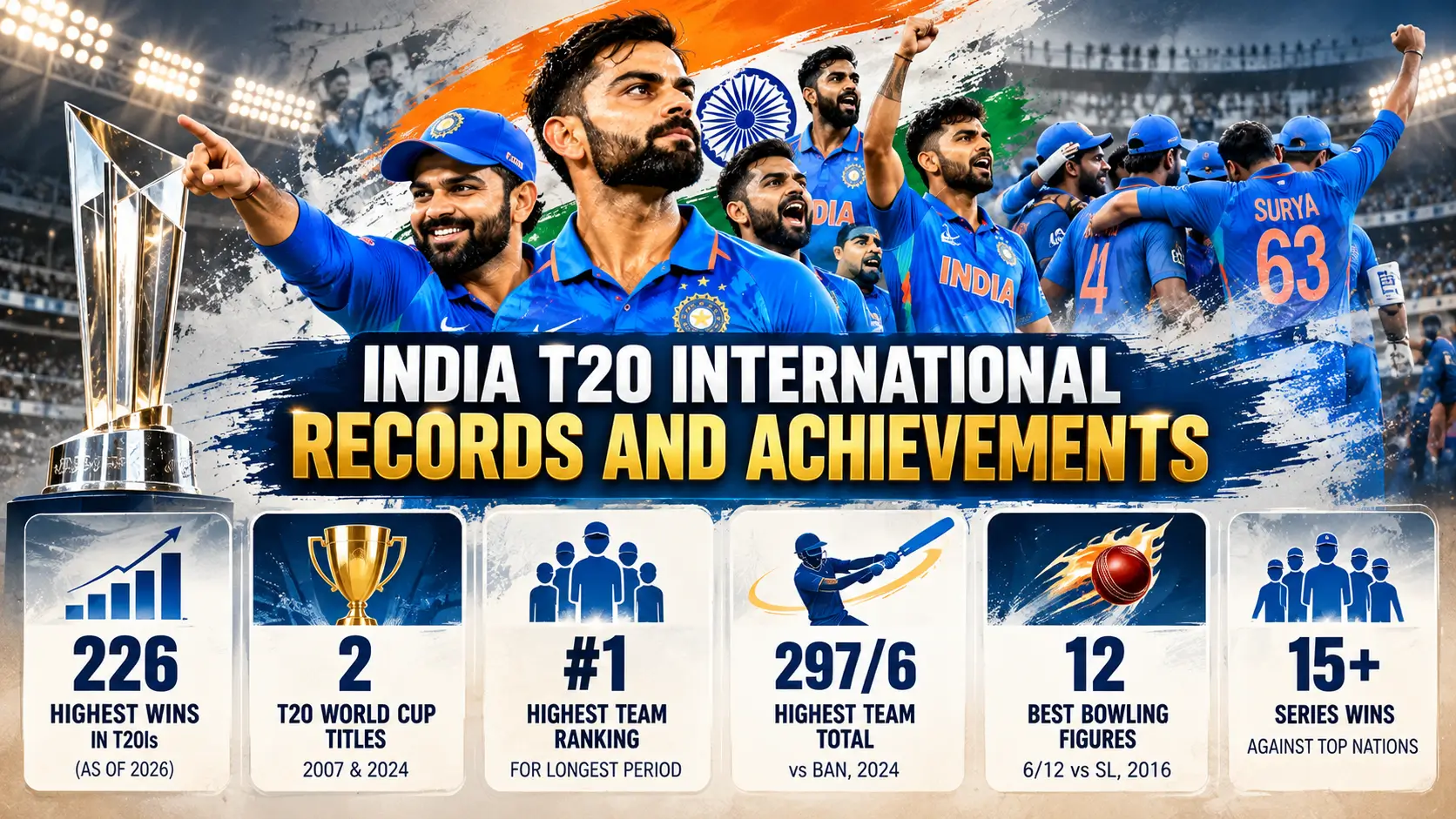
Before discussing why India dominates T20 cricket, here are some of the most important India T20I statistics and achievements.
| Achievement | India’s Record |
|---|---|
| Men’s T20 World Cup Titles | 3 (2007, 2024, 2026) |
| Consecutive T20 World Cup Titles | 2024 and 2026 |
| Highest T20I Team Score | 297/6 vs Bangladesh (2024) |
| 2026 World Cup Final Score | 255/5 vs New Zealand |
| 2026 Final Winning Margin | 96 runs |
| 2026 Player of the Tournament | Sanju Samson |
| 2024 World Cup Campaign | 8 wins, unbeaten |
1. India’s Three ICC T20 World Cup Titles
The biggest reason behind India’s supremacy in T20 international cricket is its extraordinary success in ICC tournaments.
India won its first T20 World Cup in 2007 under MS Dhoni, defeating Pakistan by five runs in a memorable final. This victory established India as an early leader in the shortest format.
In 2024, Rohit Sharma guided India to a second championship after defeating South Africa by seven runs. The triumph ended India’s long wait for another men’s T20 World Cup title.
Under Suryakumar Yadav, India successfully defended the trophy in 2026 by defeating New Zealand. India became the first men’s team to win three T20 World Cups and the first to successfully defend the title.
Graph 1: India’s Cumulative T20 World Cup Titles
ICC Men’s T20 World Cup Titles
2007 — 1 Title
2024 — 2 Titles
2026 — 3 Titles
The chart shows India’s cumulative championship count at each winning edition.
2. India’s Explosive T20 International Batting Lineup
One of the defining features of India’s T20I dominance is its powerful batting lineup. Modern Indian batters focus on attacking from the beginning rather than waiting until the final overs.
Players such as Suryakumar Yadav, Sanju Samson, Abhishek Sharma, Tilak Varma, and Ishan Kishan have provided aggressive batting options capable of changing matches quickly.
India’s 297/6 against Bangladesh in Hyderabad in October 2024 was a remarkable example of this approach. Sanju Samson scored a century as India overwhelmed the opposition bowlers.
India also registered 283/1 against South Africa in Johannesburg in November 2024, with Sanju Samson and Tilak Varma scoring unbeaten hundreds.
These Indian cricket team T20 batting records demonstrate how rapidly the team’s scoring capabilities have evolved.
Graph 2: India’s Highest Selected T20I Team Totals
Notable India T20I Innings (Runs)
Bangladesh (2024) — 297
South Africa (2024) — 283
New Zealand (January 2026) — 271
Zimbabwe (2026) — 256
New Zealand (World Cup Final 2026) — 255
Selected notable innings. Bar lengths are proportional to the highest score of 297 runs.
3. Jasprit Bumrah and India’s Powerful T20 Bowling Attack
India’s success is not dependent entirely on aggressive batting. The quality of its bowling attack is another major factor behind Team India’s T20 international achievements.
Jasprit Bumrah is widely recognized for his accuracy, yorkers, pace variations, and effectiveness in high-pressure situations. His ability to take wickets and restrict scoring across different phases makes him especially valuable.
Arshdeep Singh provides left-arm pace and useful powerplay bowling, while Axar Patel and Varun Chakaravarthy offer spin options with different styles.
During the 2026 T20 World Cup final, Bumrah took 4/15 against New Zealand, helping India defend 255/5 and secure a convincing victory.
This combination of specialist pace bowlers and attacking spinners allows India to adapt its strategy according to pitch conditions and opposition strengths.
4. Strong Bench Strength and Emerging T20 Cricket Talents
Another important reason for India’s dominance in international T20 cricket is the depth of talent available throughout the country.
India can introduce new players without completely rebuilding its batting or bowling strategy. Domestic competitions and the IPL have helped develop several promising cricketers who are prepared for high-pressure environments.
Sanju Samson’s performance in the 2026 T20 World Cup demonstrated the importance of squad depth. After initially being outside the regular playing XI, Samson became a central figure in India’s successful campaign.
He finished with 321 runs in five innings and received the Player of the Tournament award.
India’s selection system benefits from having numerous options for opening batters, middle-order players, wicketkeepers, all-rounders, fast bowlers, and spinners.
Such depth gives India a competitive advantage during long tournaments, especially when player fitness, conditions, or individual form create unexpected challenges.
5. Aggressive Captaincy and Smart T20 Leadership
Leadership has played an essential role in the evolution of the Indian T20 cricket team.
MS Dhoni laid the foundation with his calm tactical approach during the 2007 T20 World Cup. His decision-making and ability to trust younger players proved crucial.
Rohit Sharma helped redefine India’s batting mentality by encouraging attacking cricket from the beginning of an innings.
Suryakumar Yadav continued this approach during India’s successful 2026 World Cup campaign.
Modern T20 captaincy requires quick decisions regarding bowling changes, field placements, batting orders, and player matchups.
India’s leadership strength comes from combining aggressive strategies with experienced players who understand difficult match situations.
6. Match-Winning All-Rounders Create a Balanced Team
All-rounders are essential in modern T20 international cricket because they provide additional batting strength without reducing bowling options.
India has benefited from versatile players such as Hardik Pandya, Axar Patel, and Shivam Dube.
Hardik Pandya contributes aggressive middle-order batting and seam bowling. Axar Patel provides economical spin, useful lower-order runs, and dependable fielding.
Shivam Dube adds attacking batting, particularly against spin bowling, while offering another potential bowling option.
During the 2026 World Cup semi-final against England, India’s lower-middle order contributed valuable runs as the team reached 253/7.
A strong collection of all-rounders allows India to maintain batting depth and experiment with different bowling combinations.
This balance is a major reason behind the consistent performance of India in T20 cricket.
7. The Indian Premier League Develops World-Class T20 Players
The Indian Premier League has significantly influenced India’s development in the shortest format.
The IPL gives emerging Indian players opportunities to compete alongside and against experienced international cricketers.
Young players gain exposure to fast bowling, attacking spin, pressure situations, different pitch conditions, and large audiences.
This experience can accelerate their understanding of professional T20 cricket.
Domestic talents also receive opportunities to work with experienced coaches and analyze performances using modern cricket technology.
However, international cricket remains a different challenge. Strong IPL performances do not automatically guarantee success against national teams.
India’s advantage comes from combining the IPL with domestic competitions, international experience, and specialist training.
This player-development structure contributes significantly to India’s long-term T20 cricket success.
8. India’s Ability to Win High-Pressure T20 Matches
Winning important knockout matches is one of the strongest indicators of a successful international cricket team.
India has repeatedly demonstrated its ability to perform in major ICC tournaments.
The 2024 T20 World Cup final against South Africa was a closely contested encounter that India won by seven runs.
In the 2026 World Cup semi-final, India defeated England by seven runs after posting 253/7. The match demanded discipline and composure as England mounted a powerful chase.
India then defeated New Zealand by 96 runs in the 2026 final.
India’s Men’s T20 World Cup Final Results
| Year | Opponent | Result | Captain |
|---|---|---|---|
| 2007 | Pakistan | Won by 5 runs | MS Dhoni |
| 2024 | South Africa | Won by 7 runs | Rohit Sharma |
| 2026 | New Zealand | Won by 96 runs | Suryakumar Yadav |
These India T20 World Cup records illustrate the team’s ability to succeed under different captains, against different opponents, and across different generations.
9. Modern Cricket Analytics and Tactical Flexibility
Modern international T20 cricket involves much more than traditional batting and bowling skills.
Professional teams use match analysis to examine opposition weaknesses, batting strike rates, bowling economy rates, pitch conditions, and scoring patterns.
India’s diverse collection of players provides opportunities to respond to these tactical insights.
For example, the team can select different bowling combinations according to the expected conditions or adjust its batting approach against specific bowlers.
Advanced preparation can also help captains determine how to distribute bowling overs and when to introduce attacking field placements.
While statistical analysis cannot guarantee success, it helps teams identify opportunities and make informed decisions.
This tactical flexibility supports India’s ability to compete across different international venues.
10. Consistent T20 International Performances and Winning Mentality
Perhaps the most convincing evidence of India’s T20 cricket dominance is its sustained success across multiple ICC tournaments.
India completed the 2024 Men’s T20 World Cup without losing a match and then successfully defended the championship in 2026.
The 2026 tournament also demonstrated India’s ability to recover from setbacks.
After losing to South Africa in the Super Eight stage, India recovered with important victories against Zimbabwe, West Indies, England, and New Zealand.
Such performances highlight the importance of adaptability, confidence, and collective responsibility.
However, no international T20 side is unbeatable. Rivals continue to develop aggressive batting lineups and innovative bowling strategies.
India must continually improve its death bowling, fielding, tactical preparation, and player development to maintain its competitive advantage.
India’s T20 Cricket Strengths and Future Challenges
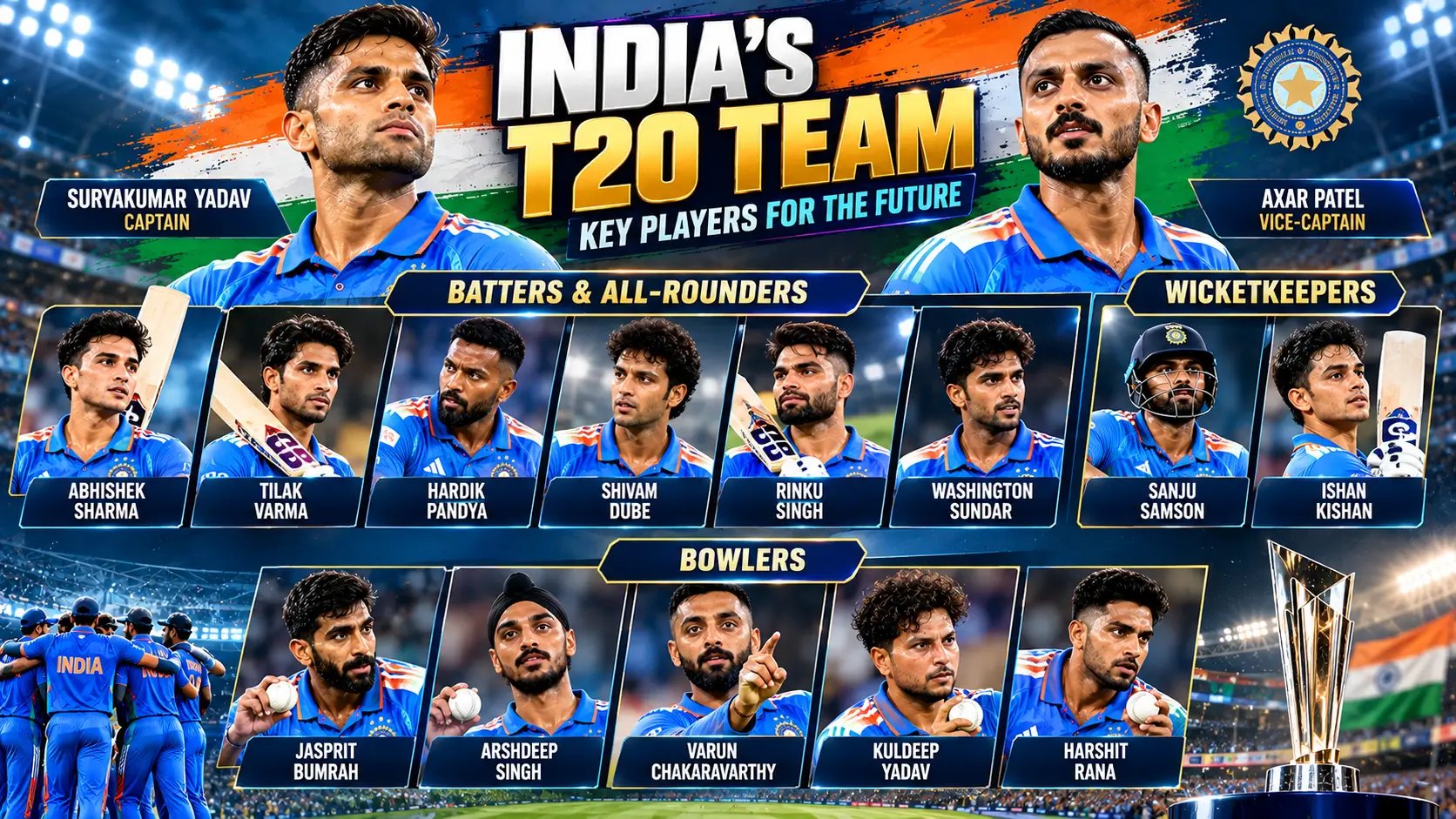
India possesses several advantages, but sustained international success requires continual improvement.
| Department | Major Strength | Future Challenge |
|---|---|---|
| Batting | Explosive scoring | Handling quality swing bowling |
| Fast Bowling | Wicket-taking ability | Death-over consistency |
| Spin Bowling | Variety and control | Adapting to flat pitches |
| All-Rounders | Team balance | Workload management |
| Squad Depth | Multiple replacements | Stable player roles |
| Leadership | Tactical adaptability | Managing transitions |
Can India Continue Dominating T20 International Cricket?
India’s future in T20 international cricket looks promising because of its extensive talent pool and established player-development structure.
The emergence of exciting players such as Sanju Samson, Abhishek Sharma, Tilak Varma, and other developing talents gives selectors different options for future international competitions.
Experienced bowlers and versatile all-rounders provide the foundation for a balanced team capable of challenging strong opponents.
As Indian T20 cricket continues to evolve, fans can explore cricket-related content, player updates, and match discussions on platforms such as bettingidindia.xyz. The combination of emerging talent, experienced players, and strategic team development positions India strongly for future T20 competitions.
Nevertheless, sustained domination will require continual improvement. Other leading cricket nations, including Australia, England, South Africa, New Zealand, and West Indies, remain formidable competitors.India’s ability to identify new talent, respond to changing strategies, and perform under pressure will ultimately determine whether it can extend its remarkable T20 success.
Conclusion: Why India Is a Powerhouse in T20 International Cricket
India’s domination in T20 international cricket is the result of several factors working together rather than one individual achievement.
Its three ICC Men’s T20 World Cup titles, aggressive batting philosophy, high-quality bowling attack, talented all-rounders, tactical leadership, and strong domestic structure have helped establish the country as a leading force in international cricket.
India’s victories in 2007, 2024, and 2026 demonstrate the team’s ability to achieve success across different generations.
The most important lesson from India’s T20 journey is that consistent success requires continual evolution. New players, improved tactics, and strong preparation are essential for maintaining a competitive advantage.
With its combination of experience, emerging talent, and match-winning ability, India is well positioned to remain a major contender in international T20 cricket.
Frequently Asked Questions About India’s T20 Dominance
1. Why is India dominant in T20 international cricket?
India’s success comes from aggressive batting, talented bowlers, quality all-rounders, strong leadership, IPL experience, and a deep pool of emerging players.
2. How many ICC Men’s T20 World Cups has India won?
India has won three ICC Men’s T20 World Cups, in 2007, 2024, and 2026.
3. What is India’s highest score in T20 international cricket?
India’s highest men’s T20I team total is 297/6, scored against Bangladesh at Hyderabad on October 12, 2024.
4. Who was India’s captain in the 2026 T20 World Cup?
Suryakumar Yadav captained India during its successful 2026 ICC Men’s T20 World Cup campaign.
5. Who was the Player of the Tournament in the 2026 T20 World Cup?
Sanju Samson won the Player of the Tournament award after scoring 321 runs in five innings.
6. Can India maintain its dominance in international T20 cricket?
India has a strong talent-development system and experienced players, but continued success will depend on tactical innovation, consistency, and performance against leading international teams.
Sources and Further Reading
For official and historical cricket information, readers can refer to the International Cricket Council and the Board of Control for Cricket in India.
Editorial note: Statistics are historical match records reviewed for this article as of October 2026. The graphs feature selected milestones and should not be interpreted as live rankings.