
Ishan Kishan is a contender for India’s 2027 ODI World Cup squad. His left-handed batting, wicketkeeping skills and versatility offer useful options, but consistent ODI performances will be essential.
India’s planning for the 2027 ICC Men’s Cricket World Cup is already raising an important selection question. The team has several established batters, but a balanced squad also needs reliable backups and players who can cover different roles.
Ishan Kishan offers an interesting combination. He is a left-handed wicketkeeper-batter who can open the innings and has also shown that he can bat in the middle order. His selection as vice-captain and wicketkeeper for the final two ODIs against New Zealand adds another chapter to his international career. That appointment is a significant opportunity, not confirmation of a World Cup place. Kishan remains a contender and must turn his talent and recent T20I success into a dependable 50-over role.
Ishan Kishan’s Journey from Domestic Cricket to India
Born on July 18, 1998, in Patna, Bihar, Ishan Kishan developed his cricket in Jharkhand. His domestic performances brought him into the national conversation, while his leadership of India’s Under-19 side at the 2016 World Cup gave him early exposure to a major tournament environment.
The Indian Premier League also helped him gain experience against high-quality bowling. He represented Gujarat Lions before becoming an important part of the Mumbai Indians setup. His strong 2020 IPL season, when he scored 516 runs in 14 matches, helped strengthen his case for international selection.
Kishan made his T20I debut against England in March 2021 and his ODI debut against Sri Lanka in July 2021. Since then, his career has included major milestones as well as periods when he has had limited opportunities.
The ODI Double-Century That Put Kishan in the Record Books
Kishan’s most memorable ODI innings came against Bangladesh in Chattogram on December 10, 2022. Opening the batting, he scored 210 from 131 balls, with 24 fours and 10 sixes. He reached 200 in only 126 deliveries, setting the record for the fastest double-century in men’s ODI cricket.
India made 409/8 and won by 227 runs. The innings showed Kishan’s ability to turn a strong start into a match-defining score. It remains a powerful example of what he can offer at the top of the order.
Statistics reference: All international career statistics in this article are updated to November 2026.
Ishan Kishan’s ODI Career Statistics
| ODI statistic | Record |
|---|---|
| Matches | 32 |
| Runs | 1,107 |
| Batting average | 42.58 |
| Strike rate | 107.06 |
| Highest score | 210 |
| Centuries | 2 |
| Half-centuries | 7 |
| Catches | 17 |
| Stumpings | 3 |
An average of 42.58 and a strike rate of 107.06 make for an impressive ODI record. Those numbers suggest that Kishan can score quickly without sacrificing the ability to build a substantial innings. However, the sample is still relatively small. His limited recent ODI game time means selectors need to assess his rhythm, shot selection and consistency across a longer run of matches.
There is also a tactical benefit to having a left-hander available in different parts of the order. A left-right batting pair can make it harder for a captain to settle into one consistent bowling plan. It may lead to more frequent changes in field settings or bowling angles. That advantage is situational, however, and should never be treated as a substitute for a batter making runs.
Squad balance matters just as much as the playing XI. A tournament squad must cover injuries, loss of form and different opposition match-ups over several weeks. If Kishan can be trusted as both a batter and a wicketkeeper, the selectors may have more room to choose a specialist bowler or an additional all-rounder. The final value depends on how many other wicketkeeping options India carry.
Why Kishan Could Help India’s 2027 World Cup Squad
India’s World Cup selection will depend on how well each player fits the team’s overall combination. Kishan is a contender, not a confirmed selection. He offers an aggressive batting option, wicketkeeping cover and experience as an opener. His ability to bat in different positions could give India another combination option, while his ODI double-century shows that he can build a substantial innings. Those qualities make him worth considering, but they do not guarantee a place.
An Extra Option in the Batting Order
Kishan’s experience as an opener gives India another top-order option if the preferred combination needs to change. He can also offer flexibility beyond the opening slot, allowing India to adjust the order according to conditions, opposition and form. His 125 from 79 balls against Afghanistan in June 2026 is an example of his ability to contribute from a different position. However, one innings does not establish him as India’s permanent middle-order solution. The selectors need to give him more chances in that role and assess whether he can repeat the performance consistently.
Wicketkeeping Cover Without Losing Batting Depth
A reserve wicketkeeper can be especially valuable during a long tournament, when injury or an unexpected change can affect the first-choice combination. Kishan’s role as a specialist keeper-batter means India would have another player capable of contributing to the batting innings, rather than carrying a replacement whose value is limited to keeping.
A Selection Case Based on Team Balance
The final decision will depend on the balance of the 15-player squad. India must weigh Kishan’s potential contribution against the need for specialist bowlers, all-rounders and other batting options. His selection will make the strongest case if he can perform a clearly defined role and improve more than one part of the team.
Kishan has attributes that could make him a useful World Cup option, but versatility alone is not enough. His selection will depend on ODI consistency, the opportunities he receives, team balance and competition from other wicketkeeper-batters.
Kishan’s T20I Comeback and Rise in the Rankings
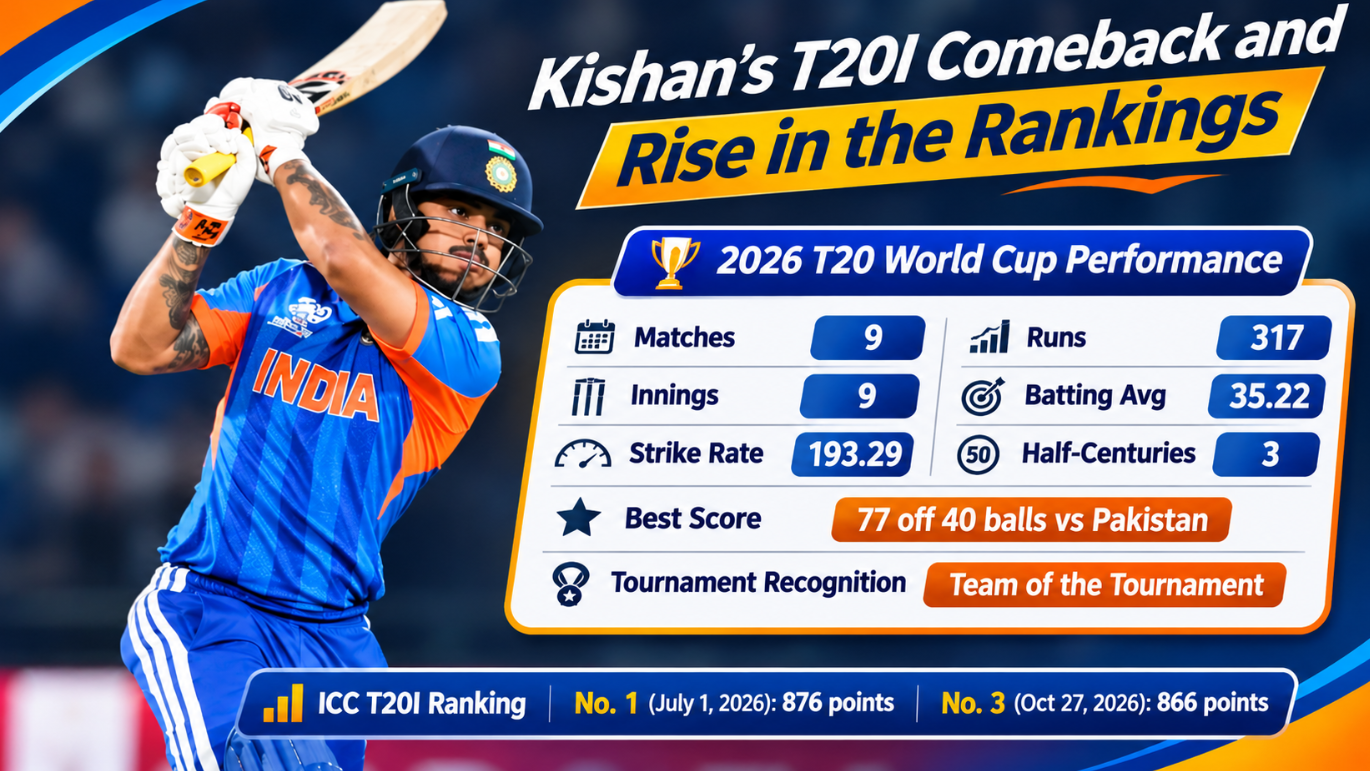
Kishan returned to India’s T20I side in January 2026 during the home series against New Zealand. He made an immediate impact, scoring 215 runs in four innings at an average of 53.75 and a strike rate of 231.18. The series also brought his maiden T20I century.
He carried that form into the 2026 ICC Men’s T20 World Cup. Kishan scored 317 runs in nine innings at an average of 35.22 and a strike rate of 193.29. He finished among the tournament’s leading run-scorers and was selected in the Team of the Tournament. His 77 from 40 balls against Pakistan was one of his standout performances. He also made useful contributions of 38 against Zimbabwe and 39 against England, showing that his value was not limited to one major innings.
The tournament gave India an aggressive option at the top of the order. Kishan’s ability to attack early helped the side put pressure on opposition bowlers, but his overall contribution also included useful runs in other matches. His final tally of 317 runs across nine innings is a stronger measure of his tournament than any single highlight.
| 2026 T20 World Cup performance | Record |
|---|---|
| Matches | 9 |
| Innings | 9 |
| Runs | 317 |
| Batting average | 35.22 |
| Strike rate | 193.29 |
| Half-centuries | 3 |
| Best score | 77 off 40 balls vs Pakistan |
| Tournament recognition | Team of the Tournament |
On July 1, 2026, Kishan reached the No. 1 position in the ICC Men’s T20I batting rankings for the first time, with 876 rating points. His rise followed a strong run of performances for India, including his impact in the 2026 T20 World Cup. However, the rankings continued to change as the season progressed. In the ICC table dated October 27, 2026, Kishan was third with 866 points, behind Abhishek Sharma (897) and Sahibzada Farhan (883). Abhishek reclaimed the top spot after scoring 113 from 38 balls against New Zealand on October 27. Kishan’s achievement remains significant, but the latest position should be described as No. 3, not No. 1.
His T20I form continued late in the year. Kishan scored 61 from 32 balls against New Zealand in the fifth T20I at Hamilton on November 1, 2026, and crossed 2,000 career runs in the format during this period. He finished 2026 with 1,220 T20I runs, the most by an Indian batter in a calendar year in men’s T20Is. That surpassed Suryakumar Yadav’s previous Indian record of 1,164 runs in 2022. Kishan’s 2026 figures also included an average of 35.88, a strike rate of 171.58, one century and eight half-centuries. This record-breaking year strengthens his case as an attacking batter, although T20I success alone cannot guarantee a place in India’s ODI World Cup squad.
Ishan Kishan’s ODI and T20I Records Compared
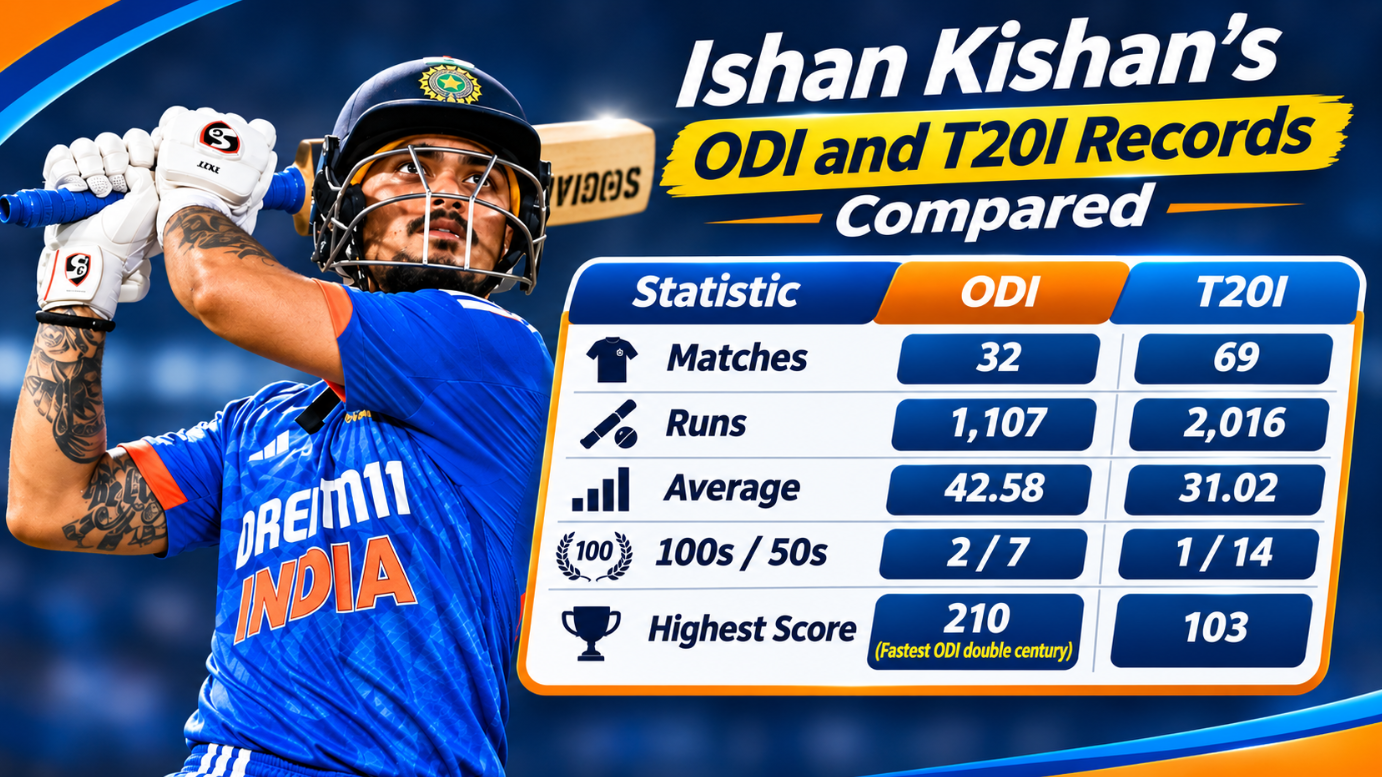
The format comparison below highlights the different demands he has handled in international cricket. These are career totals, not figures from a single series or tournament, and match the career totals checked for this November 2026 review.
| Statistic | ODI | T20I |
|---|---|---|
| Matches | 32 | 69 |
| Runs | 1,107 | 2,016 |
| Average | 42.58 | 31.02 |
| Strike rate | 107.06 | 149.23 |
| Highest score | 210 | 103 |
| Centuries | 2 | 1 |
| Half-centuries | 7 | 14 |
Career runs by format
Scale: the longer bar represents the higher career run total. Figures reflect the ICC profile at the November 2026 check.Batting average by format
Scale: ODI average is the 100% reference for this comparison.Strike rate by format
Scale: T20I strike rate is the 100% reference for this comparison.The figures show two different strengths. Kishan’s ODI average is higher, while his T20I strike rate reflects his more aggressive approach in the shortest format. India should use his attacking instincts in ODIs without expecting him to bat at a T20 pace throughout a 50-over innings.
New Zealand ODI Series: A Valuable Test Before the World Cup
The ODI series against New Zealand gives Kishan a chance to show how well he can handle the demands of international 50-over cricket. Rather than treating the matches as a simple audition for selection, India can use them to assess his decision-making, adaptability and consistency under different conditions.
Handling New-Ball Movement in New Zealand
New Zealand’s conditions can challenge attacking batters with movement and bounce. Kishan will need to stay patient through the opening overs while maintaining his natural scoring ability. Sound shot selection, effective footwork and controlled aggression will be important against the new ball.
Building partnerships and protecting his wicket during difficult periods will matter as much as finding boundaries. A composed start would give him a better platform to accelerate when the conditions become easier for batting.
Responding to Different Match Situations
An early wicket may require Kishan to help rebuild the innings, while a strong start could allow him to attack more freely. He must show that he can read these situations and adjust his approach instead of relying on one fixed tempo.
His performances should be judged through more than the final score. Strike rotation, partnership building and decision-making during the middle overs will provide a clearer picture of his readiness for international tournaments.
Delivering Consistent Performances Behind the Stumps
Wicketkeeping will be another important part of Kishan’s assessment. He must maintain concentration throughout the innings and deliver reliable performances against both pace and spin. Clean collections, quick movement and clear communication with the bowlers can strengthen his overall contribution.
The selectors will also need to consider whether he can manage the physical and mental demands of keeping for 50 overs while carrying a significant batting responsibility. Consistency in both roles would strengthen his case far more than one standout performance.
The New Zealand series gives Kishan an opportunity to provide that evidence. His ability to adapt to conditions, manage different innings situations and maintain his standards behind the stumps will help India assess his readiness for a larger ODI role.
Why the 2027 World Cup Conditions Could Matter
The 2027 tournament will test India’s ability to adapt across different venues and conditions. Preparation will be important, especially for batters and wicketkeepers who may face demanding match situations.
2027 World Cup: Venues, Dates and Hosts
The ICC Men’s Cricket World Cup 2027 will be co-hosted by South Africa, Zimbabwe and Namibia from October 2 to November 21. The 14-team tournament is scheduled to feature 57 matches across 12 venues. South Africa will host most of the matches, so adapting to its conditions will be a major part of India’s preparation.
How South African Conditions Could Challenge Kishan
South African pitches can offer pace, bounce and movement, especially with the new ball. Kishan’s attacking instincts could help India put pressure on fast bowlers, but he must also show that he can leave the ball well, defend patiently and manage movement outside off stump. His ability to shift between attack and control will be important in 50-over cricket.
How India Can Prepare for the 2027 World Cup
India’s preparation needs to go beyond choosing an explosive batting line-up. The team management has stressed the importance of giving players enough ODI game time, testing combinations, maintaining fitness and managing workloads before the tournament. India’s coaching staff has also highlighted the need to identify players who can handle South African bounce and pace. These priorities create a clear opportunity for Kishan: regular ODI chances can show whether his batting and wicketkeeping are reliable enough for a long tournament.
How Ishan Kishan Can Help India
Kishan could help in three practical ways. As a left-handed batter, he can change the match-up for opposition bowlers and add variety to the top or middle order. As a wicketkeeper, he can provide specialist cover while contributing runs. And as an aggressive batter, he can help India accelerate during the powerplay or rebuild quickly after an early wicket. To earn that role, he must deliver consistent ODI performances and maintain high standards behind the stumps.
What India Should Assess Before Selecting Kishan
India should use the remaining ODI assignments to test Kishan in clearly defined roles, assess his keeping over full innings and judge his decision-making against quality pace. His left-handed batting and wicketkeeping are useful squad assets, but they will matter only if they fit the team’s balance and produce dependable results.
Where Kishan Stands in India’s Wicketkeeper-Batter Competition
Kishan’s route into the 2027 World Cup squad is not based on batting alone. India have several players who can keep wickets, and the selectors must decide how much specialist cover the squad needs. The choice will depend on form, fitness, batting position and the balance of the final 15-player group.
KL Rahul: An Established ODI Option
KL Rahul has already handled the wicketkeeping role in India’s ODI middle order. His experience gives the team continuity, particularly when India want a batter who can build an innings and finish strongly. Kishan’s challenge is to show that his left-handed batting and attacking approach offer a different value proposition, rather than simply duplicating Rahul’s role.
Rishabh Pant: A Left-Handed Wicketkeeping Alternative
Rishabh Pant is another left-handed wicketkeeper-batter in India’s wider selection picture. His aggressive style can change the tempo of an innings, but his place in an ODI combination depends on his form, fitness and the role the team wants him to perform. Kishan must make his own case through consistent 50-over performances rather than relying on comparisons with another player.
Kumar Kushagra and the Reserve-Keeper Question
Kumar Kushagra’s inclusion in the squad for the final two New Zealand ODIs gives India another wicketkeeping option to assess. Carrying two keepers can protect a squad against injury, but the second keeper must also offer enough batting value to justify the place. Kishan’s international experience and ability to open give him a useful advantage in that discussion, provided he produces runs.
There is no need to treat the competition as a simple one-player-versus-another contest. India could select a first-choice keeper, a reserve keeper and a batter who can cover the role if required. The final combination will depend on conditions and the number of specialist bowlers and all-rounders the team wants to carry. Kishan’s best argument is to become reliable enough with both bat and gloves that his selection improves more than one part of the squad.
Kishan vs Jaiswal: Different Skills, Different Selection Cases
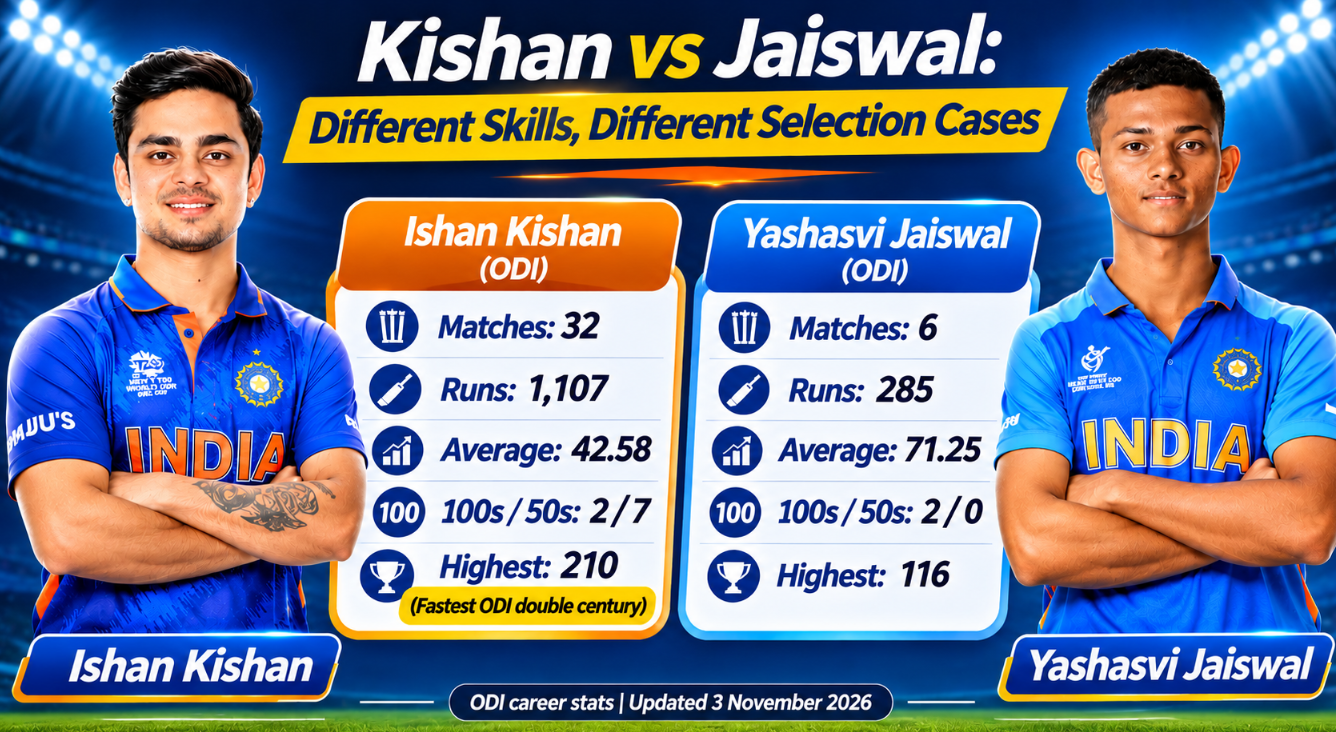
Yashasvi Jaiswal and Ishan Kishan are both left-handed batters, but they are not necessarily direct replacements for each other. Jaiswal’s primary ODI role is as an opening batter. Kishan also offers specialist wicketkeeping ability, has experience opening and could provide extra flexibility across the batting order. India could consider them for different roles or combinations; the comparison is about squad balance, not which player is better.
| Selection factor | Ishan Kishan | Yashasvi Jaiswal |
|---|---|---|
| Batting style | Left-handed | Left-handed |
| Primary ODI role | Opening batter; possible flexibility | Opening batter |
| Wicketkeeping | Specialist wicketkeeper | Not an established international role |
| ODI double-century | 210 vs Bangladesh | None |
| Squad value | Batting plus wicketkeeping cover | Top-order batting option |
| Additional selection value | Can provide specialist wicketkeeping cover | Can strengthen the left-handed top-order batting options |
This is a comparison of squad roles, not a claim that one player is better than the other. Jaiswal’s selection case should be judged on his own performances, while Kishan must prove that his flexibility can work consistently in ODIs.
There is a workload question, too. If Kishan is expected to bat in the top six and keep for 50 overs, the team must be confident that he can manage both responsibilities over consecutive matches. Preparation, recovery and match fitness will therefore be part of the decision. A versatile player is most valuable when the extra responsibilities do not reduce the quality of his main skill. That evidence should matter more than reputation or one standout innings.
The selectors should look beyond the number of dismissals when assessing his keeping. They should consider footwork to the leg side, takes against fast bowlers, collection of the ball from spinners and communication with the captain. A keeper’s contribution is also visible in how quickly he helps the field adjust after a change of bowler or a new batter arrives. These details can make a difference during a long ODI innings.
The Main Questions Kishan Must Answer
There are still important challenges in his World Cup case. T20 form is encouraging, but it cannot replace sustained performance in the 50-over format. The selectors need evidence that his attacking approach can also succeed across a 50-over innings, including periods when patience and strike rotation matter more than boundary hitting.
He must make the most of the opportunities he receives and produce consistent performances rather than rely on isolated high scores. India also need to identify his best ODI batting position. Opening may suit his natural game, while a middle-order role could offer flexibility if he proves he can handle it regularly.
Another test is whether he can balance the workload of wicketkeeping with meaningful batting contributions over a full ODI. He will also compete with established wicketkeeper-batters and other middle-order options for limited squad places. His performances, role clarity and the team’s overall combination will determine how strong his case becomes.
What India Should Do Before the 2027 World Cup
India should give Kishan a clear role and enough opportunities to show what he can do. Selection should be based on performance in defined situations rather than on the appeal of having a flexible player in the squad.
India should test Kishan in more than one batting position, giving him opportunities at the top and in the middle order when the team combination allows. This would help identify where he can contribute most effectively.
The selectors should also use him regularly as a wicketkeeper to assess his workload, consistency and communication with the bowlers. He should face different match situations, including rebuilding after early wickets, managing controlled chases and accelerating during the final overs.
Finally, India must assess his selection against the needs of the full squad. His place should be considered alongside the requirements for specialist bowlers, all-rounders and additional batting cover.
If Kishan delivers across those areas, he could become a valuable member of India’s World Cup squad. The key is to turn potential versatility into dependable match-day value.
Frequently Asked Questions
Here are answers to common questions about Kishan’s international record, wicketkeeping role and chances of making India’s 2027 World Cup squad.
Is Ishan Kishan part of India’s plans for the 2027 ODI World Cup?
He is a contender because he offers aggressive left-handed batting, wicketkeeping cover, opening experience and batting flexibility. His ODI consistency and India’s final team balance will determine his chances. India have not announced their final World Cup squad.
Why has Ishan Kishan been named vice-captain against New Zealand?
He has been named vice-captain and wicketkeeper for the fourth and fifth ODIs, with Shreyas Iyer as captain. The role gives him additional responsibility but does not guarantee World Cup selection.
Has Ishan Kishan scored an ODI double-century?
Yes. He scored 210 against Bangladesh in Chattogram on December 10, 2022. He reached 200 in 126 balls, the fastest double-century in men’s ODI cricket.
How many T20I runs has Ishan Kishan scored?
He has scored 2,016 runs in 69 T20Is, with an average of 31.02 and a strike rate of 149.23, according to the updated career figures used in this article.
Has Ishan Kishan been the No. 1 T20I batter?
Yes. He reached the top of the ICC Men’s T20I batting rankings on July 1, 2026. He was ranked third in the rankings dated October 27, 2026.
Can Ishan Kishan bat in the middle order in ODIs?
Yes, he has experience batting in different positions. His 125 from 79 balls against Afghanistan in June 2026 showed his potential outside the opening role, but more ODI opportunities and consistency are needed before India can define him as a regular middle-order option.
Can Ishan Kishan keep wickets for India?
Yes. Kishan is a specialist wicketkeeper-batter and is named as India’s wicketkeeper for the final two ODIs against New Zealand.
When will the 2027 Cricket World Cup begin?
The tournament is scheduled to begin on October 2, 2027, and finish on November 21, 2027. South Africa, Zimbabwe and Namibia will co-host it.
Conclusion: Kishan Has the Tools, but Must Deliver in ODIs
Ishan Kishan’s case for India’s 2027 World Cup squad rests on several valuable strengths. His ODI double-century showed that he can play a substantial innings, while his wicketkeeping gives India another way to balance the squad. His record-breaking T20I year in 2026 has also underlined his attacking ability and confidence at the crease.
However, success in T20Is does not settle an ODI selection debate. India still need to establish whether Kishan is best used as an opener, a middle-order option or a reserve wicketkeeper-batter. His role must fit the team’s needs and produce consistent value in 50-over cricket.
Kishan has a strong case to remain in contention, but he is not a confirmed selection. Consistent ODI performances and a clearly defined role will be essential to his 2027 World Cup ambitions.
For additional information and updates, explore Betting ID India.